E-Commerce Strategies
Amazon's eco packaging standards are now mandatory and directly impact your costs and visibility. Non-compliance can lead to higher fees (up to $1.99 per unit), slower processing, and reduced appeal to eco-conscious shoppers. On the flip side, compliant packaging can lower costs, improve fulfillment speed, and attract more customers. Here's a quick breakdown:
Packaging Tiers: Amazon has three tiers - Prep-Free (basic), Ships in Product Packaging (SIPP), and Frustration-Free Packaging (FFP). Each has specific requirements for size, durability, and sustainability.
Key Standards:
Pass ISTA-6 drop tests (17 drops from 18"–36").
Use recyclable materials (Tier 1 requires 100% curbside recyclable).
Eliminate excess packaging and ensure easy opening (under 120 seconds).
Benefits: Fee discounts ($0.04–$1.32 per item), faster processing, and higher visibility for Climate Pledge Friendly products.
Quick Tips:
Audit your packaging for size, strength, and recyclability.
Pass Amazon's drop tests (self-test for non-fragile items under 50 lbs).
Reduce empty space and avoid excess materials.
Use Amazon's Sustainability Solutions Hub for tools and certifications.
Meeting these standards ensures compliance, reduces costs, and aligns with shoppers' preferences for eco-friendly options.
EP3 Packaging - EPS Replacement Packaging, 100% sustainable, eco-friendly and Amazon FFP Approved
Amazon's Ships in Product Packaging (SIPP) Tiers Explained
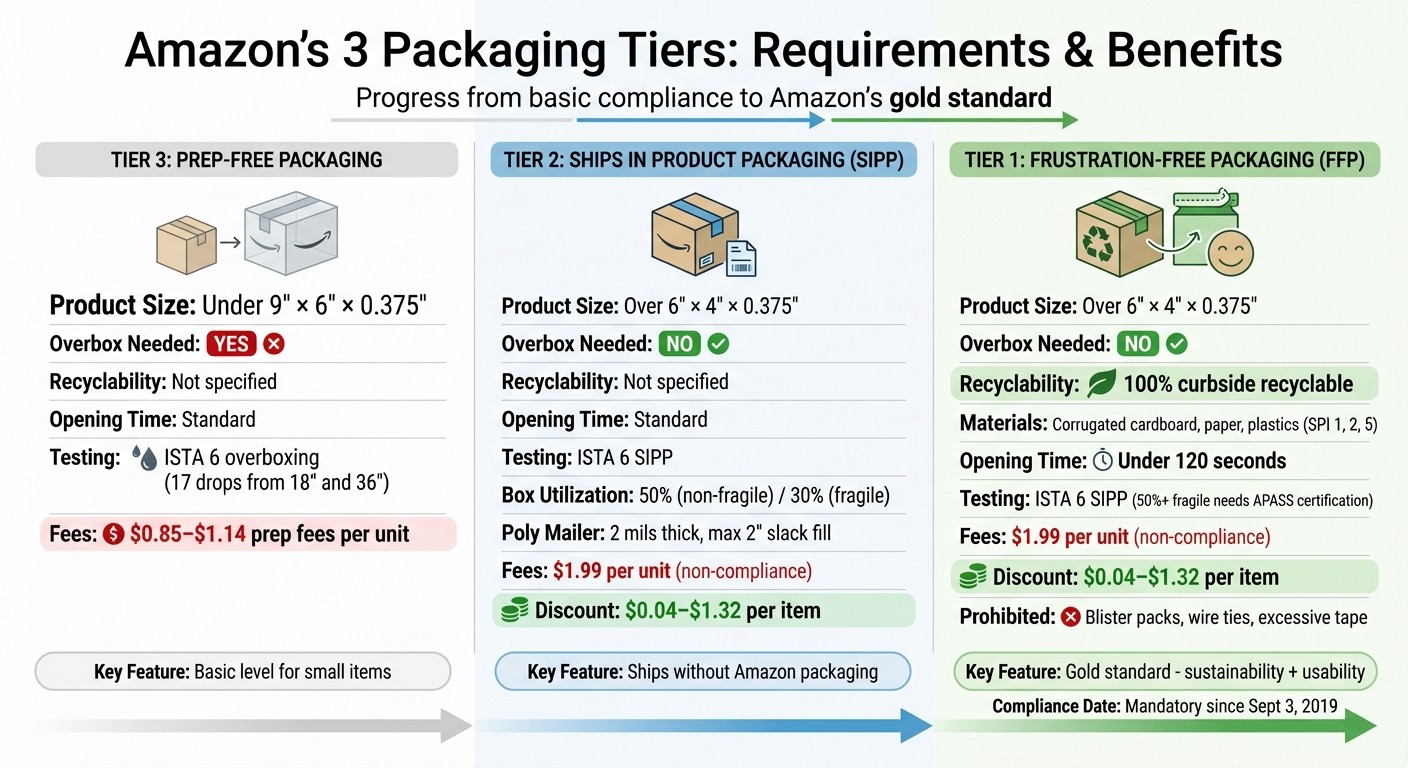
Amazon Packaging Tiers Comparison: Prep-Free vs SIPP vs FFP Requirements
Amazon organizes packaging into three distinct tiers, each tailored to a product's size, durability, and packaging materials. These tiers also influence fees and testing requirements.
The tiers range from basic to advanced. Tier 3 (Prep-Free Packaging) is the starting level for small items that still need Amazon's overbox. Tier 2 (Ships in Product Packaging) allows products to ship in their own packaging without additional materials. Finally, Tier 1 (Frustration-Free Packaging) represents the top standard, combining Tier 2 requirements with strict eco-friendly guidelines like 100% curbside recyclability.
Here’s a closer look at each tier:
Tier 3: Prep-Free Packaging Requirements
This tier applies to small, sortable items (less than 9" x 6" x 0.375") that require Amazon's overbox for shipping. These products must pass the ISTA 6 overboxing test, which involves 17 drops from heights of 18" and 36".
If your packaging doesn’t meet these standards, you’ll face fees: $1.14 per unit for bubble wrapping or $0.85 per unit for protective bagging. For non-fragile items under 50 pounds, you can conduct self-testing using Amazon's vendor drop test protocol.
Tier 2: Ships in Product Packaging (SIPP) Requirements
Tier 2 builds on Tier 3 by requiring packaging strong enough to handle the entire shipping process without an Amazon overbox. This eliminates the need for extra materials, reducing both packaging waste and shipping weight.
To qualify, your packaging must meet specific criteria:
Box utilization score: At least 50% for non-fragile items and 30% for fragile ones. This measures how efficiently your product fills the package, minimizing empty space.
Flexible packaging: Poly mailers must be at least 2 mils thick and have no more than 2 inches of slack fill.
Certified SIPP products benefit from FBA fee discounts ranging from $0.04 to $1.32 per item. Additionally, customers are notified at checkout that the item ships in its own packaging.
Tier 1: Frustration-Free Packaging (FFP) Requirements
Tier 1 is Amazon’s gold standard for packaging. It builds on Tier 2 but adds stricter sustainability and usability requirements. Packaging must be:
100% curbside recyclable, using approved materials like corrugated cardboard, paper-based products, or plastics with SPI codes 1, 2, or 5 (including tape and labels).
Easy to open, allowing access to the product within 120 seconds without tools.
Products with 50% or more fragile components must also obtain ISTA-6 certification through Amazon’s APASS network. Non-compliance results in a $1.99 chargeback per unit. Additionally, certain materials like blister packs, wire ties, and excessive tape are prohibited.
Amazon has required FFP compliance since September 3, 2019.
Feature | Tier 3: Prep-Free | Tier 2: SIPP | Tier 1: FFP |
|---|---|---|---|
Product Size | Under 9" x 6" x 0.375" | Over 6" x 4" x 0.375" | Over 6" x 4" x 0.375" |
Overbox Needed | Yes | No | No |
Recyclability | Not specified | Not specified | 100% curbside recyclable |
Opening Time | Standard | Standard | Under 120 seconds |
Fee | $0.85–$1.14 prep fees | $1.99 per unit | $1.99 per unit |
Testing Method | ISTA 6 overboxing | ISTA 6 SIPP | ISTA 6 SIPP |
Amazon Eco Packaging Compliance Checklist
Now that you’re familiar with Amazon's packaging tiers, it’s time to assess your own products. This checklist will help you align your packaging with the requirements for Ships in Product Packaging (SIPP) and Frustration-Free Packaging (FFP) standards.
Step 1: Audit Your Current Packaging
First, determine whether your products qualify for self-testing or if they need ISTA-6 lab certification. Here's how to decide:
Self-testing applies to rigid packaging under 50 lbs (non-fragile) or non-fragile flexible packaging (non-granular, non-sharp).
Lab certification is required for fragile items, products over 50 lbs, or those with sharp or granular materials. Use Amazon's APASS network for lab testing.
For self-testing, label the largest side of the package as face 1, then number the adjacent sides clockwise as faces 2–4. The remaining surfaces should be labeled as faces 5 and 6. Perform the standard 17-drop test and document the process with pre- and post-test photos (5 photos for rigid packaging, 6 for flexible packaging).
Ensure the packaging is fully sealed and free of excess slack-fill. Confirm that individual boxes meet Amazon's size and weight limits. For flexible packaging, conduct a material strength test by dropping a 9" x 3" x 6" box with a 3 lb sandbag from a height of 3 feet. The material should remain intact.
Step 2: Reduce Empty Space and Excess Materials
After completing your audit, look for ways to optimize your packaging design. Here are some tips:
Eliminate slack-fill and combine multi-piece units to make better use of space.
Use snug-fitting flexible mailers or bags to minimize empty space.
If your product passes the drop test without extra protective layers, consider removing the outer box.
For apparel categories like accessories, socks, or swimwear, remove hangers unless the item is high-value or made from materials like leather or fur. Amazon's Packaging Solutions Library, accessible through the APASS network, offers templates for right-sized packaging that reduces material waste.
Step 3: Verify Material Compatibility
Choose materials that can endure a 17-drop test and meet Amazon's environmental guidelines. Avoid vague claims like "eco-friendly" or "green." Instead, use specific statements, such as “made from 20% recycled materials.”
If your products are sold in California, ensure plastic packaging isn’t labeled as "biodegradable" or "decomposable." Compostable claims must meet ASTM or Vincotte standards. Remove theft-prevention devices and any non-Amazon marketing materials like pamphlets or price tags. Place exterior barcodes on flat surfaces - not on curves or corners - and cover or remove any outdated barcodes.
Step 4: Test Packaging for Easy Opening
Frustration-Free Packaging should allow customers to open products quickly without the need for tools. Test manual opening and aim to complete it within 120 seconds. The process should be smooth, with no excessive force or sharp edges involved.
If your packaging includes poly bags with openings of 5 inches or larger, ensure a suffocation warning is printed directly on the bag or attached as a label.
Step 5: Check Ships in Product Packaging Program Eligibility
Verify that your packaging passes both the self-drop and material strength tests. Meeting these standards can qualify you for SIPP fee discounts, which range from $0.04 to $1.32 per item. For fragile products requiring extra protection, professional testing through the APASS network may be necessary.
From here, you can explore additional tools and resources to maintain compliance.
Tools and Resources for Packaging Compliance
Amazon's Sustainability Solutions Hub
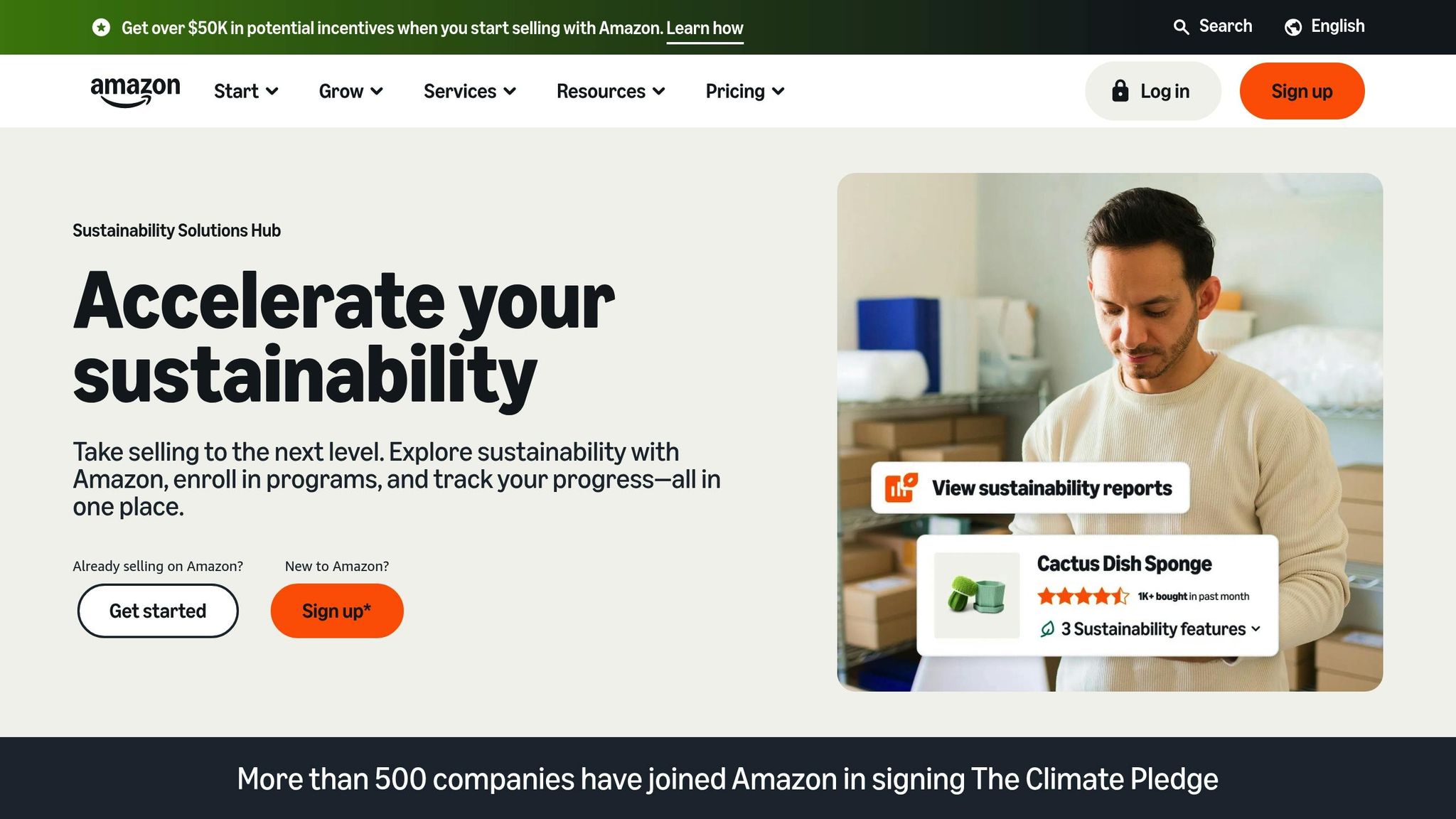
The Sustainability Solutions Hub in Seller Central is your go-to resource for managing eco-friendly packaging initiatives. You can find it by heading to Growth > Explore Programs > Sustainability Solutions Hub. This dashboard gives you an overview of your SIPP-certified products, along with key metrics like the amount of packaging weight saved and revenue generated from sustainable sales.
One standout feature is the Certification Recommendation Tool, which suggests third-party certifications (like FSC or Rainforest Alliance) tailored to your product categories. If those certifications seem too expensive, consider Amazon’s in-house options such as "Compact by Design." The Hub also includes guided videos and templates to simplify compliance, making it easier to create sustainable listings.
Add Sustainability Attributes in Seller Central
Once your packaging meets compliance standards, you can highlight sustainability attributes in Seller Central to improve product visibility. Adding these attributes often leads to higher visibility and increased sales. To do this, complete the Climate Pledge Friendly product template and share it with your certifier for validation. For certifications like USDA Organic or Plant-Based Fiber Blended, you’ll need to submit the template through a Selling Partner Support case. You can even submit multiple ASINs at once.
When making environmental claims on your product detail pages, be precise. For instance, say "made from 20% recycled materials" instead of using vague terms like "eco-friendly." If you sell in California, keep in mind that terms like "biodegradable" or "decomposable" are not allowed on plastic packaging due to state laws.
Get Expert Support for Packaging Optimization
For a more advanced approach to packaging, the Amazon Packaging Support and Supplier Network (APASS) connects you with trusted third-party service providers and ISTA-certified labs. These experts can assist with packaging design, testing, and certification - especially helpful for fragile products or items over 50 lbs that require professional lab testing rather than self-certification.
If you’re looking for comprehensive help, eStore Factory offers consulting services that cover packaging audits, compliance requirements, and design improvements.
"We have seen quite substantial cost savings from the [Ships in Product Packaging] program." - Johan Stellansson, Supply Chain Director, Go North Group
Conclusion and Next Steps
Eco packaging compliance plays a key role in Amazon selling costs, Buy Box visibility, and building customer trust. Since 2015, Amazon has cut packaging weight per shipment by over 41%, saving more than 2 million tons of materials. Sellers who meet these standards can enjoy reduced costs and better product discoverability, while non-compliance can result in $1.99 chargebacks per unit and higher storage fees.
To stay compliant, focus on these steps: Start by auditing your current FBA SKUs to identify unnecessary slack-fill and non-recyclable materials. Group similar ASINs to simplify certification, and prioritize using curbside recyclable materials like corrugated paper and plastics marked with SPI codes 1, 2, and 5. For non-fragile items under 50 lbs, you can conduct self-testing using the 17-drop test sequence from heights of 18" and 36". Be sure to document your results with pre-test and post-test photos as proof of compliance.
Next, update your product information in Seller Central. Complete the "Material Composition" and "Packaging Type" fields under Manage Inventory. This not only ensures compliance but also boosts your product's visibility with eco-friendly credentials. Including specific environmental claims, like "made from 20% recycled materials", instead of vague terms such as "eco-friendly", aligns with FTC Green Guides and appeals to increasingly eco-conscious shoppers.
For fragile items or products over 50 lbs, connect with ISTA-certified labs through the APASS network for professional testing and certification. If you need additional guidance, eStore Factory offers consulting services tailored to packaging audits, compliance, and design improvements.
Taking action now will help you avoid penalties and position your business as a leader in sustainable e-commerce.
FAQs
What happens if my packaging doesn’t meet Amazon’s eco-friendly standards?
Failing to meet Amazon's eco-friendly packaging standards can lead to a $1.99 fee for each non-compliant ASIN, higher storage and preparation expenses, and even penalties like reduced listing visibility or lower fulfillment priority. These policies are Amazon's way of pushing sellers to support their sustainability efforts while enhancing the shopping experience for customers.
By updating your packaging to meet these standards, you can sidestep these extra costs and play a part in creating a greener eCommerce environment. Acting now not only saves money but also helps you stay competitive on the platform.
How do I know if my product qualifies for self-testing or needs lab certification for Amazon eco packaging compliance?
If you're wondering whether your product qualifies for Amazon's self-testing, here's what to look for:
Rigid packaging: It should weigh under 50 lbs and not be fragile.
Flexible packaging: It needs to meet extra material strength requirements.
If your product doesn't align with these standards, you'll need to have it tested by an ISTA-certified lab. Be sure to check Amazon's updated packaging guidelines regularly to stay compliant.
How can I make sure my packaging complies with Amazon's Frustration-Free Packaging standards?
To align with Amazon's Frustration-Free Packaging (FFP) standards, focus on creating packaging that is recyclable, simple to open, and ready for shipping without requiring extra boxes. Opt for eco-friendly materials like corrugated cardboard or molded pulp, and steer clear of unnecessary plastics or clamshell designs. Make sure the product sits securely inside, leaving minimal unused space.
Run tests on your packaging to verify it can protect the product during transit, then submit it for Amazon’s certification process. Once it’s certified, apply the proper labeling so it’s ready for Amazon’s fulfillment centers. If you’re unsure about the process, eStore Factory offers expert help with packaging design, testing, and certification to ensure everything meets Amazon’s requirements.