
E-Commerce Strategies
When selling on Amazon, your keyword strategy can make or break your success. Should you aim for high-volume keywords that bring in massive traffic but come with tough competition? Or focus on low-competition keywords that are easier to rank for but attract fewer searches? Here’s the quick breakdown:
High-Volume Keywords: Broad, popular terms like "phone case" with high search traffic. They’re ideal for established brands but come with higher costs and competition.
Low-Competition Keywords: Specific, niche phrases like "leather case for iPhone SE." Easier to rank for, cost less in ads, and work well for new sellers or product launches.
Quick Comparison
Feature | High-Volume Keywords | Low-Competition Keywords |
|---|---|---|
Traffic Potential | High | Lower but targeted |
Ranking Difficulty | Hard | Easier |
PPC Cost | High | Lower |
Search Intent | Broad | Specific |
Best For | Established brands | New sellers, niche products |
Key Takeaway: Start with low-competition keywords to build momentum and sales. As your brand grows, gradually incorporate high-volume keywords to scale visibility and traffic. This balanced approach ensures sustainable growth on Amazon.
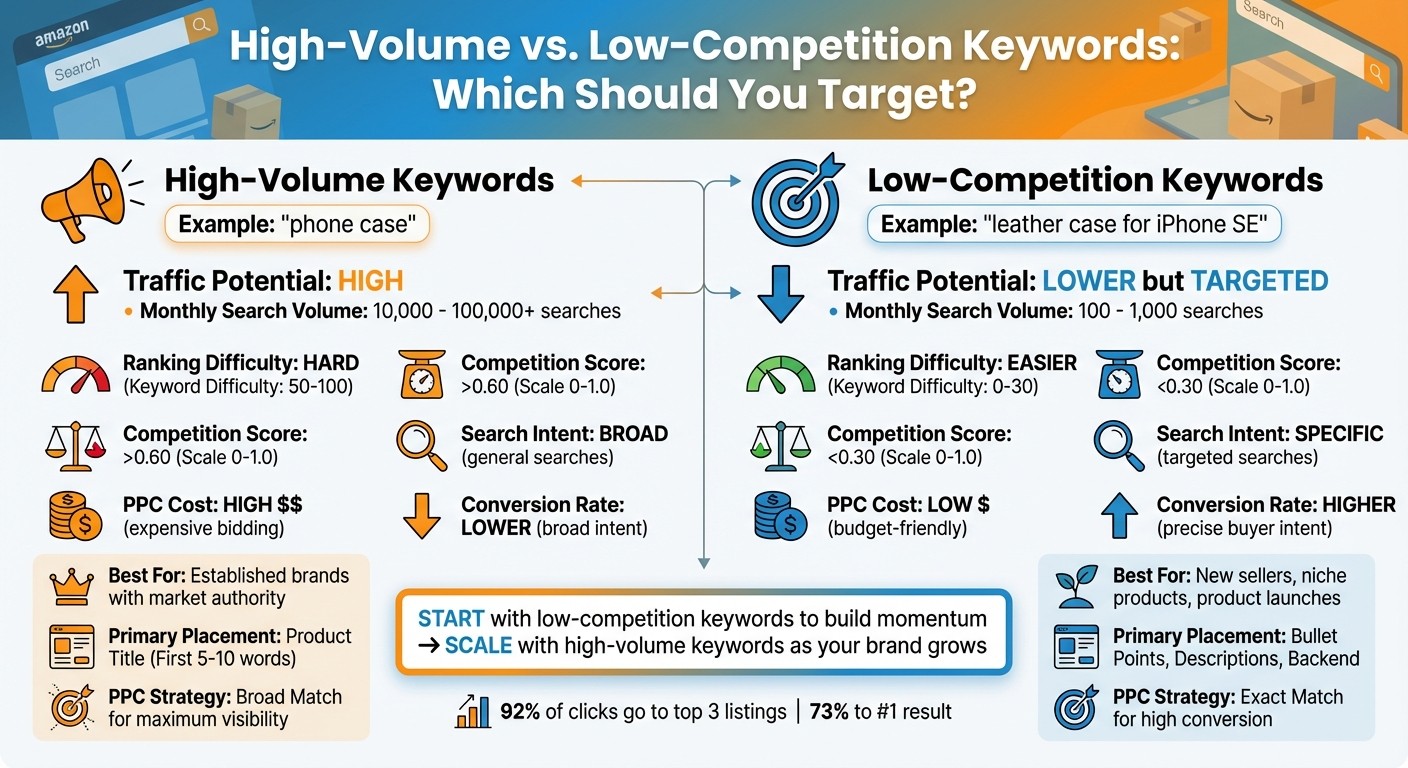
High-Volume vs Low-Competition Keywords Comparison for Amazon Sellers
What Are High-Volume Keywords?
Definition of High-Volume Keywords
High-volume keywords are search terms that attract a significant number of searches on Amazon every month. These are often "short-tail" keywords - simple phrases made up of one to three words, such as "water bottle" or "keyboard." What sets them apart is their search volume: many of these keywords see more than 1,000 searches per month, with some reaching tens of thousands.
While high-volume keywords cast a wide net, they might not always connect with the right audience. For instance, a search for "shoes" could display a broad range of products, catering to various needs and preferences. This broad search intent means you're reaching a large number of people, but not necessarily those who are ready to buy your specific product. These keywords can drive significant traffic but come with stiff competition and higher advertising costs.
Amazon evaluates search volume using its own algorithms, Brand Analytics data, and autocomplete suggestions. Third-party tools also provide estimates for "Exact Match" volume (specific phrase searches) and "Broad Match" volume (including variations and related terms).
Jonathan Dean from Helium 10 explains, "Anything below 500 searches per month is generally considered low, so look for the main search term that exceeds that number."
Knowing the scale of these keywords can help you decide how and when to use them effectively.
When to Use High-Volume Keywords
High-volume keywords are most effective when you have the resources to compete in Amazon's marketplace. Established brands with strong sales histories and robust advertising budgets often dominate these terms, as Amazon's A10 algorithm prioritizes sales velocity. For newer products or brands without recognition, ranking organically for terms like "backpack" or "coffee maker" can be extremely challenging.
These keywords can also perform well in PPC campaigns, where Amazon's sponsored product ads convert at over three times the rate of Google's product listing ads. Even with higher costs, the potential return from paid traffic can make the investment worthwhile. Additionally, high-volume keywords should be included in your backend search terms - hidden fields where you can add variations and synonyms that don’t naturally fit into your product title or description. By combining these keywords with more specific, low-competition terms, you can attract broader traffic while still focusing on conversions.
What Are Low-Competition Keywords?
Definition of Low-Competition Keywords
Low-competition keywords are search terms with fewer sellers vying for top rankings on Amazon. Think of them as the easier wins in your keyword strategy - they don’t require a lengthy sales history or a massive ad budget. These keywords are typically long-tail phrases with three or more words. For example, instead of targeting a broad term like "water bottle", you’d aim for something more specific like "aluminum water bottle with straw."
Metrics play a big role in identifying these opportunities. Keyword Difficulty (KD) is a common measure, with scores ranging from 0 to 100. Generally, anything below 30 is considered easier to rank for. In Amazon PPC, competition is scored between 0 and 1.0, where values from 0 to 0.3 indicate low competition. The key distinction lies in specificity: broad terms like "coffee beans" face heavy competition, while niche phrases like "single origin coffee beans" focus on a smaller, more targeted audience with clearer buying intent.
Joshua Hardwick, Head of Content at Ahrefs, puts it this way: "Low-competition keywords are keywords that you can rank for without much effort. You usually won't have to build many links or have high website authority."
These keywords often lead to better conversions because they attract shoppers who know exactly what they’re looking for. For instance, someone searching for "women's trail running shoes" is much closer to making a purchase than someone simply typing "shoes."
Understanding what makes a keyword low-competition helps you decide when and how to use them effectively.
When to Use Low-Competition Keywords
Low-competition keywords are particularly useful for new product launches and sellers just starting out. Competing for generic terms like "backpack" against established brands is a steep uphill battle. Instead, targeting a niche phrase like "waterproof hiking backpack with laptop compartment" gives you a better shot at ranking higher and building sales momentum.
These keywords also shine in organic ranking strategies, helping you boost visibility without burning through your ad budget. Their lower PPC costs allow you to stretch your marketing dollars while still reaching shoppers with clear intent. Make sure to include these terms in the 250-character backend search fields in Amazon Seller Central to capture niche traffic effectively.
Key Metrics: Search Volume and Competition Levels
How Search Volume and Competition Are Measured
Understanding search volume and competition levels is crucial for shaping your Amazon SEO strategy. These metrics help identify which keywords can effectively align with your goals. Search volume reflects the average number of times a term is searched by shoppers each month, typically based on a 12-month average. Both Amazon and third-party tools like Jungle Scout and Helium 10 provide these insights, offering Keyword Difficulty (KD) scores and Competition Scores to gauge ranking ease and potential ad costs. Amazon calculates search volume using internal algorithms, Brand Analytics, and autocomplete data, while tools estimate "Exact Match" and "Broad Match" volumes through large datasets.
Competition levels, on the other hand, are influenced by several factors. One key measure is the number of search results, which shows how many products are indexed for a specific keyword. For instance, a term with 500,000 indexed products is far more competitive than one with just 5,000. Amazon's A10 algorithm also evaluates seller authority by looking at factors like account age, feedback ratings, and sales history. KD scores, ranging from 0 to 100, give a sense of how challenging it is to rank for a keyword - scores under 30 suggest lower competition, while higher scores indicate tougher competition.
"Keyword difficulty is a score indicating how competitive a keyword is." - Keyword.com
The Competition Score operates on a scale from 0 to 1.0. Scores below 0.30 typically represent low competition, while those above 0.60 signal a highly competitive environment. These metrics are critical for managing both your PPC budget and organic ranking potential. For example, a keyword with 50,000 monthly searches and a KD score of 85 might drain your ad budget without yielding results, whereas a term with 800 searches and a KD score of 15 could lead to steady, profitable sales. The table below breaks down typical ranges for search volume and competition metrics.
Table: Search Volume and Competition Metrics
Metric | Low-Competition Range | High-Volume Range |
|---|---|---|
Monthly Search Volume | 100 – 1,000 searches | 10,000 – 100,000+ searches |
Keyword Difficulty (KD) | 0 – 30 (Scale 0-100) | 50 – 100 (Scale 0-100) |
Competition Score | < 0.30 (Scale 0-1.0) | > 0.60 (Scale 0-1.0) |
You Will Rank On Page 1 with NEW Amazon Keyword Strategy

Pros and Cons Comparison
Now that we've defined the key terms, let's break down their strengths and weaknesses to see how they stack up.
Benefits of High-Volume Keywords
High-volume keywords reflect what shoppers are searching for the most. By targeting these popular terms, you can tap into massive traffic opportunities and identify areas with strong market demand. However, the downside is the intense competition from major brands. For newer sellers, this can mean steep PPC costs and a struggle to stand out, especially when these keywords don’t always align with specific buyer needs.
Benefits of Low-Competition Keywords
Low-competition keywords shine in niche markets. They offer faster visibility, even for sellers without an established track record. These keywords are also easier on your PPC budget, letting you stretch your advertising dollars while connecting with shoppers who have clear buying intent. While they may attract fewer visitors, the ones they do bring are more likely to convert into customers.
Table: High-Volume vs. Low-Competition Keywords
Here’s a side-by-side look at how these two types of keywords compare:
Feature | High-Volume Keywords | Low-Competition Keywords |
|---|---|---|
Traffic Potential | Wide reach with high search volumes | Smaller audience but focused on niche searches |
Ranking Difficulty | Highly competitive, tough for newer sellers | Easier to rank without strong seller authority |
PPC Cost | Higher due to intense bidding | Lower and more budget-friendly |
Search Intent | Broad and general | Specific and targeted |
Conversion Rate | Potentially lower due to broader intent | Higher thanks to precise buyer intent |
Best For | Established brands with market authority | New sellers and product launches |
When to Target High-Volume Keywords
High-volume keywords can be incredibly effective, but only if you have the right tools in your arsenal - namely, strong Amazon authority and a solid PPC budget.
Seasonal peaks are prime opportunities to tap into these keywords. Picture this: it's summer, and searches for "beach umbrellas" are skyrocketing. If you're not front and center during these high-demand moments, you're likely leaving money on the table. However, competing for these keywords requires more than just timing; you need a well-established brand and a hefty PPC budget to stand out in a crowded field. For newer sellers or those with limited resources, chasing high-volume keywords might not be the best move - it’s often a game for the big players.
Established brands, on the other hand, can use their authority to dominate. What feels like an impossible keyword for a newcomer might be entirely achievable for a major brand with a proven track record. High-volume keywords drive significant traffic, which can lead to more sales and, eventually, better organic rankings. It’s a cycle that feeds itself, but only if you have the budget to sustain a strong PPC campaign until organic growth takes over.
In short, save high-volume keywords for when you’ve built up the authority, budget, and sales history to compete with the heavyweights. Without these, it’s easy to get lost in the shuffle.
When to Target Low-Competition Keywords
High-volume keywords might seem like the ultimate goal, but low-competition keywords often lay the groundwork for steady, long-term growth. They’re especially useful when you’re just getting started or facing limited resources. For example, during new product launches, competing for broad terms like "coffee maker" can be an uphill battle without reviews, sales history, or strong brand recognition. Instead, aiming for more specific terms like "thermal coffee maker" lets you carve out a space where big brands haven’t already dominated.
If you’re working with tight advertising budgets, low-competition keywords become even more valuable. These keywords typically come with lower costs in Sponsored Ads, so a $500 monthly budget can go much further. With lower bids, you can keep campaigns running longer, driving enough sales velocity to catch Amazon’s A10 algorithm’s attention.
Beyond budget considerations, targeting niche keywords can strengthen your overall strategy. Niche markets are filled with buyers who know exactly what they’re looking for and are ready to purchase. These shoppers are further along in the buying process compared to those browsing broad terms. While niche keywords may have lower search volumes, they often deliver higher conversion rates because they attract highly motivated buyers.
Don’t overlook emerging trends or seasonal opportunities, either. Keywords tied to new product categories or off-season items often face less competition. Getting in early allows you to establish authority before the keyword space becomes crowded with competitors.
Over time, focusing on low-competition keywords helps you build credibility within your niche. Ranking for these terms signals to Amazon that your products are relevant in your category, and that trust can eventually help you compete for more competitive keywords. It’s a smart approach when you’re working with limited resources or trying to break into a competitive market.
How to Balance High-Volume and Low-Competition Keywords
Using Both Keyword Types Together
Finding the right balance between high-volume and low-competition keywords is key to driving sales and building your brand's authority on Amazon. The most successful sellers don’t pick one over the other - they combine both to get short-term wins and long-term growth. Low-competition keywords help you gain traction quickly, while high-volume keywords broaden your reach as your listing gains momentum.
Here’s how to make it work: Place high-volume keywords within the first 5-10 words of your product title to grab attention. Then, sprinkle low-competition keywords throughout your bullet points, descriptions, and backend fields. This layered strategy ensures you’re capturing wide audiences while also appealing to buyers with specific needs. For PPC campaigns, separate your efforts - use broad match for high-volume terms to attract a wider audience and exact match for low-competition terms to focus on buyers ready to purchase. Together, these tactics boost visibility and improve conversion rates.
The numbers show just how important this balance is - 92% of all clicks on Amazon go to the top three listings, with 73% going to the first result. To reach these coveted spots, a hybrid approach is critical. Balancing Amazon SEO and PPC can help you gain traction with high-volume keywords, signaling Amazon’s A10 algorithm to improve your organic rankings. As SellerMetrics explains:
"By using your PPC ads to accelerate the sale velocity of a product listing for a particular keyword, your organic ranking for this keyword will improve as well."
This creates a "virtuous cycle." Paid ads drive sales, which improve your organic rankings, and better organic rankings reduce your reliance on ads over time. To make the most of this strategy, focus on a phased approach to keyword targeting.
Table: Balancing High-Volume and Low-Competition Keywords
Strategy Component | High-Volume Keywords | Low-Competition Keywords |
|---|---|---|
Primary Placement | Product Title (First 5-10 words) | Bullet Points, Descriptions, Backend |
PPC Match Type | Broad Match | Exact Match |
Campaign Goal | Maximum Visibility & Reach | High Conversion Rate & Low ACoS |
SEO Role | Building long-term rankings | Capturing niche search queries |
PPC Strategy | Competitive bidding for visibility | Targeted bidding for specific attributes |
Start by focusing on low-competition keywords - these usually have a decent search volume and lower CPC, making them ideal for early-stage growth. Once you’ve built a steady stream of sales and reviews, gradually shift your budget toward high-volume keywords. This approach helps you scale effectively without overspending, creating a solid foundation for long-term success on Amazon.
Conclusion
When deciding between high-volume or low-competition keywords, think about your product's stage and budget. For instance, if you're launching a new product with limited reviews and a tight budget, focusing on low-competition keywords can help you drive early sales and boost your organic rankings without battling well-established brands.
Your keyword strategy should align with your resources and goals. As Joshua Hardwick, Head of Content at Ahrefs, explains:
"Ranking difficulty is relative. If you're Target, 'black sandals' is a low-competition keyword... If you're a small mom and pop shoe store, it is high-competition."
This highlights the importance of brand authority and budget in determining your keyword targets. Established sellers can aim for broader, high-volume terms, while smaller or newer sellers should zero in on niche, low-competition phrases that align with specific buyer intent. Matching your strategy to your brand's authority and goals ensures you’re prioritizing keywords that resonate with your potential customers.
Building on the earlier discussion of search intent, focus on "money keywords" - terms with clear transactional intent. These are the phrases shoppers use when they’re ready to make a purchase. Considering that Amazon now accounts for 50% of all online shopping searches, nailing your keyword strategy can directly influence your sales performance.
To succeed, take a phased approach: start with low-competition keywords for quick wins and gradual momentum. This not only maximizes your return on investment but also sets the stage for long-term growth in an ever-competitive market.
For tailored support in optimizing your Amazon listings, check out the expert services offered by eStore Factory.
FAQs
How do I balance high-volume and low-competition keywords for my Amazon SEO strategy?
Balancing high-volume and low-competition keywords requires a mix of smart research and ongoing adjustments. Start by leveraging tools like Amazon’s autocomplete, "frequently bought together" sections, and keyword analysis platforms to uncover terms that offer a solid monthly search volume but face less competition. High-volume keywords can boost visibility, while long-tail, low-competition terms help highlight your product’s unique features or benefits.
To get the most out of your keyword strategy, prioritize placing high-volume keywords in prominent spots like your product title. Meanwhile, use those low-competition terms strategically in bullet points, descriptions, and backend fields. Keep a close eye on performance metrics like click-through rates (CTR), conversion rates, and sales trends. If you notice high-volume keywords driving traffic but not leading to conversions, consider shifting your focus toward low-competition terms that better connect with your audience. Remember, keyword optimization isn’t a one-and-done task - it’s an ongoing process of testing and fine-tuning to find the perfect balance for your product.
What are the best tools to analyze keyword competition and search volume for Amazon?
When it comes to analyzing keyword competition and search volume for Amazon, there are several tools that can make your life easier. Tools like Keyword Tool Dominator, Jungle Scout's Keyword Scout, and Sonar by Sellics are great for uncovering search volume and competition levels. These insights can help you zero in on the most effective keywords for your product listings. In addition, platforms like Ubersuggest and Google Keyword Planner also provide useful metrics that can be applied to Amazon SEO strategies.
Once you've gathered your data, the goal is to focus on high-volume, low-competition keywords. These should be strategically placed in your product titles, bullet points, and backend search terms to maximize visibility. If you're looking for expert help, eStore Factory offers specialized services to seamlessly integrate the right keywords into your Amazon listings as part of their SEO consultancy.
When is the right time to shift focus from low-competition keywords to high-volume keywords?
If your product is already performing well with low-competition keywords and generating steady sales, it might be time to step up to high-volume keywords. This shift makes sense once you’ve built enough sales momentum and have the resources to take on more competitive, higher-traffic keyword spaces.
The idea is simple: use the success you’ve achieved with low-competition keywords as a foundation. With that stability, you can confidently allocate the budget and effort needed to target high-volume keywords, opening the door to greater visibility and a larger customer base on Amazon.