
E-Commerce Strategies
Your Amazon IPI score determines your FBA storage capacity and fees. Keeping it above 400 is critical to avoid restrictions and penalties. Here's how to improve your score:
Fix Stranded Inventory: Relist or remove unsellable items taking up storage space.
Reduce Excess Inventory: Maintain a 30–60 day supply to avoid overstock penalties.
Keep Best-Sellers in Stock: Prevent stockouts to boost your in-stock rate and sales.
Use Demand Forecasting: Predict sales trends to balance inventory levels effectively.
Run Weekly IPI Audits: Monitor key metrics like sell-through and excess inventory.
Key Tip: Check your IPI metrics weekly, as Amazon updates scores every Monday using a 90-day rolling average. Consistent management ensures steady improvement and avoids costly fees.
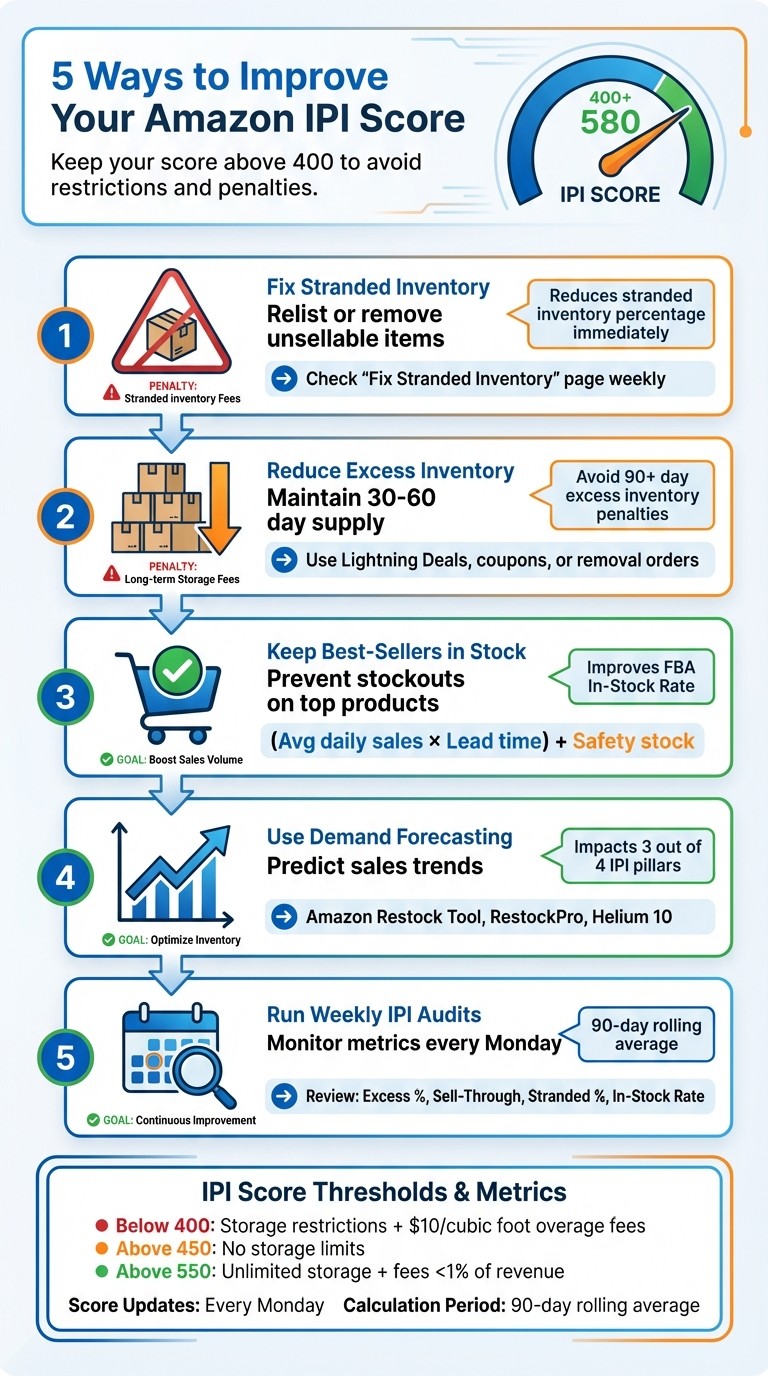
5 Steps to Improve Your Amazon IPI Score Above 400
IPI Score for Amazon FBA: What It Is, What It Means, and How to Fix It

1. Fix Stranded Inventory Right Away
If you want to improve your IPI score, one of the first things to tackle is stranded inventory. Stranded inventory refers to products sitting in Amazon's fulfillment centers without active listings. These items can't be sold, yet they take up valuable warehouse space and rack up storage fees. Worse, they drag down your IPI score by increasing your stranded inventory percentage.
Impact on IPI Score Improvement
Addressing stranded inventory can give your IPI score an immediate lift. Each unit you relist or remove reduces your stranded inventory percentage [(unavailable FBA units / total FBA units) x 100], which directly improves your score. As Amazon Forum Moderator KJ_Amazon puts it:
"Stranded inventory and other 'Unfulfillable Inventory' in an Amazon fulfillment center that do not have active listings and can't be sold can reduce your IPI score."
The common culprits? Pricing errors, missing images, suppressed or restricted listings, or deleted listings with leftover stock. Each issue requires a specific fix, but Amazon’s dashboard makes it simple to pinpoint and address the problem. Because of its direct impact, fixing stranded inventory should be a top priority for every seller.
Ease of Implementation for Sellers
This is one of the simplest ways to boost your IPI score. Amazon offers a "Fix Stranded Inventory" page under the Inventory tab in Seller Central. This tool lists all stranded ASINs, explains why they're stranded, and provides a "Fix listings" button to resolve the issue. For recurring problems, you can even enable Amazon’s automated tool to relist products automatically.
Make a habit of checking this page weekly to catch and resolve issues quickly. If a listing can't be fixed - due to a policy violation or a discontinued product - submit a removal or liquidation order right away. Once you request removal, that inventory stops affecting your IPI score, even before it leaves the warehouse.
Cost-Effectiveness of the Strategy
This strategy is highly efficient and requires no upfront costs. By resolving stranded inventory issues, you eliminate unnecessary storage fees and regain the ability to sell those products. Sellers with high IPI scores pay minimal storage fees - less than 1% of revenue - while those with low scores (below 400) face restrictions and overage fees as high as $10 per cubic foot. Fixing stranded inventory not only helps you avoid these penalties but also puts your products back in front of customers where they belong.
2. Reduce Excess Inventory
Once you've dealt with stranded inventory, the next step to improving your IPI performance is tackling excess inventory.
Excess inventory can drag down your IPI score significantly. Amazon considers any product with more than a 90-day supply as "excess", based on projected demand. Why? Because Amazon's goal is to operate as a fulfillment center, not a storage facility. As Brian Connolly, Ecommerce Expert at Jungle Scout, puts it:
"Amazon wants to serve as a fulfillment center, not a long-term storage facility, and prefers that FBA products move from the warehouse floor to customers' doorsteps relatively quickly."
Idle inventory increases your Excess Inventory Percentage and racks up costly storage fees. If inventory sits in a fulfillment center for over 365 days, you'll also face aged inventory surcharges on top of standard storage fees.
Impact on IPI Score Improvement
Reducing excess inventory has a direct, positive impact on your IPI score. It lowers your Excess Inventory Percentage and improves your sell-through rate. Ideally, you want to maintain 30 to 60 days of supply - enough to meet demand without overstocking. Plus, as soon as you submit a removal or liquidation order, that inventory is no longer counted against your IPI score.
Simplifying the Process for Sellers
Managing excess inventory is easier than you might think. Head to the "Manage Inventory Health" page in Seller Central and click the "Reduce excess inventory" button. This tool identifies SKUs that are costing you more in storage fees than they're generating in sales. From there, you can take action by:
Running Lightning Deals
Offering coupons
Enrolling products in Amazon Outlet
Bundling slower-moving items with bestsellers
For products that simply aren't selling, it's best to submit removal orders right away.
Cost-Effectiveness of This Strategy
While markdowns may temporarily reduce your profit margin, they help you avoid ongoing storage fees and aged inventory surcharges. Sellers with an IPI score above 450 typically avoid storage limits, while those with lower scores might face restrictions. If your IPI score drops below 350, Amazon could impose penalty fees of $10 per cubic foot on excess inventory, making it even more critical to address overstock issues promptly.
How Long It Takes to See Results
Amazon updates IPI scores every Monday, based on a rolling 90-day period. While it might take a few weeks to see the full impact of your changes, maintaining lean inventory levels will consistently improve your metrics. Check your Inventory Performance Dashboard weekly to monitor progress and make adjustments as needed.
3. Keep Top Products in Stock
Keeping your best-selling products consistently in stock is a critical step in improving your IPI score. Stockouts on these high-demand items not only hurt your sales but also have a direct negative impact on your IPI. Amazon places significant weight on your FBA In-Stock Rate, one of the four key factors influencing your IPI score. This metric evaluates how effectively you maintain inventory for popular, replenishable ASINs over the past 30 days, factoring in their 60-day sales velocity. When your top-performing products run out of stock, the damage to your IPI score can be substantial.
Impact on IPI Score Improvement
Your in-stock rate plays a pivotal role in determining your IPI score, which ranges from 0 to 1,000. Falling below 400 can lead to restricted storage capacity and overage fees of $10 per cubic foot. By keeping top products in stock, you also support your Sell-Through Rate, another important IPI metric, by ensuring steady sales momentum. Amazon tracks "missed sales" when items go out of stock, which reflects poorly on your inventory management. This makes avoiding stockouts a key part of maintaining a strong IPI score.
Tools and Strategies for Sellers
Amazon’s Restock Inventory tool in Seller Central simplifies stock management by providing demand-based recommendations tailored to your sales trends. To avoid stockouts, use the Reorder Point (ROP) formula:
(Average daily sales × Lead time) + Safety stock.
This formula helps ensure that your inventory arrives before you run out. You can also apply ABC Analysis to focus on the top 20% of products that generate the most revenue and prioritize keeping these in stock. For one-off or limited-edition items, mark them as "non-replenishable" in the Restock Inventory dashboard to prevent them from negatively affecting your in-stock rate. With these systems in place, regular monitoring will help you maintain a healthy IPI score.
Financial Benefits of Staying Stocked
Avoiding stockouts saves you from losing organic search rankings and the Buy Box - both of which can be costly to recover through advertising. A high IPI score also keeps storage fees manageable, typically below 1% of your revenue. By maintaining an optimal inventory balance, you can prevent overstock penalties while ensuring your top products are always available.
Timeline for Results
Amazon updates IPI scores every Monday, based on a rolling 90-day period. While the score reflects past performance, improvements in your in-stock rate can show measurable results within one to two weeks of restocking. Since the in-stock rate focuses on the last 30 days, consistent availability of your top items can quickly boost this metric. To stay on track, review your Inventory Performance Dashboard weekly and adjust your reorder points as needed. This proactive approach ensures steady progress toward a stronger IPI score.
4. Use Demand Forecasting and Restock Planning
When it comes to managing stranded and excess inventory, demand forecasting plays a critical role in striking the right balance between having enough stock and controlling costs. It’s a game changer for improving your Inventory Performance Index (IPI) score because it directly influences three out of the four IPI pillars: Excess Inventory, FBA Sell-Through Rate, and FBA In-Stock Rate. By accurately predicting demand, you can avoid overstocking items for more than 90 days and ensure your most popular ASINs remain available. This approach helps you dodge penalties for excess stock while keeping your sales momentum strong. Let’s break down how you can start using these tools effectively.
Impact on IPI Score Improvement
Accurate demand forecasting helps you avoid having your inventory flagged as "excess" by Amazon, which happens when stock exceeds a 90-day demand forecast. This not only saves you from aged inventory surcharges but also cuts down on monthly storage fees. For example, one client who adopted these strategies saw their IPI score jump by 41 points in just three months. They achieved this by focusing on FBA replenishment reports and forward-thinking demand planning, which also helped them increase their restock limits.
Ease of Implementation for Sellers
Getting started with demand forecasting doesn’t have to be expensive or complicated. Amazon’s Restock Inventory tool, available for free in Seller Central, offers recommendations based on your historical sales data. If you’re ready to take it up a notch, third-party tools like RestockPro, Skubana, and Helium 10 use AI to automate tasks like tracking lead times and setting reorder points. To calculate reorder points manually, use this formula:
(Average daily sales × Lead time) + Safety stock.
This ensures you maintain the right inventory levels while avoiding stockouts or excess penalties. For seasonal or one-off items, mark them as "non-replenishable" to keep them from negatively affecting your in-stock rate.
Time Required to See Measurable Results
While Amazon updates IPI scores weekly - typically every Monday - demand forecasting strategies generally show noticeable improvements over a 90-day period. This is because metrics like sell-through and excess inventory are calculated on a rolling 90-day basis. As Tanner Rankin, CEO of The Source Approach, explains:
"The four main metrics that make up the Amazon IPI score are updated daily whereas the final IPI score is updated weekly, typically on a Monday."
With consistent effort, you can see quick wins in the weekly updates, but fully recovering from a low score often takes several weeks of steady improvement.
5. Run Weekly IPI Audits
Regular audits are like a weekly checkup for your inventory’s health, ensuring your Inventory Performance Index (IPI) score stays on track. Since Amazon updates your IPI score every Monday, aligning your audits with these updates gives you the chance to address potential issues before they snowball. Weekly audits help you tackle problems like stranded inventory, slow-moving stock, and excess inventory, all of which can drag down your 90-day rolling average if left unchecked.
How Weekly Audits Help Your IPI Score
Weekly audits go hand-in-hand with actions like fixing stranded inventory and managing excess stock, keeping your IPI score moving in the right direction. By monitoring your inventory metrics every week, you can make timely adjustments to improve sell-through rates, clear out stranded inventory, and maintain in-stock performance. Savannah A from Seller Labs highlights the importance of this consistency:
"Amazon updates your IPI score weekly, so consistent improvement can lead to fast gains."
Focus your efforts on the four key metrics Amazon uses to calculate your IPI score: Excess Inventory Percentage, FBA Sell-Through Rate, Stranded Inventory Percentage, and FBA In-Stock Rate. Regularly reviewing these metrics ensures your physical inventory aligns with what’s shown in Seller Central, helping you avoid costly errors.
Easy to Get Started
Amazon makes it simple for sellers to perform audits with the free tools available in Seller Central. Just go to Inventory > Inventory Planning > Performance to access your IPI dashboard. These tools allow you to quickly identify and resolve issues. For sellers managing large catalogs, third-party tools like RestockPro, Jungle Scout, or Helium 10 can automate reports and send real-time alerts, saving you time and effort.
Budget-Friendly Strategy
Weekly audits are a cost-effective way to avoid penalties and maintain control over your inventory. If you stick to Amazon’s built-in tools, this process is entirely free, making it accessible to sellers of all sizes. For those with more complex inventories, subscription-based software can help streamline the process, with costs varying based on your SKU count and the features you need. Either way, the investment is small compared to the potential savings from avoiding storage volume limits and the Storage Utilization Surcharge, which kicks in if you hold inventory for more than 26 weeks.
When to Expect Results
Although Amazon updates your IPI score weekly, keep in mind that it’s calculated on a 90-day rolling basis. So while quick fixes like removing stranded inventory are helpful, they won’t immediately impact your score. As Tanner Rankin, CEO of The Source Approach, explains:
"Quick changes like inventory removals or sudden spikes in sales will not reflect right away."
With consistent weekly audits, you’ll start noticing measurable improvements over time. And if your score dips below the 400 threshold, Amazon typically gives you a six-week grace period to make corrections before imposing storage limits for the next quarter. By staying consistent with your audits, you can avoid these penalties and keep your inventory strategy on solid ground.
Conclusion
Improving your Amazon IPI score means keeping a close eye on the four key metrics Amazon monitors: stranded inventory, excess inventory, in-stock rates, and sell-through performance. To stay ahead, focus on five essential strategies: address stranded listings right away, trim excess stock to maintain a 30–60 day supply, ensure best sellers are always in stock, use demand forecasting for smarter restocking, and conduct weekly audits - preferably every Monday. Remember, your IPI score updates on a 90-day rolling basis, so consistent efforts will pay off over time.
The stakes couldn’t be higher. Falling below the 400 threshold can result in restrictive storage limits and costly overage fees, eating into your profits. On the other hand, maintaining a score above 550 gives you unlimited storage capacity and keeps storage fees below 1% of your total revenue. As Channel Key highlights:
"A poor IPI score isn't just a minor inconvenience. It can create serious operational and financial challenges... disrupting your entire supply chain." – Channel Key
For sellers managing large catalogs or complex supply chains, expert help can make all the difference. Partnering with specialists like eStore Factory can simplify inventory management. Their services, including account management, PPC optimization, and tailored listing strategies, work together to keep your inventory flowing. With AI-powered forecasting tools and customized replenishment plans, they help automate these critical processes - giving you more time to focus on growing your business while ensuring long-term inventory health.
At the end of the day, effective inventory management does more than protect your rankings and cut fees - it ensures your customers always find what they need. Whether you manage it internally or bring in expert support, staying on top of your IPI score is essential for thriving on Amazon.
FAQs
How does addressing stranded inventory affect my IPI score?
Fixing stranded inventory quickly is crucial for improving your Amazon Inventory Performance Index (IPI) score. Stranded inventory includes products stored in Amazon’s fulfillment centers that can’t be sold, usually because of listing errors or policy violations. Addressing these problems promptly ensures your items are available for purchase, avoids penalties for unsellable stock, and boosts the inventory availability factor of your IPI score - helping you see an immediate improvement.
Why is it important to maintain a 30–60 day inventory supply on Amazon?
Keeping a 30–60 day supply of inventory strikes the perfect balance between having enough stock to meet customer demand and avoiding excessive storage costs. This strategy helps you prevent stockouts that could hurt your sales and customer satisfaction while also keeping Amazon storage fees for surplus inventory in check.
On top of that, managing your inventory this way can boost your Inventory Performance Index (IPI) score by showcasing efficient stock management. With a well-maintained supply, you're ready to handle demand shifts, like seasonal surges, without locking up extra capital in unsold products.
How does demand forecasting help improve my Amazon IPI score?
Accurate demand forecasting plays a crucial role in keeping your inventory in sync with customer needs. By anticipating sales trends effectively, you can steer clear of overstocking and reduce the risk of stranded inventory. This not only boosts your sell-through rates but also has a direct impact on improving your Amazon IPI score.
When you prioritize demand forecasting, you can maintain balanced stock levels - ensuring your products are ready for customers without locking up funds in unnecessary inventory. Striking this balance is essential for enhancing both your IPI score and overall inventory management.