E-Commerce Strategies
Navigating international FBA shipping costs can be challenging, but understanding and managing key cost drivers can significantly improve your profit margins. Here’s a quick summary of the most effective strategies to reduce expenses:
Dimensional Weight Optimization: Use smaller, custom-fit packaging to avoid higher fees. Amazon charges based on the greater of actual or dimensional weight, so reducing box size can save $1.00+ per unit.
Seasonal Planning: Avoid peak Q4 storage fees ($2.40 per cubic foot) by timing shipments carefully. Use tools like Amazon’s Inventory Age dashboard to prevent long-term storage costs.
Inventory Placement: Minimize inbound placement fees (e.g., $0.27 per unit for standard items) by sending inventory to multiple fulfillment centers directly or using 3PL warehouses.
Regional Distribution: Position inventory closer to customers to reduce shipping distances and costs. Programs like Pan-European FBA can cut fulfillment fees by up to 53% in Europe.
Amazon Cost-Saving Programs: Take advantage of initiatives like the FBA New Selection Program (waiving inbound fees for new ASINs) or the Low-Price FBA program (saving ~$0.77 per unit for items under $10).
Technology Tools: Use shipping calculators, inventory management platforms, and compliance tracking tools to monitor costs, avoid penalties, and automate processes.
How To Optimize International Shipping Cost for Amazon FBA
What Drives International FBA Shipping Costs
Getting a handle on what influences your FBA shipping costs is the first step to managing them effectively. Amazon's fee structure plays a big role here. By breaking down the factors that drive these costs, you can spot areas where you might save.
Dimensional Weight and Package Size
Amazon doesn’t just look at the actual weight of your product; they also factor in how much space it takes up. This is where dimensional weight becomes a major cost factor for international FBA shipments. The dimensional weight is calculated by multiplying your package's length, width, and height (in inches) and dividing by a dimensional factor - usually 166 for standard shipments. Amazon charges based on whichever is higher: the actual or dimensional weight. Even a slightly larger box can lead to higher fees when you’re shipping in bulk.
For lighter products, fulfillment fees typically range from $2.50 to $4.00. Meanwhile, heavier standard items, around 2–3 pounds, tend to cost about $5–$6 in fees. If your standard-size item exceeds 3 pounds, Amazon adds roughly $0.32 per pound beyond the 3-pound mark. By optimizing your packaging - like trimming down box dimensions - you can reduce dimensional weight fees and save money over time. Once your packaging is dialed in, it’s also worth considering how seasonal demand impacts costs.
Seasonal Rate Adjustments
Shipping costs don’t stay consistent throughout the year. During peak seasons - especially Q4 (October through December) - fees rise due to increased demand and limited warehouse space. For example, storage fees during Q4 can climb to $2.40 per cubic foot, and inbound placement fees may tack on about $0.89 per unit. These higher costs make precise inventory management and timing essential to protecting your margins.
Work with your suppliers to time shipments so products arrive at fulfillment centers just before demand spikes, rather than too early, which could lead to hefty storage fees. Amazon’s Inventory Age and Inventory Performance Index (IPI) dashboards can help you monitor aging stock and avoid long-term storage fees. For slow-moving inventory, consider using FBA Liquidations or automated removal programs to cut down on accumulating costs.
Recent fee adjustments also play a role. Fulfillment fees rose by 5.2% in 2025, and for standard-size products priced between $10 and $50, an additional increase of $0.08 per unit is expected in 2026. While Amazon generally aims to keep fees stable during non-peak times, these seasonal increases can still impact how you calculate costs and set prices. Beyond seasonal changes, the location of your inventory is another key factor.
Fulfillment Center Locations and Shipping Distances
Where Amazon stores your products has a direct impact on your shipping expenses. When you send inventory for international FBA, Amazon may spread your products across multiple warehouses. The internal movement of inventory, reflected in the Inbound Placement Service Fee, is largely influenced by shipping distances. These fees average $0.27 per unit for standard items and $1.58 for bulkier products.
To cut these costs, you might consider a distributed placement strategy. This involves sending inventory to multiple fulfillment centers yourself, bypassing Amazon’s redistribution process. While this approach can eliminate many inbound placement fees, it does require more planning. Another option is to use third-party logistics (3PL) warehouses strategically located on both coasts. This allows you to create shipments that align with specific fulfillment centers, reducing the need for long-distance transfers.
If you’re expanding internationally, it’s crucial to understand which regional fulfillment centers serve your target markets. By positioning your inventory strategically, you can lower internal redistribution fees and speed up delivery times.
Amazon also offers incentives to help sellers manage costs. Through the FBA New Selection Program, inbound placement fees are waived for up to 100 units of new parent ASINs. This is a great opportunity for sellers launching products or entering new markets to establish themselves while keeping initial costs down.
Additionally, the Low-Price FBA program provides discounts for products priced under $10. For example, sellers can save approximately $0.77 off the usual fulfillment fee in the U.S., which translates to a 15–30% reduction in costs. This is especially useful for those in competitive, price-sensitive categories.
How to Place Inventory for Lower Costs
The way you manage and place your inventory can have a big impact on your profit margins. For instance, sending all your inventory to a single fulfillment center can lead to additional fees, like Amazon's Inbound Placement Service Fee. This fee averages $0.27 per unit for standard-size items and $1.58 for bulky items, covering Amazon's redistribution costs. To avoid these charges, Amazon encourages spreading inventory across multiple fulfillment centers. By carefully planning shipments and working with third-party logistics (3PL) providers or prep centers, you can avoid these fees and even speed up delivery times. This ties into the concept of regional distribution, which we'll explore further.
Benefits of Regional Distribution
Spreading your inventory across several fulfillment centers brings your products closer to your customers, which can significantly cut shipping costs. For example, using a fulfillment center near your customers reduces transportation expenses and allows for quicker deliveries. Faster shipping times can improve customer satisfaction, boost your seller ratings, and increase conversion rates.
This strategy works because customers often prefer buying products that ship from nearby locations. Listing items from the closest fulfillment center not only lowers costs but also makes you more competitive in the marketplace. To make this work effectively, you need to analyze your customer base. If most of your sales come from states like Texas, Florida, or California, focusing on fulfillment centers near these areas can make a big difference. Amazon's inventory management tools in Seller Central can help you identify which fulfillment centers align best with your customer base, allowing you to make smarter decisions about shipment distribution.
For a global approach, Amazon's Multi-Country Inventory (MCI) program takes regional distribution to the next level. With MCI, you can send inventory directly to fulfillment centers worldwide, enabling Amazon to store and ship your products locally. This is especially helpful if you're targeting specific international markets or managing sales across multiple regions.
A practical way to implement regional distribution is by minimizing shipment splits. For instance, you can send large quantities of the same product type to one fulfillment center in key regions - such as shipping to a West Coast center for western states and an East Coast center for eastern states. This keeps logistics simple while ensuring inventory is closer to both customers and destination ports.
Working with 3PL providers can also streamline this process. They can handle splitting and prepping shipments according to Amazon's requirements, helping you avoid inbound placement, prep, and labeling fees. Additionally, Amazon's Partnered Carrier program offers discounted shipping rates when sending inventory to FBA warehouses, which can further reduce your costs.
Pan-European FBA as a Cost-Efficient Solution
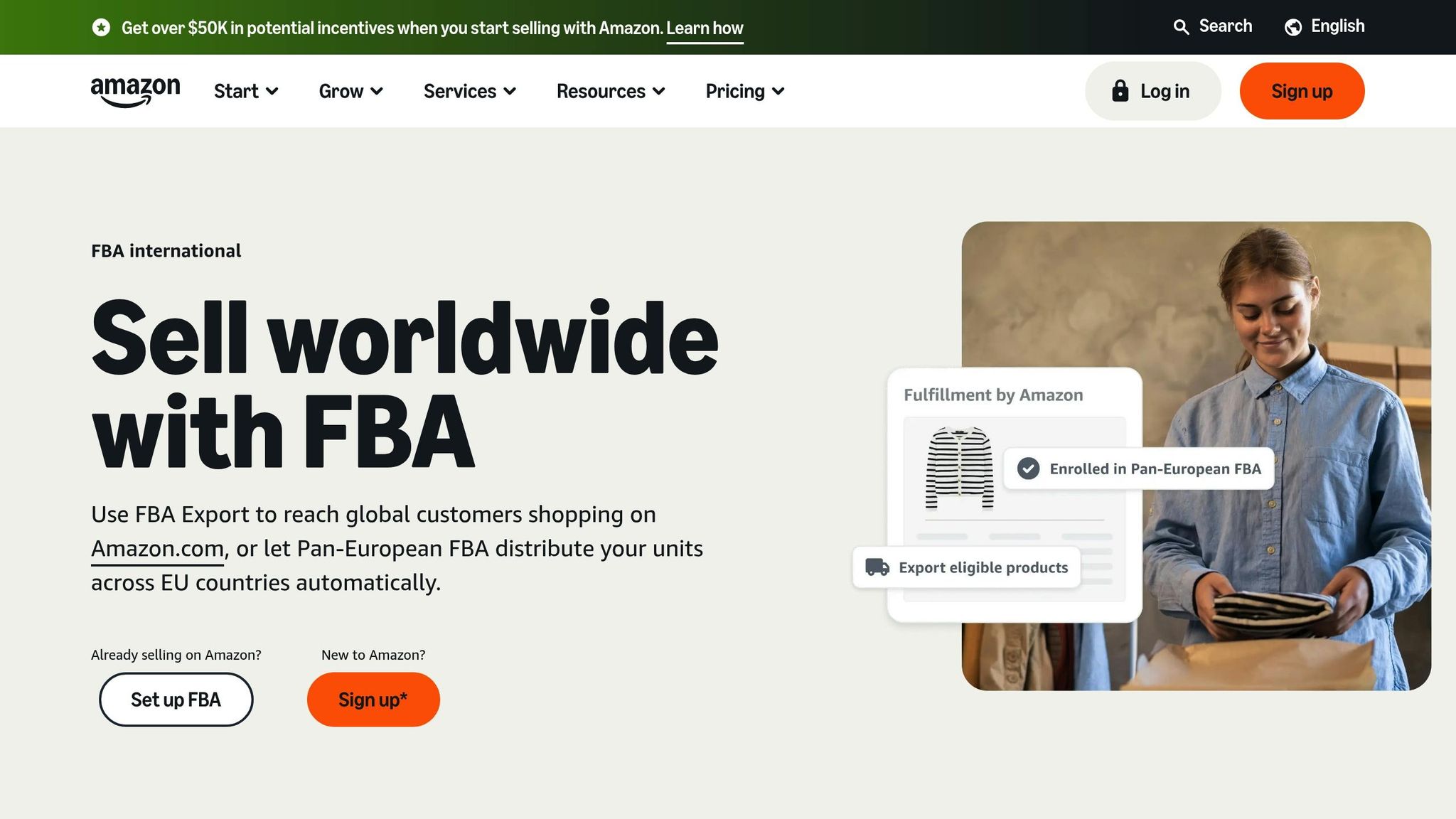
For sellers expanding into international markets, Pan-European FBA offers an efficient way to distribute inventory across Europe. With this program, you store your inventory in one EU country, and Amazon takes care of distributing orders from the nearest fulfillment center. This reduces both shipping distances and costs.
The savings can be impressive. Sellers using Pan-European FBA may see up to 53% reductions in fulfillment fees compared to traditional international shipping. By handling logistics and routing orders to the most efficient location, Amazon simplifies the process while lowering your operational costs and improving delivery times.
Pan-European FBA also eliminates much of the complexity involved in managing shipments for multiple European marketplaces. Instead of sending separate shipments to countries like Germany, France, or Spain, you can send one consolidated shipment. Amazon then handles the distribution, ensures compliance with local regulations, and fulfills orders from the best location for each customer.
While MCI gives you detailed control over global inventory placement, Pan-European FBA automates the process for Europe. Both options require careful inventory management and monitoring stock levels across multiple fulfillment centers. However, the cost savings and competitive edge gained through faster deliveries make the extra effort worthwhile.
When choosing between these strategies, think about your target markets and operational capacity. If you're new to international selling, Pan-European FBA is a simpler way to enter the European market. As your business grows, you can combine MCI strategies with Pan-European FBA to optimize costs across regions while keeping operations manageable.
For expert advice on implementing these strategies, companies like eStore Factory offer specialized Amazon consulting services to help you lower your FBA shipping costs and streamline inventory management.
How to Optimize Packaging for Cost Savings
Packaging plays a direct role in determining profit margins for international FBA sellers. Amazon calculates fulfillment fees based on either actual weight or dimensional weight - whichever is higher. This means even lightweight products can end up in a more expensive shipping tier if the packaging is bulky. By designing packaging strategically, you can cut costs while staying compliant with Amazon’s rules.
Since inventory placement and regional distribution already influence costs, packaging optimization becomes another critical way to manage fees effectively.
Amazon's Packaging Requirements
Before diving into packaging redesigns, it’s essential to understand Amazon’s packaging rules for international FBA shipments. These standards cover everything from box sizes and weight limits to labeling and protective materials. Ignoring these requirements can lead to unplanned prep fees and penalties.
For instance, certain products must be packaged in polybags with suffocation warnings, while others may need bubble wrap or additional protective materials. If these steps are skipped, Amazon will handle the packaging for you, charging between $0.55 and $0.70 per unit - a cost that quickly adds up when shipping in bulk.
Packaging requirements also vary by region. What works for shipments to the U.S. might not meet the standards for Europe or other markets. Always double-check the specific rules for your target marketplace, including box dimensions, labeling formats, and any special handling instructions for fragile or hazardous items.
The goal is to strike a balance: meet Amazon’s compliance standards without overpacking to the point where dimensional weight increases. Using just enough protective materials, choosing the right-sized boxes, and ensuring proper labeling can help you avoid extra charges. Partnering with experienced third-party prep services can also simplify this process, ensuring every shipment is compliant before it leaves your facility.
Once compliance is covered, the focus shifts to reducing dimensional weight through smarter packaging design.
Reducing Dimensional Weight Through Packaging Design
Optimizing packaging design is one of the most effective ways to lower costs tied to dimensional weight. Custom-fit packaging eliminates wasted space, helping to reduce dimensional weight. For example, instead of using a standard-sized box with excessive void fill for a small product, switch to a smaller box or a padded mailer for durable items. This adjustment can move your product into a lower-cost shipping tier, saving money on every unit.
Even minor changes can make a big difference. Reducing box height by just 0.5 inches can lower a product’s shipping tier, saving over $1.00 per unit. For sellers shipping thousands of units annually, these savings add up quickly. Bundling multiple small items into a single compact package instead of shipping them separately is another way to cut both dimensional weight and per-unit costs.
Flexible or collapsible packaging materials are another option. Products that don’t need rigid protection can often be shipped in flexible mailers or shrink-wrapped packages that conform to the product’s shape. This eliminates empty space, reducing dimensional weight while still protecting the items during transit.
Collaborate with your packaging suppliers to test and refine designs. Consider alternatives like custom-sized boxes, thinner materials, or innovative configurations that maintain protection while reducing volume. Even small tweaks - such as using thinner cardboard or reducing void fill - can significantly impact shipping costs.
Amazon’s fulfillment fees vary based on weight and size. For standard-size products under 3 lbs, fees range from $2.50 to $4.00. Heavier items (2–3 lbs) incur fees of $5.00 to $6.00. Products priced under $10 qualify for a $0.77 discount on fulfillment fees in the U.S., making it even more critical to optimize packaging for lightweight, compact shipments.
Looking ahead to 2025, eco-friendly packaging initiatives may offer reduced fees and better search rankings. While sustainable materials can sometimes be lighter and more compact, poorly designed eco-friendly packaging could increase dimensional weight or require extra protective materials. Work with packaging experts to ensure your sustainable choices don’t unintentionally raise costs.
Leverage digital tools and AI platforms to analyze dimensions, suggest optimized packaging options, and simulate shipping costs. These tools integrate with Amazon’s systems, offering real-time feedback on how packaging adjustments affect fulfillment fees. This data-driven approach simplifies decision-making.
Finally, regular packaging audits are key to staying cost-efficient. Periodically review your processes, test new materials, and keep up with Amazon’s evolving requirements. Training staff on proper packaging techniques and using automated solutions can further minimize errors and expenses. If you need expert assistance, agencies like eStore Factory provide specialized Amazon consulting services that include tailored packaging strategies for your products and markets.
Using Technology and Tools for Cost Optimization
When it comes to managing international FBA shipping costs, technology plays a crucial role. The complexity of Amazon's dynamic fees, seasonal adjustments, and multi-regional shipping logistics makes manual tracking nearly impossible. By leveraging the right tools, you can gain real-time visibility into costs, automate repetitive tasks, and uncover opportunities to save money.
With Amazon's reported fee increases, staying on top of your expenses is more important than ever. Technology platforms can analyze your shipping patterns, forecast costs, and recommend adjustments that help you cut expenses without compromising service quality.
Shipping and Inventory Management Tools
Start with Amazon's fee calculators to estimate shipment costs before committing to a fulfillment center or shipping method. This upfront insight is vital for accurate budgeting and planning.
For deeper insights, inventory management tools are essential. Dashboards like the Inventory Performance Index (IPI) and Inventory Age help you monitor aging stock and avoid long-term storage fees. These tools make it easier to decide whether to liquidate or remove old inventory, saving you from unnecessary expenses.
For international shipping, Amazon Global Logistics (AGL) simplifies freight forwarding and customs management. AGL handles documentation and customs clearance, reducing the risk of delays and unexpected charges. Sellers using AGL often benefit from streamlined processes and lower costs compared to juggling multiple carriers and brokers.
Third-party logistics (3PL) providers can also help optimize costs. These partners store your inventory and send it to Amazon only when needed, avoiding long-term storage fees and keeping your IPI score healthy. Some 3PL providers strategically distribute inventory to multiple Amazon fulfillment centers, reducing inbound placement fees.
Prep centers are another valuable resource. These facilities handle quality checks and ensure your shipments meet Amazon’s requirements, avoiding unexpected prep fees - like $0.70 for polybags or $0.55 for labeling - which can add up quickly. A popular strategy is to use prep centers on both coasts of the U.S. to minimize cross-country shipping splits while maintaining flexibility.
The Amazon Partnered Carrier program offers discounted shipping rates through carriers familiar with Amazon’s standards. These carriers ensure smoother deliveries and reduce the risk of rejected shipments. Bulk shipping through partnered carriers can lead to even greater discounts, significantly lowering per-item shipping costs.
To tie everything together, analytics dashboards are indispensable. They track fulfillment fees, monitor inbound placement charges, and analyze inventory turnover. For international sellers, these tools provide insights into regional fulfillment center usage and shipping distances, highlighting cost-saving opportunities in different markets.
Shipping analytics tools also help you identify seasonal trends and fee changes, allowing you to plan shipments strategically. For example, timing inventory arrivals just before peak demand seasons can minimize storage fees during high-cost periods like October through December, potentially saving thousands of dollars.
For international shipments, dimensional weight calculators are particularly helpful. Amazon charges based on unit weight or dimensional weight - whichever is higher. These tools calculate dimensional weight (length × width × height ÷ 166 for cubic inches) and flag when packaging exceeds optimal dimensions, suggesting alternatives to save on shipping costs.
Integrating Technology with Amazon Systems
Once you’ve implemented cost-saving measures, integrating these tools with Amazon’s systems takes optimization to the next level. Seamless integration ensures that all your platforms work together, providing up-to-date information on inventory, shipping costs, and compliance requirements.
Look for platforms with direct API connections to Amazon Seller Central. These connections automate alerts for fee changes, seasonal adjustments, and compliance updates, saving you from manually monitoring these factors. Automated systems notify you when action is needed, helping you avoid costly errors.
Automated removal programs are another game-changer. These tools proactively manage aging inventory, preventing long-term storage fees from piling up. For sellers managing stock across multiple markets, this automation is invaluable, as it eliminates the need to track aging inventory manually.
For international operations, compliance tracking tools are essential. When paired with Amazon Global Logistics, these systems ensure shipments meet all regional requirements, avoiding penalties and delays. This is particularly important for Pan-European FBA operations, where regulations vary by country. Compliance tools verify documentation, flag products needing special handling, and ensure proper tariff classifications.
Integration also helps you take advantage of Amazon’s fee waiver programs. For instance, between December 1, 2024, and March 31, 2025, Amazon will waive inbound placement fees for up to 100 units of new parent ASINs under the FBA New Selection Program. Integrated systems can identify qualifying products automatically, ensuring you don’t miss out on savings like $0.89 per unit.
When rolling out third-party tools, start with a pilot program on a small subset of products or markets. This approach allows you to test integrations, resolve issues, and train your team without disrupting your operations. During the pilot, track key metrics such as cost per unit shipped, cost per cubic foot stored, and regional shipping costs to confirm the tools are delivering the expected benefits.
For international sellers, audit trails and documentation features are must-haves. Integrated systems should maintain records of shipments, compliance checks, and fee calculations. These records not only protect you during audits but also reveal patterns that can lead to further cost savings.
By combining shipping analytics, inventory management, and compliance tracking, you create a system that continuously improves over time. As more data is collected, the system becomes better at predicting costs, offering recommendations, and automating routine decisions. This gives you a competitive edge, helping you thrive even as Amazon’s fees evolve.
If you’re unsure where to start, agencies like eStore Factory specialize in Amazon consulting and can guide you in building a tailored technology stack for your products and target markets. Their expertise ensures you maximize savings while staying compliant across all regions.
Monitoring FBA Fee Changes and Compliance Requirements
Amazon's fee structure is constantly evolving, and these changes can have a direct impact on your profitability. For FBA sellers, the challenge grows when managing fees across multiple marketplaces, each with its own currency, regulations, and pricing updates. Overlooking fee adjustments or compliance updates can quickly eat into your margins.
Thankfully, Amazon provides tools and notifications to help sellers stay informed. Below, we’ll explore how to effectively track fee changes and meet regional compliance standards, especially when expanding internationally.
Staying Updated on Fee Changes
Amazon has pledged to maintain fee stability for standard FBA fees at 2024 non-peak levels through 2025. However, there are still adjustments to be aware of:
Fulfillment fees increased by 5.2% in 2025, with Q4 storage fees reaching $2.40 per cubic foot.
Standard-size products priced between $10 and $50 will see an average fulfillment fee hike of $0.08 per unit in 2026.
Large Bulky-size products benefited from reduced inbound placement service fees in 2025, saving sellers up to $0.58 per unit.
The Low-Price FBA program offers discounts of around $0.77 per unit for products under $10 in the U.S. and $0.80 CAD for eligible items in Canada.
The FBA New Selection Program waived inbound placement fees for up to 100 units of new parent ASINs for shipments made between December 1, 2024, and March 31, 2025.
For sellers managing thousands of units across multiple regions, these changes can significantly impact profit margins.
To stay ahead, make it a habit to review Amazon's official fee calculators, Seller Central announcements, and tools like the Inventory Age and Inventory Performance Index (IPI) dashboards. These resources can alert you to aging inventory before long-term storage fees - typically applied after 6 to 12 months - start cutting into your profits. Subscribing to Amazon Seller Central notifications and following official Amazon blogs is another way to stay informed about fee adjustments across different regions.
External factors, like U.S. tariff changes, also play a role. A 10% baseline tariff on many imported goods has added to shipping and landed costs. When combined with rising FBA fees, these tariffs can further squeeze profit margins unless pricing is adjusted.
To simplify fee tracking, consolidate regional FBA fees into a single dashboard that accounts for currency and fee variations. Regularly review these costs alongside your agreements with suppliers and logistics providers to uncover potential savings. At the same time, ensure your products meet the latest regional regulations to avoid disruptions.
Understanding Regional Compliance Standards
Meeting compliance requirements is just as important as monitoring fees, especially for international FBA sellers. Non-compliance can result in penalties, product removal, or even shipment rejections - disrupting operations and driving up costs.
Amazon has updated its guidelines for handling dangerous goods, which may now require additional packaging or labeling that impacts dimensional weight. Even non-hazardous items might need special handling, depending on the region. For example, European FBA has stricter packaging and labeling standards compared to North America. A product that’s approved for sale in the U.S. might face rejection in certain EU countries if it doesn’t meet their specific requirements.
To avoid these pitfalls, research the safety, labeling, and packaging regulations for each marketplace you operate in. Partnering with experienced 3PL providers can also help ensure your products comply with regional standards.
For Pan-European FBA sellers, compliance becomes even more intricate. Regulations can vary by country; a product approved in France might need additional documentation or labeling to sell in Poland. Using compliance tools can help verify documentation, flag items needing special handling, and ensure proper tariff classification. These tools also simplify audit preparation and may even reveal opportunities to reduce costs.
Adopt a proactive approach by staying informed about regulatory changes in your target markets. Reviewing compliance requirements quarterly can help you avoid unexpected penalties and operational disruptions.
If compliance tracking feels overwhelming, consider working with agencies like eStore Factory, which specialize in Amazon consulting. Their expertise can guide you through region-specific requirements and help you optimize costs while ensuring compliance.
Conclusion
Cutting down on international FBA shipping costs calls for a well-rounded approach that tackles multiple cost factors at once. The strategies shared here - like understanding dimensional weight pricing and placing inventory strategically across fulfillment centers - work in unison to help sellers achieve noticeable savings and improve their profit margins.
Savings are within reach. Sellers who adopt these methods can see 15-30% reductions in total FBA expenses. Optimizing packaging and placing inventory wisely can lower per-unit fees, while carefully timing shipments helps avoid piling up long-term storage costs during peak times.
However, achieving these savings isn’t a one-and-done task. Fee structures are always changing, so staying updated is critical. Regular monitoring through tools like Seller Central dashboards, fee calculators, and official Amazon updates ensures you can adapt quickly and protect your profitability.
Leverage technology to your advantage. Inventory management tools offering real-time insights can guide smarter decisions about where and when to ship inventory. The Amazon Partnered Carrier program simplifies bookings and provides lower shipping rates, while third-party logistics providers can help maintain high Inventory Performance Index scores by sending inventory to Amazon just when it's needed, sidestepping long-term storage fees.
Compliance is non-negotiable. Different regions have their own packaging, labeling, and safety standards. Failing to meet these can lead to unexpected prep fees or penalties, so understanding and adhering to regional requirements is essential.
For sellers managing intricate international operations, eStore Factory offers professional support to streamline your cost-saving efforts.
These strategies not only cut costs but also deliver operational perks. Better packaging, smarter inventory placement, and improved management can speed up deliveries, reduce product damage, and prevent stockouts. Together, these improvements give you a competitive edge and pave the way for long-term success in global markets.
FAQs
How can I use Amazon's Inventory Age dashboard to reduce long-term storage fees?
Amazon's Inventory Age dashboard is a handy resource for keeping your inventory in check and steering clear of hefty long-term storage fees. By examining the age of your stock, you can spot products that have been sitting in fulfillment centers for too long. Pay special attention to items approaching the 365-day mark, as they could lead to higher fees.
To cut down on costs, try strategies like running promotions, offering discounts, or bundling slower-moving products to boost sales. You might also want to remove unsold items or tweak your restocking plans to avoid having too much inventory on hand. Keeping a close eye on this dashboard helps you stay ahead of the game and manage your inventory more efficiently.
What are the benefits of using third-party logistics (3PL) providers for regional distribution in international FBA shipping?
Using third-party logistics (3PL) providers for regional distribution in international FBA shipping can be a game-changer for your business.
First, they help cut shipping costs by storing your inventory closer to your key markets. This reduces the shipping distance, which means lower expenses and faster delivery times.
Second, 3PL providers bring expertise in handling international shipping regulations. Their established networks can make customs clearance smoother and reduce the risk of delays, which is crucial for keeping your customers happy.
Finally, 3PL providers take care of warehousing, packaging, and shipping. This means you can scale your operations without getting bogged down in logistics, giving you more time to focus on growing your Amazon business.
How can Amazon's Pan-European FBA program help lower fulfillment costs for sellers targeting European markets?
Amazon's Pan-European FBA program is designed to help sellers cut down on fulfillment costs by strategically storing inventory closer to customers in various European countries. This setup reduces cross-border shipping expenses since products are shipped locally within each country rather than across international borders. On top of that, it can lead to faster delivery times, which not only boosts customer satisfaction but may also drive up sales.
Sellers using this program can take advantage of Amazon's competitive local fulfillment fees while avoiding the steep costs of international shipping. That said, joining the program does come with its own set of responsibilities - specifically, ensuring compliance with VAT regulations in every country where inventory is stored. Careful planning is key to navigating these requirements successfully.