
E-Commerce Strategies
Amazon repricing tools adjust your product prices automatically, helping you stay competitive in a fast-moving marketplace. But are they worth the cost? Here's what the study found:
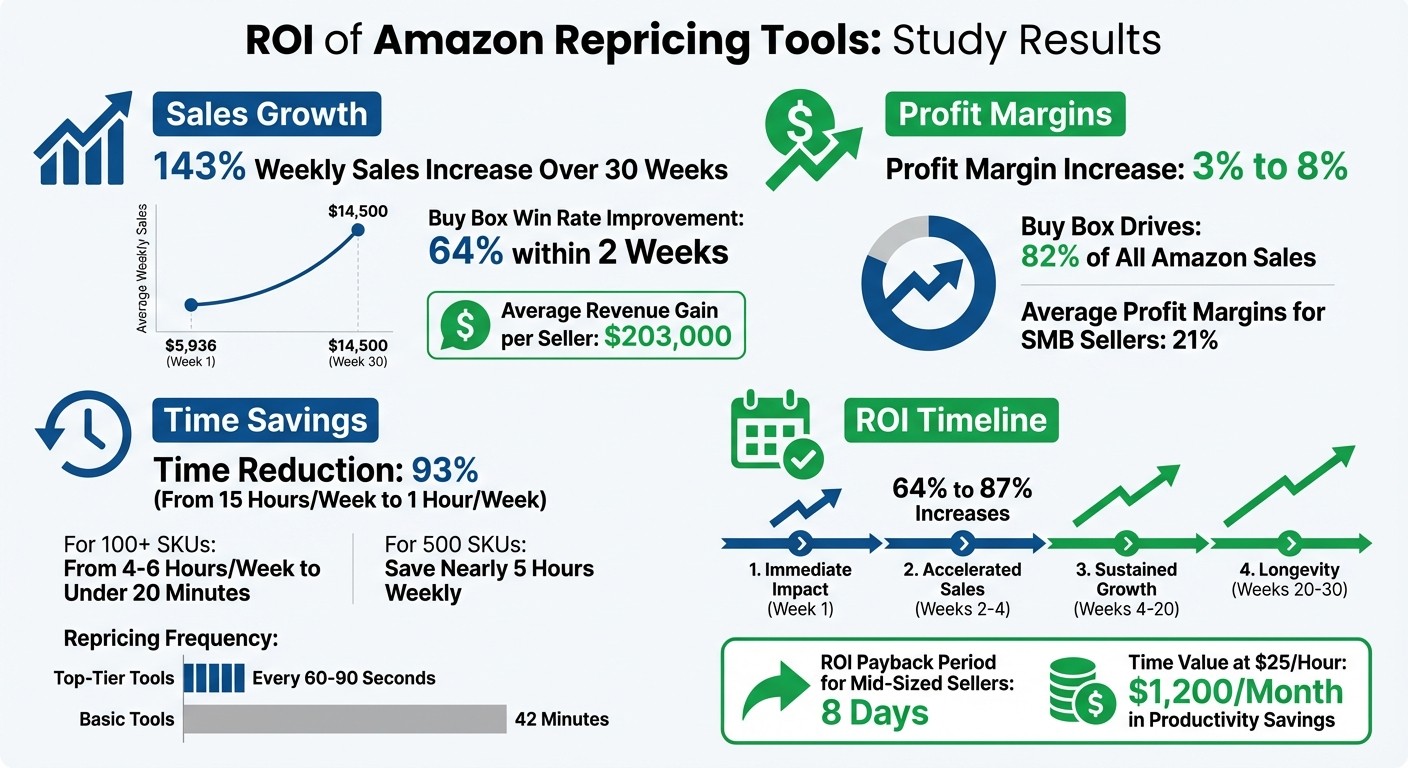
Sales Growth: Sellers using these tools saw weekly sales increase by 143% over 30 weeks. Buy Box win rates improved by 64% within two weeks.
Profit Margins: Tools helped increase profit margins by 3% to 8%, especially through smarter pricing strategies like raising prices when competitors are out of stock.
Time Savings: Pricing management time was reduced by 93%, from 15 hours per week to just 1 hour.
Quick ROI: For mid-sized sellers, subscription costs were often offset in just 8 days.
Key metrics to track include Buy Box percentage, profit margins, and time investment. Advanced tools (like AI-powered repricers) offer the best results, but they require careful setup to avoid pricing errors or unnecessary margin losses. By automating pricing adjustments and improving efficiency, these tools can transform how you manage your Amazon business.
ROI of Amazon Repricing Tools: Key Performance Metrics and Results
Amazon Sellers: This Repricing Hack Will Save You Thousands!
Key Metrics for Measuring ROI of Repricing Tools
To truly gauge the ROI of Amazon repricing tools, you need to focus on specific metrics. Tracking the right data ensures you're not just paying for a subscription but actually improving your profitability. Let’s break down the numbers that matter.
Sales Growth Metrics
One of the most critical indicators is your Featured Offer (Buy Box) Percentage. With 70% to 80% of Amazon sales coming through the Buy Box, securing this spot directly impacts your revenue. Compare your Buy Box win rate before and after using a repricer - strategic adjustments can boost your win rate by as much as 45%.
In addition to Buy Box performance, keep an eye on your total sales volume and revenue. A 2025 study by Repricer.com, which tracked over 300 Amazon sellers for 30 weeks, revealed that average weekly sales climbed from $5,936 in Week 1 to over $14,500 by Week 30 - a 143% increase. This growth translated to an average revenue gain of $203,000 per seller. According to Colin Palin, Product Manager at Repricer.com, this growth followed four stages: Immediate (Week 1), Accelerated (Weeks 2–4 with 64% to 87% increases), Sustained (Weeks 4–20), and Longevity (Weeks 20–30).
Another key metric is Unit Session Percentage, or your conversion rate. This shows how pricing tweaks influence buyer behavior. When paired with your Best Sellers Rank (BSR), it helps identify the pricing sweet spot that maximizes not just sales volume but overall profit. However, increased sales volume alone isn’t enough - it’s essential to ensure profitability remains intact, which brings us to the next point.
Profit Margin Improvements
Revenue growth is only meaningful if your profit margins hold steady - or improve. To calculate your net profit, subtract your cost of goods sold (COGS), Amazon referral and FBA fees (usually 35% of revenue), and advertising spend (15% to 20% of revenue) from your total revenue. For many small-to-medium Amazon sellers, average profit margins hover around 21%, meaning $100,000 in sales might yield $15,000 to $20,000 in pre-tax profit.
Sellers often see profit margin increases of 3% to 8% after adopting repricing tools. This improvement frequently stems from upward repricing - when competitors are out of stock or when you dominate the Buy Box, smart tools can raise prices instead of defaulting to price cuts. Even small price increases can significantly impact your overall profitability.
"Repricing isn't just about racing to the bottom. Smart automated pricing actually helps you maximize profit margins by finding the sweet spot between competitiveness and profitability." - Colin Palin, Product Manager, Repricer.com
To protect your margins during price wars, set floor prices (minimum) and ceiling prices (maximum). Additionally, track your Total Advertising Cost of Sale (TACoS) to ensure increased sales don’t come at the expense of your bottom line.
Time Savings and Operational Efficiency
Repricing tools don’t just boost sales - they save you time. Sellers report a 93% reduction in time spent managing prices, cutting weekly efforts from 15 hours to just 1 hour. For those managing 100+ SKUs, manual price adjustments can take 4 to 6 hours weekly, while automated tools reduce this to under 20 minutes.
Measure your weekly time investment before and after adopting automation. Tasks like competitor monitoring, price changes, performance analysis, and error correction see dramatic time reductions. For instance, these tasks might drop from 120, 150, 45, and 30 minutes respectively to just 3, 5, 20, and 2 minutes per week. Sellers with 500 SKUs can save nearly 5 hours weekly.
Another factor to consider is repricing frequency. Top-tier tools adjust prices every 60 to 90 seconds, while basic tools might take up to 42 minutes to react to market changes. For mid-size sellers managing 500 to 2,000 SKUs, the efficiency gains often offset the subscription cost within the first eight days. If you value your time at $25 per hour, saving 10 hours weekly translates to about $1,200 per month in productivity - time that can be reinvested into sourcing, expanding your catalog, or exploring new markets.
"Repricer.com has given me back an entire day every week to focus on sourcing and growing my catalog. Best investment I've made in my Amazon business." - Marcus Chen, FBA Seller
These measurable improvements lay the groundwork for strategies that can further amplify your ROI.
Study Findings: ROI Results from the Research
The research provides clear evidence of measurable ROI, shedding light on how repricing tools deliver tangible benefits for Amazon sellers.
Sales Growth and Revenue Increases
The study followed 300 Amazon sellers over a 30-week period, uncovering substantial sales growth. Within the first two to three weeks, sellers saw an impressive 64% increase in sales, which surged to 87% by Week 4. Alongside this, Buy Box ownership also saw a boost, climbing from 63% to 64% in just two weeks. These numbers illustrate how repricing tools turn theoretical advantages into real-world results.
Profit Margin Optimization
While increasing revenue is vital, protecting profit margins is equally critical. Advanced repricing tools adjust prices strategically to avoid harmful price wars. For instance, a consumer electronics seller using Repricer.com's AI technology for 1,247 SKUs achieved remarkable results: their Buy Box win rate jumped from 68% to 92%, leading to a 137% revenue increase - all while maintaining healthy profit margins. Another example involved a kitchen supplies seller who used time-of-day repricing to secure 23% of daily sales at premium prices, resulting in an 18% improvement in overall profit margins without sacrificing sales volume.
ROI Realization Timeline
The path to ROI unfolds in four stages: Immediate Impact (Week 1), Accelerated Sales (Weeks 2–4), Sustained Growth (Weeks 4–20), and Longevity (Weeks 20–30). Sellers often see initial results within the first week, with rapid acceleration during the first month. For mid-sized sellers handling 500 to 2,000 SKUs, efficiency gains frequently offset subscription costs within just eight days. These timelines highlight how repricing tools provide both quick wins and long-term benefits.
The findings emphasize the value of tailored strategies to maximize ROI, setting the stage for the next section's discussion.
Best Practices for Maximizing ROI with Repricing Tools
Aligning Tools with Business Goals
Your repricing strategies should reflect your business model. For arbitrage and wholesale sellers, it's crucial to prioritize tools that focus on the Buy Box and filter competitors by their fulfillment methods. If you're an FBA seller, configure your tool to ignore non-Prime FBM offers - this allows you to maintain competitive pricing without unnecessarily lowering it. Meanwhile, private label sellers often require a completely different approach. Since they're usually the sole seller for their listings, the focus should be on tools that enhance search rankings and protect brand value instead of just chasing the Buy Box.
Inventory levels should also shape your pricing decisions. For instance, aggressively discount seasonal overstock to clear it out, but raise prices on low-stock items to safeguard your margins. Research consistently shows that profit-focused strategies paired with algorithmic repricers deliver the best long-term results. A real-world example? In October 2025, Marcus Chen, an FBA seller managing over 800 SKUs in electronics, implemented Repricer.com. Within just one week, his Buy Box percentage jumped from 62% to 84%, and he slashed his weekly pricing management time from 5.5 hours to just 30 minutes. Tailored strategies like these not only simplify operations but also set the foundation for precise performance tracking.
Tracking the Right Metrics
Once you've aligned your tools with your goals, focus on metrics that truly measure ROI. While it's tempting to obsess over sales numbers, profit margins should take center stage to avoid unintended losses. The Buy Box win rate is also critical, given that it accounts for roughly 82% of all Amazon sales. However, balance is key - winning the Buy Box shouldn't come at the expense of profitability. Another essential metric is inventory velocity, which tracks how quickly your products sell. This insight helps you decide whether to adjust prices to avoid long-term storage fees or prevent stockouts.
Speed is another game-changer. Top-tier repricers can react to competitor price changes in under two minutes, compared to the 4–6 hours it might take to do it manually. This responsiveness directly translates to a higher Buy Box win rate. Dedicate 30–60 minutes each week to review competitor trends and identify opportunities for optimization before they escalate into issues.
Avoiding Common Pitfalls
One of the biggest mistakes sellers make is failing to set a hard minimum price. Always establish a floor at least 15–20% above your break-even point to avoid losses during price wars. Another common error is applying uniform rules across all products, which can lead to unnecessary margin erosion, especially for high-performing items.
It's also important to consider non-price factors like shipping speed, customer reviews, and order defect rates. Even with the lowest price, weak seller metrics can cost you the Buy Box. For beginners, tools with a "Safe Mode" feature can simulate pricing rules in action, allowing you to test strategies without going live. Timing also matters - try scheduling price increases during slow sales periods or late at night to see if you can maintain the Buy Box while improving margins.
Here’s a quick summary of best practices and common mistakes to help you protect and improve your ROI:
Best Practice | Common Mistake | ROI Impact |
|---|---|---|
Set minimum prices 15–20% above break-even | Minimums set too low | Prevents losses during price wars |
Filter competitors by fulfillment method | Competing with irrelevant sellers | Maintains higher prices with Prime advantage |
Use AI/Game Theory algorithms | Simple "stay $0.01 lower" rules | Avoids the race to the bottom |
Adjust pricing based on inventory levels | Static pricing regardless of stock | Clears overstock and maximizes low-stock margins |
Coordinate with active promotions | Ignoring coupons and Lightning Deals | Avoids double-discounting that reduces margins |
Conclusion
Summary of ROI Insights
Automated repricing tools deliver measurable benefits across critical performance metrics. Sellers who use these tools have reported a 143% increase in weekly sales over a 30-week period, with Buy Box acquisition rates surging by 64% within the first two weeks. Beyond sales growth, the tools drastically improve efficiency, cutting pricing management time by 93% - from 15 hours per week to just 1 hour. On top of that, AI-driven pricing strategies contribute to profit margin improvements of 2% to 5%. These results underscore a major shift in how sellers compete on Amazon, especially given that the Buy Box drives around 82% of all sales and converts at rates 5 to 10 times higher than non–Buy Box placements.
The benefits of automated repricing don’t just appear overnight - they build steadily. Sellers see the best results when they make data-driven decisions, such as setting price guardrails 15–20% above break-even, filtering competitors by fulfillment method, and adjusting prices based on inventory movement. The most successful sellers don’t simply chase the lowest price; instead, they use algorithms to strategically raise prices when they control the Buy Box and competitors are out of stock. To fully capitalize on these advantages, tapping into Amazon marketing services is often essential.
The Role of Expert Support
Achieving sustainable growth through repricing tools often requires specialized expertise. Agencies like eStore Factory help sellers fine-tune their strategies by setting optimal price thresholds and selecting the most effective repricing logic. This guidance ensures that tools are tailored to specific goals - whether it’s clearing excess inventory, maximizing profits on low-stock items, or launching private-label products without sparking price wars.
The difference between average and exceptional ROI often comes down to the finer details. For example, syncing repricing rules with inventory levels, coordinating with active promotions to avoid double-discounting, and maintaining strong seller metrics that influence Buy Box eligibility are all critical. For sellers managing hundreds or even thousands of SKUs across multiple marketplaces, expert support turns repricing into a dynamic system - one that adapts to shifting market conditions and aligns with evolving business priorities.
FAQs
How do Amazon repricing tools affect your profit margins?
Amazon repricing tools are designed to help sellers maintain and potentially boost profit margins using advanced algorithms and smart pricing strategies. These tools automatically adjust your product prices in real time, ensuring you remain competitive without falling into destructive price wars.
One of their key functions is optimizing prices to secure the Buy Box, which is crucial for increasing sales. By keeping your products competitively priced while safeguarding your profits, repricing tools strike a balance that helps sellers grow both revenue and profitability over the long term.
What metrics should Amazon sellers track to measure the ROI of repricing tools?
To assess the return on investment (ROI) of repricing tools, keep an eye on critical metrics like sales growth, total revenue growth, and Buy Box win rates. For instance, many sellers experience noticeable jumps in sales, impressive revenue gains - sometimes reaching six figures - and better Buy Box performance when leveraging effective repricing tools.
By consistently tracking these metrics, sellers can gauge how these tools influence their profitability and competitive edge on Amazon.
How soon can Amazon sellers see ROI from using repricing tools?
Amazon sellers frequently see a noticeable return on investment (ROI) within just a week of using repricing tools. These tools dynamically adjust your prices, keeping you competitive and often leading to a quick uptick in sales.
Of course, the specific results depend on factors like your product category, pricing strategy, and the level of competition. However, repricing tools are built to optimize your listings right away, helping you secure more sales and boost your profits.