

Back to Page
Amazon Marketing
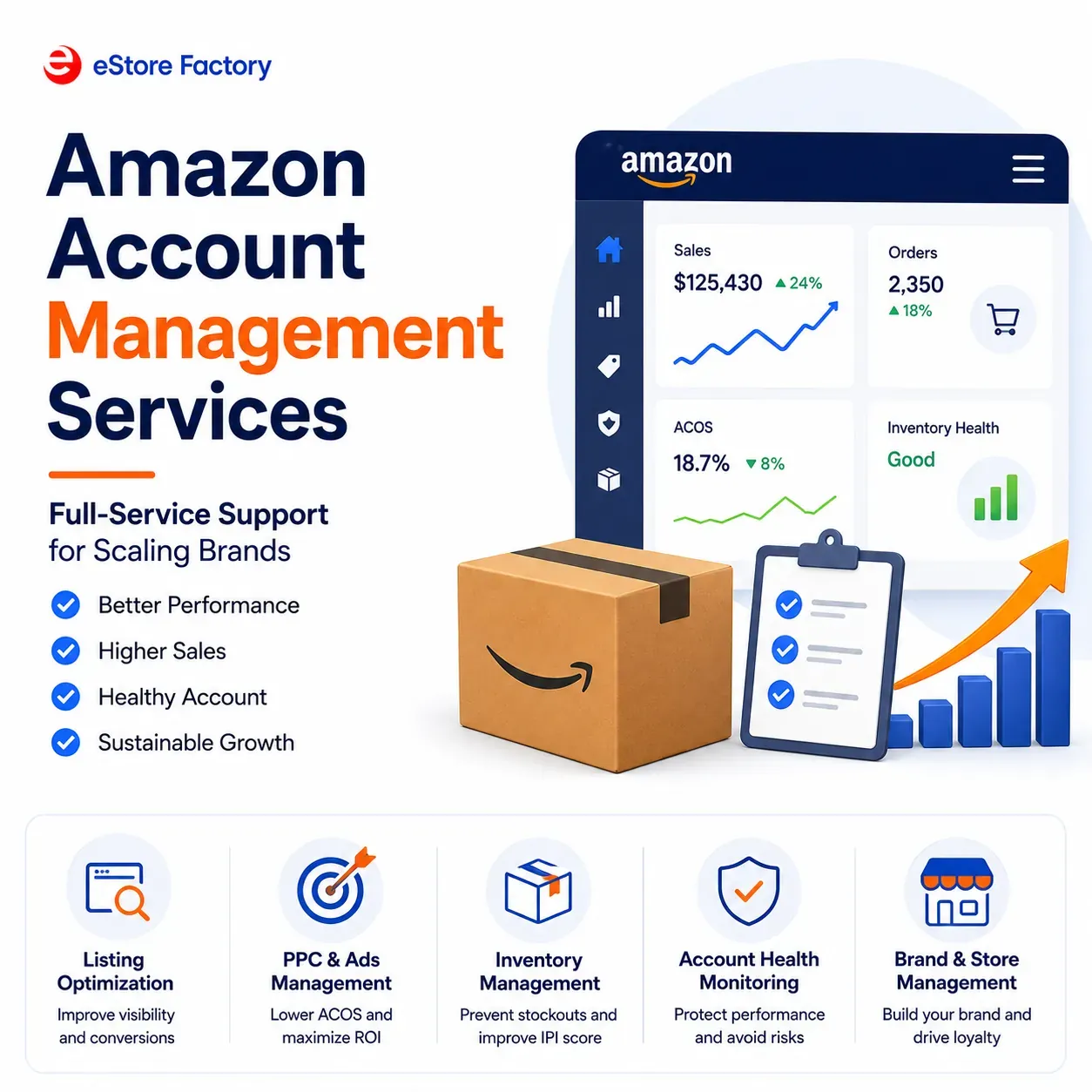
Amazon Account Management Services: Full-Service Support for Scaling Brands
Amazon Account Management Services: Full-Service Support for Scaling Brands
Back to Page
Amazon Marketing
Amazon Account Management Services: Full-Service Support for Scaling Brands
What if the reason your Amazon sales have plateaued has nothing to do with your product? Most sellers pour time into sourcing and pricing, but the real gaps live deeper, in account health, ad structure, inventory controls, and listing quality that slowly decays without anyone noticing. Managing all of this alone is not a strategy. It is a workload that grows faster than one person can handle, and the business pays the price quietly over time. That is where professional Amazon account management becomes less of an option and more of a necessity for brands that are serious about growth.
The brands that scale without constant operational chaos have one thing in common: structured, expert-led Amazon store management covering every layer of their account. eStore Factory works with brands across the US to build exactly that kind of end-to-end operational foundation, so sellers can focus on growth instead of firefighting.
What Actually Happens When You're Managing Your Amazon Account Alone?
Running your own Amazon account feels manageable in the beginning. Orders come in, you handle the listings, adjust bids when you remember to, and respond to customer messages when time allows. But as the catalog grows and sales volume increases, the same approach that worked at the start begins to create visible cracks.
The problem is not effort. The problem is that managing your Amazon business account manually means every task competes for the same limited time and attention. Something always gets pushed to later, and on Amazon, later has a cost.
Here is what typically gets neglected first:
Listing quality declines as competitors update their content and yours stays the same.
Account health metrics like Order Defect Rate and IPI score go unmonitored until Amazon flags them.
Ad spend runs on outdated campaigns with no strategic adjustment, draining budget without improving returns.
Amazon account management at the operational level requires daily attention, not weekly check-ins.
Sellers who reach $30K to $50K in monthly revenue often find that the habits that got them there are the same habits now holding them back.
What Does Full-Service Amazon Store Management Actually Cover?
When sellers hear "account management," most picture someone updating a few listings and checking in once a week. In reality, full-service Amazon store management covers every operational layer that keeps an account healthy, competitive, and growing.
The table below breaks down what professional account management actually includes and why each area directly affects your bottom line.
Service Area | What It Includes | Why It Matters |
Listing Optimization | Titles, bullets, backend keywords, A+ content | Improves search visibility and conversion rate |
Sponsored Ads Management | PPC, DSP, bid strategy, campaign structure | Controls ad spend and improves return on investment |
Account Health Monitoring | ODR, IPI score, policy compliance tracking | Prevents warnings, suspensions, and listing removals |
Amazon Inventory Tracking | Stock level monitoring, reorder alerts, FBA reconciliation | Avoids stockouts and stranded inventory that hurt rankings |
Brand Registry on Amazon | IP protection, storefront setup, enhanced content access | Unlocks seller tools and protects brand integrity |
Why Does Amazon Account Management Break Down at Scale?
There is a specific point in every growing Amazon business where the volume of work stops matching the capacity of the team managing it. It does not happen all at once. It builds gradually until one area of the account starts affecting another, and the compounding effect becomes hard to reverse.
Professional Amazon account management exists precisely because scaling a brand on Amazon is not just about selling more. It is about managing more, with greater precision, across more moving parts than most in-house teams are built to handle.
When Volume Outpaces Visibility
As order volume grows, the operational gaps grow with it. This is where Amazon inventory tracking becomes a core business function, not an afterthought.
A single stockout can erase months of ranking progress, and manual stock checks rarely catch the problem before it happens.
FBA shipment discrepancies often sit unresolved for weeks, and the reimbursements owed never get claimed because no one is actively reconciling them.
Listing content across a growing catalog gets left behind as competitors refresh their pages and yours stays the same.
Policy changes from Amazon rarely come with loud alerts, and unaddressed compliance issues turn into account warnings faster than most sellers expect.
When Ads Run Without a Clear Strategy
Ad spend is usually where a scaling account bleeds money the longest before anyone notices.
Campaigns set up at lower revenue levels rarely get restructured as the catalog expands and budgets increase, so the same inefficiencies just cost more over time.
Search behavior changes over time, and keyword targeting that worked six months ago may now be missing the terms that actually drive purchases.
Most self-managed accounts over-rely on Sponsored Products and never fully activate Sponsored Brands or Display, which means large portions of the buying funnel get no coverage.
When ad performance and organic rankings are managed separately, higher ad spend rarely produces the revenue growth sellers expect from it.
What Should a Reliable Amazon Account Management Agency Actually Deliver?
Not every Amazon account management agency delivers the same depth of service. Some handle what is easy to see, while the real operational gaps keep costing brands money in the background. Before signing with any agency, hold them to these standards:
Proactive Account Health Monitoring: The agency should be watching ODR, IPI, and policy compliance on an ongoing basis, not reaching out after Amazon has already issued a warning.
Full-Funnel Ad Management: Sponsored Products, Sponsored Brands, Display, and DSP all need to work together toward revenue goals, not just focus on bringing ACoS numbers down.
Brand Registry on Amazon: Getting registered is only the starting point. The agency should actively go after listing hijackers, counterfeiters, and unauthorized sellers on an ongoing basis.
Amazon Inventory Tracking: Stock velocity, reorder timelines, and FBA reconciliation should show up in regular reporting, not get treated as someone else's job.
Transparent Performance Reporting: The numbers shared should tell you something meaningful about revenue, conversions, and account health, not just look good on a slide.
Clear Escalation Processes: Account suspensions and policy disputes need fast, structured responses with the right documentation, not generic back-and-forth with seller support.
Dedicated Account Communication: One person who genuinely knows your catalog and history will always outperform a support queue that treats your account as a fresh ticket every time.
How Does eStore Factory's Amazon Account Management Go Beyond the Basics?
Most agencies manage the parts of your account that are easy to see. eStore Factory is built to manage what sits underneath, the operational layers that quietly determine whether a brand scales or stalls. From brand registry on Amazon to full-account oversight, eStore Factory brings 12+ years of hands-on experience and a 3x SPN Award-winning framework to every account it manages.
1. End-to-End Listing Control: Titles, keywords, and A+ pages at eStore Factory get reviewed and updated on a rolling basis. The market shifts, competitors refresh their content, and listings need to keep pace with that, not just get optimized once at the start.
2. Amazon Inventory Tracking Built Into Account Management: Stock velocity, FBA reconciliation, and reorder timelines are part of how eStore Factory monitors every account day to day. By the time a stockout or stranded inventory issue becomes visible, the team has usually already flagged it.
3. Brand Registry as a Growth Tool: Registration is where most agencies stop. eStore Factory uses brand registry on Amazon to go further, pulling in storefront features, brand analytics, and enhanced content that give the brand more control over how it shows up and converts.
4. Dedicated 360° Account Oversight: Listings, ads, inventory, and account health do not get managed as four separate workstreams. At eStore Factory, they are connected under one strategy so the account functions as a whole, not a collection of tasks.
Your Amazon Account Deserves Better Than Guesswork
Scaling an Amazon brand is not just about getting more traffic or running more ads. It requires every part of the account, from listings and inventory to ads and account health, to work together under a structured and consistent management system. That is what separates brands that grow steadily from those that plateau despite putting in the effort.
eStore Factory gives growing brands the full-service Amazon account management support they need to move from reactive to strategic. If your account deserves more than manual oversight and last-minute fixes, now is the right time to work with an Amazon account management agency that manages every layer with the depth your brand requires. Book a free strategy call with eStore Factory today.
FAQs
What does an Amazon account management service include?
How do I know if my Amazon account needs professional management?
What is the role of the brand registry on Amazon?
How does Amazon inventory tracking affect account performance?
Can a small brand benefit from hiring an Amazon account management agency?
What if the reason your Amazon sales have plateaued has nothing to do with your product? Most sellers pour time into sourcing and pricing, but the real gaps live deeper, in account health, ad structure, inventory controls, and listing quality that slowly decays without anyone noticing. Managing all of this alone is not a strategy. It is a workload that grows faster than one person can handle, and the business pays the price quietly over time. That is where professional Amazon account management becomes less of an option and more of a necessity for brands that are serious about growth.
The brands that scale without constant operational chaos have one thing in common: structured, expert-led Amazon store management covering every layer of their account. eStore Factory works with brands across the US to build exactly that kind of end-to-end operational foundation, so sellers can focus on growth instead of firefighting.
What Actually Happens When You're Managing Your Amazon Account Alone?
Running your own Amazon account feels manageable in the beginning. Orders come in, you handle the listings, adjust bids when you remember to, and respond to customer messages when time allows. But as the catalog grows and sales volume increases, the same approach that worked at the start begins to create visible cracks.
The problem is not effort. The problem is that managing your Amazon business account manually means every task competes for the same limited time and attention. Something always gets pushed to later, and on Amazon, later has a cost.
Here is what typically gets neglected first:
Listing quality declines as competitors update their content and yours stays the same.
Account health metrics like Order Defect Rate and IPI score go unmonitored until Amazon flags them.
Ad spend runs on outdated campaigns with no strategic adjustment, draining budget without improving returns.
Amazon account management at the operational level requires daily attention, not weekly check-ins.
Sellers who reach $30K to $50K in monthly revenue often find that the habits that got them there are the same habits now holding them back.
What Does Full-Service Amazon Store Management Actually Cover?
When sellers hear "account management," most picture someone updating a few listings and checking in once a week. In reality, full-service Amazon store management covers every operational layer that keeps an account healthy, competitive, and growing.
The table below breaks down what professional account management actually includes and why each area directly affects your bottom line.
Service Area | What It Includes | Why It Matters |
Listing Optimization | Titles, bullets, backend keywords, A+ content | Improves search visibility and conversion rate |
Sponsored Ads Management | PPC, DSP, bid strategy, campaign structure | Controls ad spend and improves return on investment |
Account Health Monitoring | ODR, IPI score, policy compliance tracking | Prevents warnings, suspensions, and listing removals |
Amazon Inventory Tracking | Stock level monitoring, reorder alerts, FBA reconciliation | Avoids stockouts and stranded inventory that hurt rankings |
Brand Registry on Amazon | IP protection, storefront setup, enhanced content access | Unlocks seller tools and protects brand integrity |
Why Does Amazon Account Management Break Down at Scale?
There is a specific point in every growing Amazon business where the volume of work stops matching the capacity of the team managing it. It does not happen all at once. It builds gradually until one area of the account starts affecting another, and the compounding effect becomes hard to reverse.
Professional Amazon account management exists precisely because scaling a brand on Amazon is not just about selling more. It is about managing more, with greater precision, across more moving parts than most in-house teams are built to handle.
When Volume Outpaces Visibility
As order volume grows, the operational gaps grow with it. This is where Amazon inventory tracking becomes a core business function, not an afterthought.
A single stockout can erase months of ranking progress, and manual stock checks rarely catch the problem before it happens.
FBA shipment discrepancies often sit unresolved for weeks, and the reimbursements owed never get claimed because no one is actively reconciling them.
Listing content across a growing catalog gets left behind as competitors refresh their pages and yours stays the same.
Policy changes from Amazon rarely come with loud alerts, and unaddressed compliance issues turn into account warnings faster than most sellers expect.
When Ads Run Without a Clear Strategy
Ad spend is usually where a scaling account bleeds money the longest before anyone notices.
Campaigns set up at lower revenue levels rarely get restructured as the catalog expands and budgets increase, so the same inefficiencies just cost more over time.
Search behavior changes over time, and keyword targeting that worked six months ago may now be missing the terms that actually drive purchases.
Most self-managed accounts over-rely on Sponsored Products and never fully activate Sponsored Brands or Display, which means large portions of the buying funnel get no coverage.
When ad performance and organic rankings are managed separately, higher ad spend rarely produces the revenue growth sellers expect from it.
What Should a Reliable Amazon Account Management Agency Actually Deliver?
Not every Amazon account management agency delivers the same depth of service. Some handle what is easy to see, while the real operational gaps keep costing brands money in the background. Before signing with any agency, hold them to these standards:
Proactive Account Health Monitoring: The agency should be watching ODR, IPI, and policy compliance on an ongoing basis, not reaching out after Amazon has already issued a warning.
Full-Funnel Ad Management: Sponsored Products, Sponsored Brands, Display, and DSP all need to work together toward revenue goals, not just focus on bringing ACoS numbers down.
Brand Registry on Amazon: Getting registered is only the starting point. The agency should actively go after listing hijackers, counterfeiters, and unauthorized sellers on an ongoing basis.
Amazon Inventory Tracking: Stock velocity, reorder timelines, and FBA reconciliation should show up in regular reporting, not get treated as someone else's job.
Transparent Performance Reporting: The numbers shared should tell you something meaningful about revenue, conversions, and account health, not just look good on a slide.
Clear Escalation Processes: Account suspensions and policy disputes need fast, structured responses with the right documentation, not generic back-and-forth with seller support.
Dedicated Account Communication: One person who genuinely knows your catalog and history will always outperform a support queue that treats your account as a fresh ticket every time.
How Does eStore Factory's Amazon Account Management Go Beyond the Basics?
Most agencies manage the parts of your account that are easy to see. eStore Factory is built to manage what sits underneath, the operational layers that quietly determine whether a brand scales or stalls. From brand registry on Amazon to full-account oversight, eStore Factory brings 12+ years of hands-on experience and a 3x SPN Award-winning framework to every account it manages.
1. End-to-End Listing Control: Titles, keywords, and A+ pages at eStore Factory get reviewed and updated on a rolling basis. The market shifts, competitors refresh their content, and listings need to keep pace with that, not just get optimized once at the start.
2. Amazon Inventory Tracking Built Into Account Management: Stock velocity, FBA reconciliation, and reorder timelines are part of how eStore Factory monitors every account day to day. By the time a stockout or stranded inventory issue becomes visible, the team has usually already flagged it.
3. Brand Registry as a Growth Tool: Registration is where most agencies stop. eStore Factory uses brand registry on Amazon to go further, pulling in storefront features, brand analytics, and enhanced content that give the brand more control over how it shows up and converts.
4. Dedicated 360° Account Oversight: Listings, ads, inventory, and account health do not get managed as four separate workstreams. At eStore Factory, they are connected under one strategy so the account functions as a whole, not a collection of tasks.
Your Amazon Account Deserves Better Than Guesswork
Scaling an Amazon brand is not just about getting more traffic or running more ads. It requires every part of the account, from listings and inventory to ads and account health, to work together under a structured and consistent management system. That is what separates brands that grow steadily from those that plateau despite putting in the effort.
eStore Factory gives growing brands the full-service Amazon account management support they need to move from reactive to strategic. If your account deserves more than manual oversight and last-minute fixes, now is the right time to work with an Amazon account management agency that manages every layer with the depth your brand requires. Book a free strategy call with eStore Factory today.
FAQs
What does an Amazon account management service include?
How do I know if my Amazon account needs professional management?
What is the role of the brand registry on Amazon?
How does Amazon inventory tracking affect account performance?
Can a small brand benefit from hiring an Amazon account management agency?
What if the reason your Amazon sales have plateaued has nothing to do with your product? Most sellers pour time into sourcing and pricing, but the real gaps live deeper, in account health, ad structure, inventory controls, and listing quality that slowly decays without anyone noticing. Managing all of this alone is not a strategy. It is a workload that grows faster than one person can handle, and the business pays the price quietly over time. That is where professional Amazon account management becomes less of an option and more of a necessity for brands that are serious about growth.
The brands that scale without constant operational chaos have one thing in common: structured, expert-led Amazon store management covering every layer of their account. eStore Factory works with brands across the US to build exactly that kind of end-to-end operational foundation, so sellers can focus on growth instead of firefighting.
What Actually Happens When You're Managing Your Amazon Account Alone?
Running your own Amazon account feels manageable in the beginning. Orders come in, you handle the listings, adjust bids when you remember to, and respond to customer messages when time allows. But as the catalog grows and sales volume increases, the same approach that worked at the start begins to create visible cracks.
The problem is not effort. The problem is that managing your Amazon business account manually means every task competes for the same limited time and attention. Something always gets pushed to later, and on Amazon, later has a cost.
Here is what typically gets neglected first:
Listing quality declines as competitors update their content and yours stays the same.
Account health metrics like Order Defect Rate and IPI score go unmonitored until Amazon flags them.
Ad spend runs on outdated campaigns with no strategic adjustment, draining budget without improving returns.
Amazon account management at the operational level requires daily attention, not weekly check-ins.
Sellers who reach $30K to $50K in monthly revenue often find that the habits that got them there are the same habits now holding them back.
What Does Full-Service Amazon Store Management Actually Cover?
When sellers hear "account management," most picture someone updating a few listings and checking in once a week. In reality, full-service Amazon store management covers every operational layer that keeps an account healthy, competitive, and growing.
The table below breaks down what professional account management actually includes and why each area directly affects your bottom line.
Service Area | What It Includes | Why It Matters |
Listing Optimization | Titles, bullets, backend keywords, A+ content | Improves search visibility and conversion rate |
Sponsored Ads Management | PPC, DSP, bid strategy, campaign structure | Controls ad spend and improves return on investment |
Account Health Monitoring | ODR, IPI score, policy compliance tracking | Prevents warnings, suspensions, and listing removals |
Amazon Inventory Tracking | Stock level monitoring, reorder alerts, FBA reconciliation | Avoids stockouts and stranded inventory that hurt rankings |
Brand Registry on Amazon | IP protection, storefront setup, enhanced content access | Unlocks seller tools and protects brand integrity |
Why Does Amazon Account Management Break Down at Scale?
There is a specific point in every growing Amazon business where the volume of work stops matching the capacity of the team managing it. It does not happen all at once. It builds gradually until one area of the account starts affecting another, and the compounding effect becomes hard to reverse.
Professional Amazon account management exists precisely because scaling a brand on Amazon is not just about selling more. It is about managing more, with greater precision, across more moving parts than most in-house teams are built to handle.
When Volume Outpaces Visibility
As order volume grows, the operational gaps grow with it. This is where Amazon inventory tracking becomes a core business function, not an afterthought.
A single stockout can erase months of ranking progress, and manual stock checks rarely catch the problem before it happens.
FBA shipment discrepancies often sit unresolved for weeks, and the reimbursements owed never get claimed because no one is actively reconciling them.
Listing content across a growing catalog gets left behind as competitors refresh their pages and yours stays the same.
Policy changes from Amazon rarely come with loud alerts, and unaddressed compliance issues turn into account warnings faster than most sellers expect.
When Ads Run Without a Clear Strategy
Ad spend is usually where a scaling account bleeds money the longest before anyone notices.
Campaigns set up at lower revenue levels rarely get restructured as the catalog expands and budgets increase, so the same inefficiencies just cost more over time.
Search behavior changes over time, and keyword targeting that worked six months ago may now be missing the terms that actually drive purchases.
Most self-managed accounts over-rely on Sponsored Products and never fully activate Sponsored Brands or Display, which means large portions of the buying funnel get no coverage.
When ad performance and organic rankings are managed separately, higher ad spend rarely produces the revenue growth sellers expect from it.
What Should a Reliable Amazon Account Management Agency Actually Deliver?
Not every Amazon account management agency delivers the same depth of service. Some handle what is easy to see, while the real operational gaps keep costing brands money in the background. Before signing with any agency, hold them to these standards:
Proactive Account Health Monitoring: The agency should be watching ODR, IPI, and policy compliance on an ongoing basis, not reaching out after Amazon has already issued a warning.
Full-Funnel Ad Management: Sponsored Products, Sponsored Brands, Display, and DSP all need to work together toward revenue goals, not just focus on bringing ACoS numbers down.
Brand Registry on Amazon: Getting registered is only the starting point. The agency should actively go after listing hijackers, counterfeiters, and unauthorized sellers on an ongoing basis.
Amazon Inventory Tracking: Stock velocity, reorder timelines, and FBA reconciliation should show up in regular reporting, not get treated as someone else's job.
Transparent Performance Reporting: The numbers shared should tell you something meaningful about revenue, conversions, and account health, not just look good on a slide.
Clear Escalation Processes: Account suspensions and policy disputes need fast, structured responses with the right documentation, not generic back-and-forth with seller support.
Dedicated Account Communication: One person who genuinely knows your catalog and history will always outperform a support queue that treats your account as a fresh ticket every time.
How Does eStore Factory's Amazon Account Management Go Beyond the Basics?
Most agencies manage the parts of your account that are easy to see. eStore Factory is built to manage what sits underneath, the operational layers that quietly determine whether a brand scales or stalls. From brand registry on Amazon to full-account oversight, eStore Factory brings 12+ years of hands-on experience and a 3x SPN Award-winning framework to every account it manages.
1. End-to-End Listing Control: Titles, keywords, and A+ pages at eStore Factory get reviewed and updated on a rolling basis. The market shifts, competitors refresh their content, and listings need to keep pace with that, not just get optimized once at the start.
2. Amazon Inventory Tracking Built Into Account Management: Stock velocity, FBA reconciliation, and reorder timelines are part of how eStore Factory monitors every account day to day. By the time a stockout or stranded inventory issue becomes visible, the team has usually already flagged it.
3. Brand Registry as a Growth Tool: Registration is where most agencies stop. eStore Factory uses brand registry on Amazon to go further, pulling in storefront features, brand analytics, and enhanced content that give the brand more control over how it shows up and converts.
4. Dedicated 360° Account Oversight: Listings, ads, inventory, and account health do not get managed as four separate workstreams. At eStore Factory, they are connected under one strategy so the account functions as a whole, not a collection of tasks.
Your Amazon Account Deserves Better Than Guesswork
Scaling an Amazon brand is not just about getting more traffic or running more ads. It requires every part of the account, from listings and inventory to ads and account health, to work together under a structured and consistent management system. That is what separates brands that grow steadily from those that plateau despite putting in the effort.
eStore Factory gives growing brands the full-service Amazon account management support they need to move from reactive to strategic. If your account deserves more than manual oversight and last-minute fixes, now is the right time to work with an Amazon account management agency that manages every layer with the depth your brand requires. Book a free strategy call with eStore Factory today.
FAQs
What does an Amazon account management service include?
How do I know if my Amazon account needs professional management?
What is the role of the brand registry on Amazon?
How does Amazon inventory tracking affect account performance?
Can a small brand benefit from hiring an Amazon account management agency?





eStore Factory is a full-service agency for Amazon Sellers dedicated to building end-to-end strategies for brands of all sizes.


SERVICES FOR AMAZON
Product Setup ON AMAZON
GRAPHICS & BRANDING SERVICES
PPC MANAGEMENT
© Copyright 2014 - 2026. All Rights Reserved.
eStore Factory is a full-service agency for Amazon Sellers dedicated to building end-to-end strategies for brands of all sizes.
SERVICES FOR AMAZON
Product Setup ON AMAZON
GRAPHICS & BRANDING SERVICES
PPC MANAGEMENT
© Copyright 2014 - 2026. All Rights Reserved.
eStore Factory is a full-service agency for Amazon Sellers dedicated to building end-to-end strategies for brands of all sizes.
SERVICES FOR AMAZON
Product Setup ON AMAZON
GRAPHICS & BRANDING SERVICES
PPC MANAGEMENT
© Copyright 2014 - 2026. All Rights Reserved.