

Back to Page
Amazon Accounts Suspension
Amazon account suspension in 2026: The complete guide to appeals, reinstatement, and prevention
Amazon account suspension in 2026: The complete guide to appeals, reinstatement, and prevention

Back to Page
Amazon Accounts Suspension
Amazon account suspension in 2026: The complete guide to appeals, reinstatement, and prevention
TL;DR
Amazon account suspensions in 2026 are increasing due to stricter AI monitoring, and most suspensions are triggered by performance metrics, policy violations, or product authenticity issues.
The most common causes include a high Order Defect Rate above 1%, Late Shipment Rate above 4%, intellectual property complaints, review manipulation, related accounts, and restricted category violations.
A strong Plan of Action must clearly explain the root cause, the corrective actions already taken, and the preventive measures implemented, with specific details and supporting documents.
Poorly written appeals that blame Amazon, use vague promises, or copy generic templates are often rejected and can delay reinstatement.
Suspension length depends on violation severity, appeal quality, account history, and Amazon’s review queue, with well-prepared appeals sometimes reinstated within 24 to 48 hours.
Preventing suspension requires consistent monitoring of account health metrics, maintaining proper supplier documentation, auditing listings regularly, avoiding review manipulation, and responding quickly to customer issues.
Getting hit with an Amazon account suspension is one of the most stressful things a seller can experience. One day you're processing orders, the next your entire business is experiencing no sales, no visibility, no cash flow.
With over 9.7 million sellers worldwide on Amazon and increasingly aggressive AI-driven enforcement, suspensions are becoming more frequent in 2026 than ever before. This guide covers exactly why Amazon suspends seller accounts, how the appeal process works, and practical steps you can take to protect your business.
Why did Amazon suspend my seller account?
Amazon doesn't suspend accounts randomly. Every suspension occurred due to performance failures, policy violations, or restricted product issues. Here's the reality: Amazon's algorithm monitors your account around the clock.
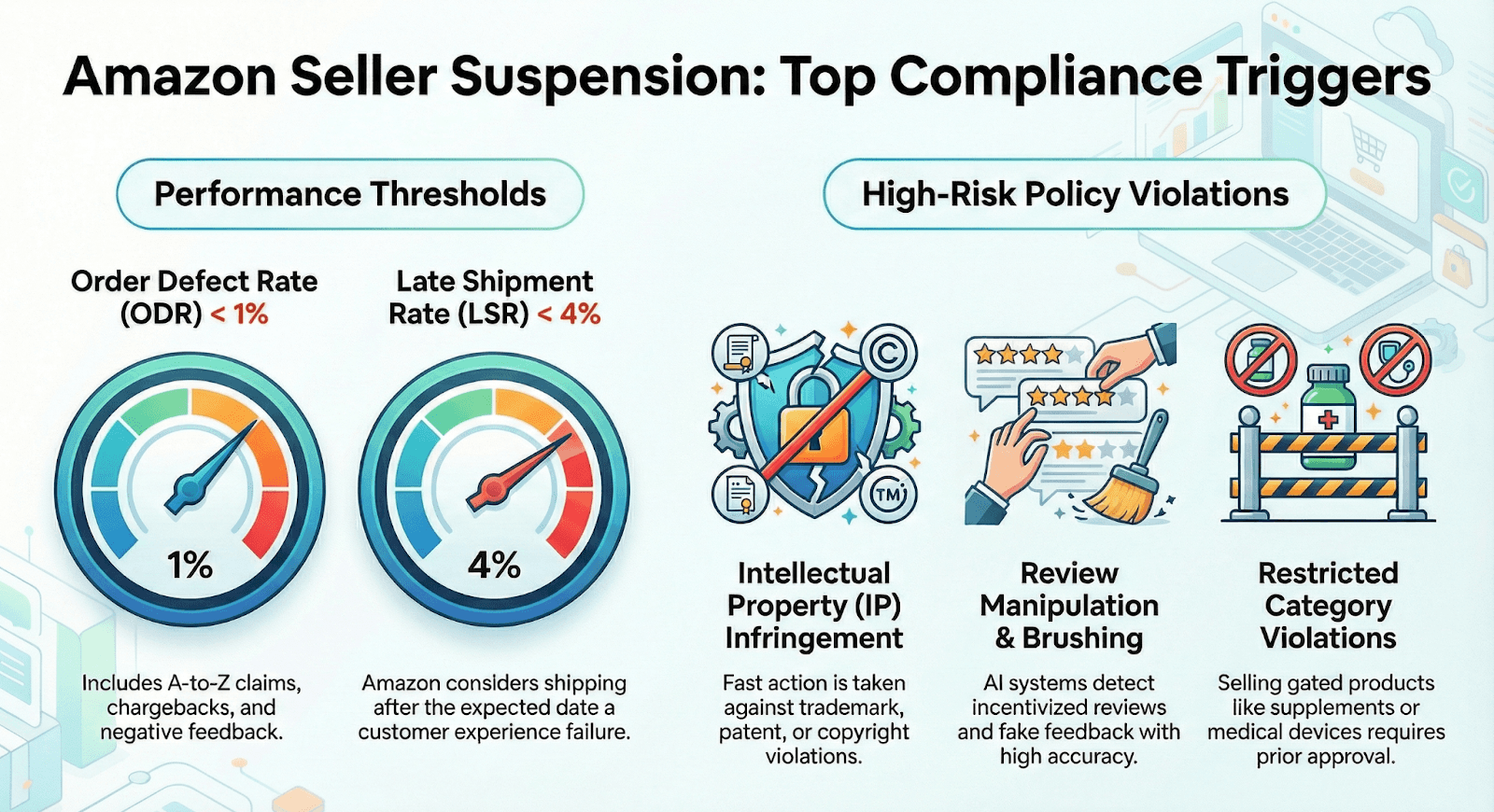
It tracks metrics, flags buyer complaints, and cross-references your activity against a growing list of policy rules. When something triggers the system, even if it's a misunderstanding, the default response is to restrict first and investigate later. The most common reasons for Amazon account deactivation include:
Poor Order Defect Rate (ODR): Amazon requires your ODR to stay below 1%. It includes A-to-Z Guarantee claims, chargebacks, and negative feedback. Cross that threshold, and your account gets flagged immediately.
Late Shipment Rate (LSR): If more than 4% of your orders ship after the expected date, Amazon views that as a customer experience failure.
Product complaints: Even a handful of buyer complaints claiming your product is "not as described" or "inauthentic" can trigger a suspension, whether the claims are legitimate or not.
Intellectual Property Violations: Selling products that infringe on trademarks, patents, or copyrights leads to fast action by Amazon's Counterfeit Crimes Unit.
Related Account Violations: Amazon's systems now use advanced IP and activity matching to detect linked accounts. If you're operating multiple seller accounts without approval, that's a suspension trigger.
Review manipulation: Incentivized reviews, fake feedback, and "brushing" schemes are detected by Amazon's AI with increasing accuracy.
Restricted category violations: Selling in gated categories (supplements, medical devices, pesticides, etc.) without proper approvals leads to immediate listing suppression or full account suspension.
How long does an Amazon seller account suspension last?
An Amazon account suspension can last anywhere from a few days to several months, and in worst-case scenarios, it can become permanent. Here's what determines the duration:
Severity of the violation. A late shipment rate issue resolves faster than a counterfeit complaint.
Quality of your appeal. A well-structured Plan of Action can get you reinstated in 24 to 48 hours. A vague, emotional appeal can extend the process by weeks.
Your account history. First-time issues are treated differently from repeat violations.
Amazon's review queue. During peak seasons (Q4 especially), response times stretch. Outside of peak, most sellers hear back within 2 to 7 business days on their initial appeal.
For sellers doing $10K+ monthly, even a one-week suspension represents significant lost income and, potentially, a drop in organic rankings that takes weeks to recover from.
What is a plan of action for the Amazon suspension?
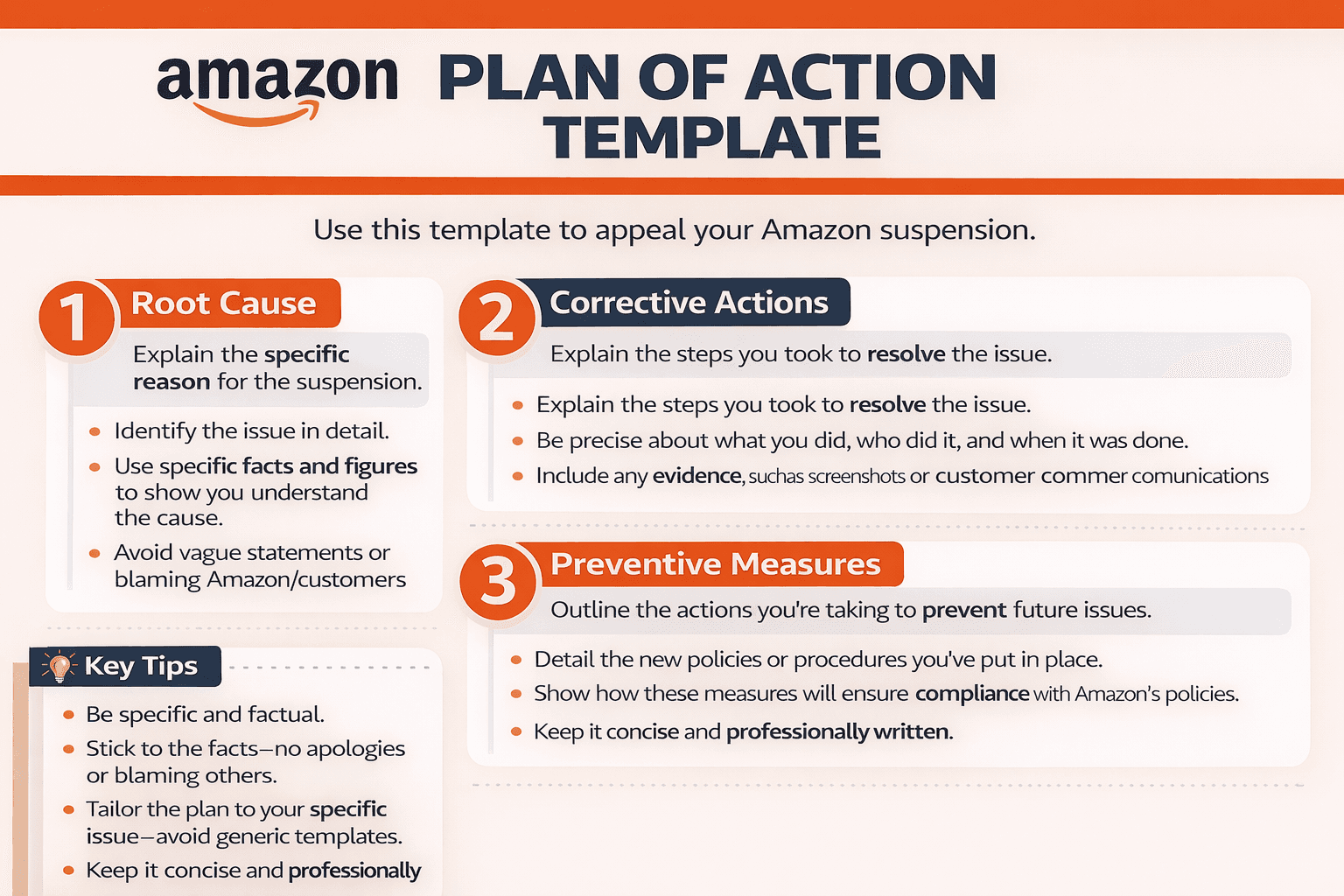
A Plan of Action (POA) is the formal document Amazon requires when you appeal a suspension. Think of it as your case to Amazon explaining three things:
Root cause: What specifically caused the issue
Corrective actions: What you've already done to fix it
Preventive measures: What systems have you put in place to ensure it never happens again
This isn't a place for apologies or emotional pleas. Amazon's Seller Performance team reviews thousands of appeals. They want clear, factual, structured responses. Using a solid Amazon plan of action template helps, but the key is specificity.
What gets your appeal rejected:
Blaming Amazon or customers
Vague statements like "we'll do better" or "it won't happen again"
Copying a generic template without tailoring it to your specific violation
Submitting multiple appeals in rapid succession without meaningful changes
Your POA is your one shot to demonstrate professionalism and operational competence. Treat it that way.
Amazon plan of action template
How do I write an Amazon appeal letter for an Amazon account suspension?
Your Amazon appeal letter is framed around your plan of action. While the POA covers the what and how, the appeal letter sets the tone and context. Here's a structure that works:
Opening: State your seller account name, the suspension notification date, and the specific ASIN(s) or policy cited. Don't waste space on pleasantries.
Acknowledgment: Briefly acknowledge the issue. This shows Amazon you've read and understood the notification, not that you're guessing.
Plan of action: Present your root cause, corrective actions, and preventive measures (as outlined above).
Closing: Request reinstatement directly. Reaffirm your commitment to Amazon's policies and the customer experience.
Formatting tips that matter:
Keep it under one page for better scanning.
Use bullet points for your POA sections and don't bury your fixes in long paragraphs.
Attach documents like invoices, shipping records, and supplier authorizations
Proofread. Typos and disorganized formatting undermine your credibility.
What are the common reasons for Amazon account deactivation?
#1 Supply chain documentation gaps
Amazon may ask you to verify product authenticity at any time. If you can't produce invoices from authorized distributors within the required timeframe, your listings get pulled, and sometimes your entire account.
#2 Listing policy violations
It includes everything from prohibited claims in your bullet points (medical claims, unapproved certifications) to incorrect variation structures or manipulated product categories. Amazon's zero-tolerance approach to listing violations is intensifying in 2026, where small mistakes carry much bigger consequences.
#3 Customer complaint patterns
A spike in A-to-Z claims, returns with reason codes like "item not as described," or negative seller feedback creates a pattern that Amazon's algorithm flags automatically. Selling used products as new, even if the product is technically new but arrives in damaged packaging or with missing accessories, buyer complaints can trigger an "item condition" suspension.
Operating in Violation of Amazon's Terms of Service. It covers everything from having someone else manage your account without proper authorization to operating from a sanctioned country. Amazon protects the buyer experience above everything else. So, the behavior or pattern that threatens that trust triggers enforcement.
How to prevent an Amazon seller suspension?
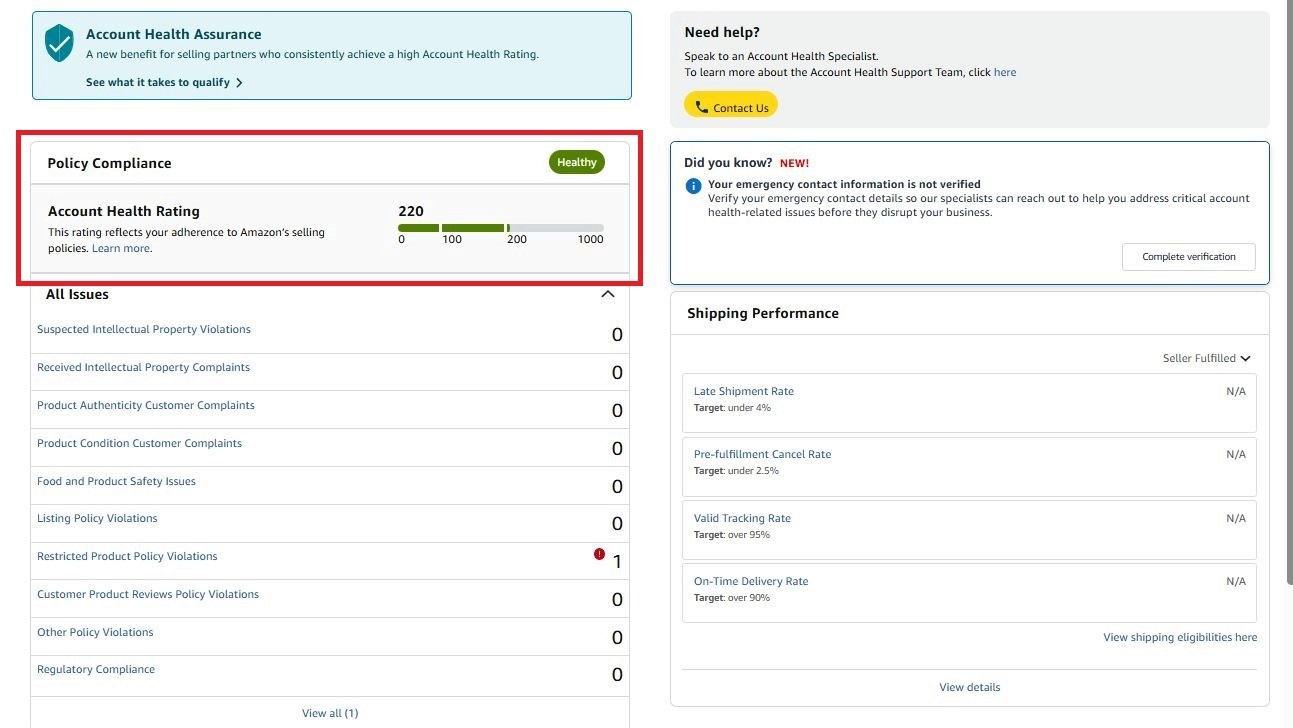
Sellers need to monitor their account health dashboard weekly. Amazon provides an Account Health Rating (AHR) score. Stay above 200 to be in good standing. Check your ODR (keep it below 1%), Late Shipment Rate (below 4%), Pre-Fulfillment Cancel Rate (below 2.5%), and Valid Tracking Rate (above 95%).
Keep your supply chain documentation airtight. Maintain invoices from authorized suppliers that match your ASIN catalog. Amazon can request these at any time, and you typically have limited time to respond.
Audit your listings regularly. Check for suppressed listings, policy compliance warnings, and category-specific requirements. What was compliant six months ago may not be today, and Amazon updates its policies frequently.
Don't cut corners on reviews. No incentivized reviews, no review manipulation services, no asking friends and family. Amazon's AI detection is more sophisticated than most sellers realize, and the penalties are severe.
Use FBA strategically. Fulfillment by Amazon handles shipping performance for you, which eliminates LSR and delivery-related risk. If you're FBM (Fulfillment by Merchant), invest in reliable carriers and real-time tracking.
Stay current on policy changes. Amazon updates its Terms of Service, category requirements, and seller policies regularly. Subscribe to Seller Central announcements and follow Amazon's official news channels.
Respond to customer issues quickly. Most A-to-Z claims and negative feedback situations can be resolved before they impact your metrics if you catch them early and respond within 24 hours. Knowing how to prevent Amazon account suspension comes down to consistent monitoring, proper documentation, and fast responses to any account health alerts.
Wrap up
Dealing with an Amazon account suspension is time-sensitive, and the stakes are high. Every day your account is down, you're losing revenue, organic ranking, and potentially your Buy Box position.
eStore Factory's amazon account health management experts specializes in seller account reinstatement from diagnosing the root cause of your suspension to managing the full appeal process. We've worked with sellers across the US, Canada, UK, and Australia who needed expert support to get their accounts back on track and keep them healthy long-term.
Contact us today and we will assess your situation and give you a clear path forward.
FAQs
How do I check my Amazon account health?
Log in to Seller Central and navigate to Performance > Account Health. This dashboard shows your overall Account Health Rating (AHR). Amazon recommends keeping your AHR above 200. Review it at least weekly, don't wait for a warning notification.
How do I get my Amazon seller account reactivated?
Submit a Plan of Action. Your POA must include the root cause of the issue, what corrective actions you've taken, and what preventive measures you've implemented. Attach supporting documentation, and if your first appeal is denied, revise your POA with more specifics before resubmitting.
Can I open a new Amazon seller account after being suspended?
No, opening a new account after a suspension is considered a "related account" violation and typically results in that new account being suspended as well. Amazon's systems track device fingerprints, IP addresses, bank account information, and other identifiers. The recommended path is always to appeal and reinstate your original account.
What happens to my funds when Amazon suspends my account?
According to Amazon's policy, funds are held for a 90-day settlement period following account deactivation. During this period, the balance covers potential customer refunds, chargebacks, and A-to-Z claims. After 90 days, you can request disbursement of remaining funds. If your account is reinstated before the 90 days, normal disbursement schedules resume.
TL;DR
Amazon account suspensions in 2026 are increasing due to stricter AI monitoring, and most suspensions are triggered by performance metrics, policy violations, or product authenticity issues.
The most common causes include a high Order Defect Rate above 1%, Late Shipment Rate above 4%, intellectual property complaints, review manipulation, related accounts, and restricted category violations.
A strong Plan of Action must clearly explain the root cause, the corrective actions already taken, and the preventive measures implemented, with specific details and supporting documents.
Poorly written appeals that blame Amazon, use vague promises, or copy generic templates are often rejected and can delay reinstatement.
Suspension length depends on violation severity, appeal quality, account history, and Amazon’s review queue, with well-prepared appeals sometimes reinstated within 24 to 48 hours.
Preventing suspension requires consistent monitoring of account health metrics, maintaining proper supplier documentation, auditing listings regularly, avoiding review manipulation, and responding quickly to customer issues.
Getting hit with an Amazon account suspension is one of the most stressful things a seller can experience. One day you're processing orders, the next your entire business is experiencing no sales, no visibility, no cash flow.
With over 9.7 million sellers worldwide on Amazon and increasingly aggressive AI-driven enforcement, suspensions are becoming more frequent in 2026 than ever before. This guide covers exactly why Amazon suspends seller accounts, how the appeal process works, and practical steps you can take to protect your business.
Why did Amazon suspend my seller account?
Amazon doesn't suspend accounts randomly. Every suspension occurred due to performance failures, policy violations, or restricted product issues. Here's the reality: Amazon's algorithm monitors your account around the clock.
It tracks metrics, flags buyer complaints, and cross-references your activity against a growing list of policy rules. When something triggers the system, even if it's a misunderstanding, the default response is to restrict first and investigate later. The most common reasons for Amazon account deactivation include:
Poor Order Defect Rate (ODR): Amazon requires your ODR to stay below 1%. It includes A-to-Z Guarantee claims, chargebacks, and negative feedback. Cross that threshold, and your account gets flagged immediately.
Late Shipment Rate (LSR): If more than 4% of your orders ship after the expected date, Amazon views that as a customer experience failure.
Product complaints: Even a handful of buyer complaints claiming your product is "not as described" or "inauthentic" can trigger a suspension, whether the claims are legitimate or not.
Intellectual Property Violations: Selling products that infringe on trademarks, patents, or copyrights leads to fast action by Amazon's Counterfeit Crimes Unit.
Related Account Violations: Amazon's systems now use advanced IP and activity matching to detect linked accounts. If you're operating multiple seller accounts without approval, that's a suspension trigger.
Review manipulation: Incentivized reviews, fake feedback, and "brushing" schemes are detected by Amazon's AI with increasing accuracy.
Restricted category violations: Selling in gated categories (supplements, medical devices, pesticides, etc.) without proper approvals leads to immediate listing suppression or full account suspension.
How long does an Amazon seller account suspension last?
An Amazon account suspension can last anywhere from a few days to several months, and in worst-case scenarios, it can become permanent. Here's what determines the duration:
Severity of the violation. A late shipment rate issue resolves faster than a counterfeit complaint.
Quality of your appeal. A well-structured Plan of Action can get you reinstated in 24 to 48 hours. A vague, emotional appeal can extend the process by weeks.
Your account history. First-time issues are treated differently from repeat violations.
Amazon's review queue. During peak seasons (Q4 especially), response times stretch. Outside of peak, most sellers hear back within 2 to 7 business days on their initial appeal.
For sellers doing $10K+ monthly, even a one-week suspension represents significant lost income and, potentially, a drop in organic rankings that takes weeks to recover from.
What is a plan of action for the Amazon suspension?
A Plan of Action (POA) is the formal document Amazon requires when you appeal a suspension. Think of it as your case to Amazon explaining three things:
Root cause: What specifically caused the issue
Corrective actions: What you've already done to fix it
Preventive measures: What systems have you put in place to ensure it never happens again
This isn't a place for apologies or emotional pleas. Amazon's Seller Performance team reviews thousands of appeals. They want clear, factual, structured responses. Using a solid Amazon plan of action template helps, but the key is specificity.
What gets your appeal rejected:
Blaming Amazon or customers
Vague statements like "we'll do better" or "it won't happen again"
Copying a generic template without tailoring it to your specific violation
Submitting multiple appeals in rapid succession without meaningful changes
Your POA is your one shot to demonstrate professionalism and operational competence. Treat it that way.
Amazon plan of action template
How do I write an Amazon appeal letter for an Amazon account suspension?
Your Amazon appeal letter is framed around your plan of action. While the POA covers the what and how, the appeal letter sets the tone and context. Here's a structure that works:
Opening: State your seller account name, the suspension notification date, and the specific ASIN(s) or policy cited. Don't waste space on pleasantries.
Acknowledgment: Briefly acknowledge the issue. This shows Amazon you've read and understood the notification, not that you're guessing.
Plan of action: Present your root cause, corrective actions, and preventive measures (as outlined above).
Closing: Request reinstatement directly. Reaffirm your commitment to Amazon's policies and the customer experience.
Formatting tips that matter:
Keep it under one page for better scanning.
Use bullet points for your POA sections and don't bury your fixes in long paragraphs.
Attach documents like invoices, shipping records, and supplier authorizations
Proofread. Typos and disorganized formatting undermine your credibility.
What are the common reasons for Amazon account deactivation?
#1 Supply chain documentation gaps
Amazon may ask you to verify product authenticity at any time. If you can't produce invoices from authorized distributors within the required timeframe, your listings get pulled, and sometimes your entire account.
#2 Listing policy violations
It includes everything from prohibited claims in your bullet points (medical claims, unapproved certifications) to incorrect variation structures or manipulated product categories. Amazon's zero-tolerance approach to listing violations is intensifying in 2026, where small mistakes carry much bigger consequences.
#3 Customer complaint patterns
A spike in A-to-Z claims, returns with reason codes like "item not as described," or negative seller feedback creates a pattern that Amazon's algorithm flags automatically. Selling used products as new, even if the product is technically new but arrives in damaged packaging or with missing accessories, buyer complaints can trigger an "item condition" suspension.
Operating in Violation of Amazon's Terms of Service. It covers everything from having someone else manage your account without proper authorization to operating from a sanctioned country. Amazon protects the buyer experience above everything else. So, the behavior or pattern that threatens that trust triggers enforcement.
How to prevent an Amazon seller suspension?
Sellers need to monitor their account health dashboard weekly. Amazon provides an Account Health Rating (AHR) score. Stay above 200 to be in good standing. Check your ODR (keep it below 1%), Late Shipment Rate (below 4%), Pre-Fulfillment Cancel Rate (below 2.5%), and Valid Tracking Rate (above 95%).
Keep your supply chain documentation airtight. Maintain invoices from authorized suppliers that match your ASIN catalog. Amazon can request these at any time, and you typically have limited time to respond.
Audit your listings regularly. Check for suppressed listings, policy compliance warnings, and category-specific requirements. What was compliant six months ago may not be today, and Amazon updates its policies frequently.
Don't cut corners on reviews. No incentivized reviews, no review manipulation services, no asking friends and family. Amazon's AI detection is more sophisticated than most sellers realize, and the penalties are severe.
Use FBA strategically. Fulfillment by Amazon handles shipping performance for you, which eliminates LSR and delivery-related risk. If you're FBM (Fulfillment by Merchant), invest in reliable carriers and real-time tracking.
Stay current on policy changes. Amazon updates its Terms of Service, category requirements, and seller policies regularly. Subscribe to Seller Central announcements and follow Amazon's official news channels.
Respond to customer issues quickly. Most A-to-Z claims and negative feedback situations can be resolved before they impact your metrics if you catch them early and respond within 24 hours. Knowing how to prevent Amazon account suspension comes down to consistent monitoring, proper documentation, and fast responses to any account health alerts.
Wrap up
Dealing with an Amazon account suspension is time-sensitive, and the stakes are high. Every day your account is down, you're losing revenue, organic ranking, and potentially your Buy Box position.
eStore Factory's amazon account health management experts specializes in seller account reinstatement from diagnosing the root cause of your suspension to managing the full appeal process. We've worked with sellers across the US, Canada, UK, and Australia who needed expert support to get their accounts back on track and keep them healthy long-term.
Contact us today and we will assess your situation and give you a clear path forward.
FAQs
How do I check my Amazon account health?
Log in to Seller Central and navigate to Performance > Account Health. This dashboard shows your overall Account Health Rating (AHR). Amazon recommends keeping your AHR above 200. Review it at least weekly, don't wait for a warning notification.
How do I get my Amazon seller account reactivated?
Submit a Plan of Action. Your POA must include the root cause of the issue, what corrective actions you've taken, and what preventive measures you've implemented. Attach supporting documentation, and if your first appeal is denied, revise your POA with more specifics before resubmitting.
Can I open a new Amazon seller account after being suspended?
No, opening a new account after a suspension is considered a "related account" violation and typically results in that new account being suspended as well. Amazon's systems track device fingerprints, IP addresses, bank account information, and other identifiers. The recommended path is always to appeal and reinstate your original account.
What happens to my funds when Amazon suspends my account?
According to Amazon's policy, funds are held for a 90-day settlement period following account deactivation. During this period, the balance covers potential customer refunds, chargebacks, and A-to-Z claims. After 90 days, you can request disbursement of remaining funds. If your account is reinstated before the 90 days, normal disbursement schedules resume.
TL;DR
Amazon account suspensions in 2026 are increasing due to stricter AI monitoring, and most suspensions are triggered by performance metrics, policy violations, or product authenticity issues.
The most common causes include a high Order Defect Rate above 1%, Late Shipment Rate above 4%, intellectual property complaints, review manipulation, related accounts, and restricted category violations.
A strong Plan of Action must clearly explain the root cause, the corrective actions already taken, and the preventive measures implemented, with specific details and supporting documents.
Poorly written appeals that blame Amazon, use vague promises, or copy generic templates are often rejected and can delay reinstatement.
Suspension length depends on violation severity, appeal quality, account history, and Amazon’s review queue, with well-prepared appeals sometimes reinstated within 24 to 48 hours.
Preventing suspension requires consistent monitoring of account health metrics, maintaining proper supplier documentation, auditing listings regularly, avoiding review manipulation, and responding quickly to customer issues.
Getting hit with an Amazon account suspension is one of the most stressful things a seller can experience. One day you're processing orders, the next your entire business is experiencing no sales, no visibility, no cash flow.
With over 9.7 million sellers worldwide on Amazon and increasingly aggressive AI-driven enforcement, suspensions are becoming more frequent in 2026 than ever before. This guide covers exactly why Amazon suspends seller accounts, how the appeal process works, and practical steps you can take to protect your business.
Why did Amazon suspend my seller account?
Amazon doesn't suspend accounts randomly. Every suspension occurred due to performance failures, policy violations, or restricted product issues. Here's the reality: Amazon's algorithm monitors your account around the clock.
It tracks metrics, flags buyer complaints, and cross-references your activity against a growing list of policy rules. When something triggers the system, even if it's a misunderstanding, the default response is to restrict first and investigate later. The most common reasons for Amazon account deactivation include:
Poor Order Defect Rate (ODR): Amazon requires your ODR to stay below 1%. It includes A-to-Z Guarantee claims, chargebacks, and negative feedback. Cross that threshold, and your account gets flagged immediately.
Late Shipment Rate (LSR): If more than 4% of your orders ship after the expected date, Amazon views that as a customer experience failure.
Product complaints: Even a handful of buyer complaints claiming your product is "not as described" or "inauthentic" can trigger a suspension, whether the claims are legitimate or not.
Intellectual Property Violations: Selling products that infringe on trademarks, patents, or copyrights leads to fast action by Amazon's Counterfeit Crimes Unit.
Related Account Violations: Amazon's systems now use advanced IP and activity matching to detect linked accounts. If you're operating multiple seller accounts without approval, that's a suspension trigger.
Review manipulation: Incentivized reviews, fake feedback, and "brushing" schemes are detected by Amazon's AI with increasing accuracy.
Restricted category violations: Selling in gated categories (supplements, medical devices, pesticides, etc.) without proper approvals leads to immediate listing suppression or full account suspension.
How long does an Amazon seller account suspension last?
An Amazon account suspension can last anywhere from a few days to several months, and in worst-case scenarios, it can become permanent. Here's what determines the duration:
Severity of the violation. A late shipment rate issue resolves faster than a counterfeit complaint.
Quality of your appeal. A well-structured Plan of Action can get you reinstated in 24 to 48 hours. A vague, emotional appeal can extend the process by weeks.
Your account history. First-time issues are treated differently from repeat violations.
Amazon's review queue. During peak seasons (Q4 especially), response times stretch. Outside of peak, most sellers hear back within 2 to 7 business days on their initial appeal.
For sellers doing $10K+ monthly, even a one-week suspension represents significant lost income and, potentially, a drop in organic rankings that takes weeks to recover from.
What is a plan of action for the Amazon suspension?
A Plan of Action (POA) is the formal document Amazon requires when you appeal a suspension. Think of it as your case to Amazon explaining three things:
Root cause: What specifically caused the issue
Corrective actions: What you've already done to fix it
Preventive measures: What systems have you put in place to ensure it never happens again
This isn't a place for apologies or emotional pleas. Amazon's Seller Performance team reviews thousands of appeals. They want clear, factual, structured responses. Using a solid Amazon plan of action template helps, but the key is specificity.
What gets your appeal rejected:
Blaming Amazon or customers
Vague statements like "we'll do better" or "it won't happen again"
Copying a generic template without tailoring it to your specific violation
Submitting multiple appeals in rapid succession without meaningful changes
Your POA is your one shot to demonstrate professionalism and operational competence. Treat it that way.
Amazon plan of action template
How do I write an Amazon appeal letter for an Amazon account suspension?
Your Amazon appeal letter is framed around your plan of action. While the POA covers the what and how, the appeal letter sets the tone and context. Here's a structure that works:
Opening: State your seller account name, the suspension notification date, and the specific ASIN(s) or policy cited. Don't waste space on pleasantries.
Acknowledgment: Briefly acknowledge the issue. This shows Amazon you've read and understood the notification, not that you're guessing.
Plan of action: Present your root cause, corrective actions, and preventive measures (as outlined above).
Closing: Request reinstatement directly. Reaffirm your commitment to Amazon's policies and the customer experience.
Formatting tips that matter:
Keep it under one page for better scanning.
Use bullet points for your POA sections and don't bury your fixes in long paragraphs.
Attach documents like invoices, shipping records, and supplier authorizations
Proofread. Typos and disorganized formatting undermine your credibility.
What are the common reasons for Amazon account deactivation?
#1 Supply chain documentation gaps
Amazon may ask you to verify product authenticity at any time. If you can't produce invoices from authorized distributors within the required timeframe, your listings get pulled, and sometimes your entire account.
#2 Listing policy violations
It includes everything from prohibited claims in your bullet points (medical claims, unapproved certifications) to incorrect variation structures or manipulated product categories. Amazon's zero-tolerance approach to listing violations is intensifying in 2026, where small mistakes carry much bigger consequences.
#3 Customer complaint patterns
A spike in A-to-Z claims, returns with reason codes like "item not as described," or negative seller feedback creates a pattern that Amazon's algorithm flags automatically. Selling used products as new, even if the product is technically new but arrives in damaged packaging or with missing accessories, buyer complaints can trigger an "item condition" suspension.
Operating in Violation of Amazon's Terms of Service. It covers everything from having someone else manage your account without proper authorization to operating from a sanctioned country. Amazon protects the buyer experience above everything else. So, the behavior or pattern that threatens that trust triggers enforcement.
How to prevent an Amazon seller suspension?
Sellers need to monitor their account health dashboard weekly. Amazon provides an Account Health Rating (AHR) score. Stay above 200 to be in good standing. Check your ODR (keep it below 1%), Late Shipment Rate (below 4%), Pre-Fulfillment Cancel Rate (below 2.5%), and Valid Tracking Rate (above 95%).
Keep your supply chain documentation airtight. Maintain invoices from authorized suppliers that match your ASIN catalog. Amazon can request these at any time, and you typically have limited time to respond.
Audit your listings regularly. Check for suppressed listings, policy compliance warnings, and category-specific requirements. What was compliant six months ago may not be today, and Amazon updates its policies frequently.
Don't cut corners on reviews. No incentivized reviews, no review manipulation services, no asking friends and family. Amazon's AI detection is more sophisticated than most sellers realize, and the penalties are severe.
Use FBA strategically. Fulfillment by Amazon handles shipping performance for you, which eliminates LSR and delivery-related risk. If you're FBM (Fulfillment by Merchant), invest in reliable carriers and real-time tracking.
Stay current on policy changes. Amazon updates its Terms of Service, category requirements, and seller policies regularly. Subscribe to Seller Central announcements and follow Amazon's official news channels.
Respond to customer issues quickly. Most A-to-Z claims and negative feedback situations can be resolved before they impact your metrics if you catch them early and respond within 24 hours. Knowing how to prevent Amazon account suspension comes down to consistent monitoring, proper documentation, and fast responses to any account health alerts.
Wrap up
Dealing with an Amazon account suspension is time-sensitive, and the stakes are high. Every day your account is down, you're losing revenue, organic ranking, and potentially your Buy Box position.
eStore Factory's amazon account health management experts specializes in seller account reinstatement from diagnosing the root cause of your suspension to managing the full appeal process. We've worked with sellers across the US, Canada, UK, and Australia who needed expert support to get their accounts back on track and keep them healthy long-term.
Contact us today and we will assess your situation and give you a clear path forward.
FAQs
How do I check my Amazon account health?
Log in to Seller Central and navigate to Performance > Account Health. This dashboard shows your overall Account Health Rating (AHR). Amazon recommends keeping your AHR above 200. Review it at least weekly, don't wait for a warning notification.
How do I get my Amazon seller account reactivated?
Submit a Plan of Action. Your POA must include the root cause of the issue, what corrective actions you've taken, and what preventive measures you've implemented. Attach supporting documentation, and if your first appeal is denied, revise your POA with more specifics before resubmitting.
Can I open a new Amazon seller account after being suspended?
No, opening a new account after a suspension is considered a "related account" violation and typically results in that new account being suspended as well. Amazon's systems track device fingerprints, IP addresses, bank account information, and other identifiers. The recommended path is always to appeal and reinstate your original account.
What happens to my funds when Amazon suspends my account?
According to Amazon's policy, funds are held for a 90-day settlement period following account deactivation. During this period, the balance covers potential customer refunds, chargebacks, and A-to-Z claims. After 90 days, you can request disbursement of remaining funds. If your account is reinstated before the 90 days, normal disbursement schedules resume.





eStore Factory is a full-service agency for Amazon Sellers dedicated to building end-to-end strategies for brands of all sizes.


SERVICES FOR AMAZON
Product Setup ON AMAZON
GRAPHICS & BRANDING SERVICES
PPC MANAGEMENT
© Copyright 2014 - 2026. All Rights Reserved.
eStore Factory is a full-service agency for Amazon Sellers dedicated to building end-to-end strategies for brands of all sizes.
SERVICES FOR AMAZON
Product Setup ON AMAZON
GRAPHICS & BRANDING SERVICES
PPC MANAGEMENT
© Copyright 2014 - 2026. All Rights Reserved.
eStore Factory is a full-service agency for Amazon Sellers dedicated to building end-to-end strategies for brands of all sizes.
SERVICES FOR AMAZON
Product Setup ON AMAZON
GRAPHICS & BRANDING SERVICES
PPC MANAGEMENT
© Copyright 2014 - 2026. All Rights Reserved.