

Back to Page
Amazon Brand Registry
Amazon Brand Registry 3.0: Everything you need to know about its benefits
Amazon Brand Registry 3.0: Everything you need to know about its benefits
Back to Page
Amazon Brand Registry
Amazon Brand Registry 3.0: Everything you need to know about its benefits
TL;DR
Amazon Brand Registry in 2026 is the foundation for brand protection, listing control, and access to powerful brand-building and advertising tools on Amazon.
It helps prevent listing hijacks, unauthorized content changes, and counterfeit activity while giving sellers stronger control over how their brand appears.
Enrollment requires a valid or pending trademark, consistent brand and logo usage, product or packaging proof, and an active Seller Central account.
The enrollment process is straightforward and faster in 2026, with most applications approved within a few days after verification.
New sellers benefit from higher conversion tools like A+ Content, access to Sponsored Brands and Stores, and better brand-level insights.
Brand Registry makes it easier to scale confidently by creating a consistent, protected brand presence across multiple products and marketplaces.
If you’re building a real brand on Amazon in 2026, Amazon Brand Registry isn't just another optional feature; it's become one of the most powerful tools for protecting your brand and growing your business on Amazon.
It's the foundation for brand protection, stronger conversion tools, and access to key brand ads. Without it, selling becomes much harder. Your listing content can be changed without notice, look-alike sellers may appear on your product pages, and you lose access to brand-exclusive tools that are designed to support growth and long-term control.
This complete guide walks you through everything you need to know about Amazon Brand Registry in 2026, from eligibility requirements to the step-by-step enrollment process, and most importantly, the concrete brand registry benefits that can transform your Amazon business.
What is Amazon Brand Registry 3.0?
Amazon Brand Registry is a free program designed to help brand owners protect and grow their brands on Amazon. Think of it as your VIP pass to Amazon's most powerful seller tools. When you enroll in Amazon Brand Registry, you're essentially telling Amazon: This is my brand, and I need brand protection and tools to manage it properly.
In return, Amazon gives you access to advanced search features, predictive automation, and a suite of tools designed to help you control how your brand appears on their platform. In 2026, it’s best to think of Brand Registry as a control center that unlocks:
Better brand protection tools to fight hijackers, counterfeits, and IP abuse
Advanced listing control and content tools like A+ Content, testing tools
Upgraded brand-building and advertising options, including Stores, Sponsored Brands access
Amazon doesn’t officially market “Brand Registry 3.0” as a separate product you toggle on; it’s more of a seller term for the modern Brand Registry experience: stronger verification, more tools, and tighter brand control.
Amazon Brand Registry eligibility requirements (2026)
To enroll in Amazon Brand Registry in 2026, Amazon wants to confirm one thing: you’re the real brand owner, and your brand identity is consistent across your trademark, your products, and your Amazon presence. Here’s what sellers need to have in place before applying.
The first requirement is a trademark. You’ll typically need either an active registered trademark or a pending trademark application. Amazon accepts both common trademark types, including a word mark (text-based) or a design mark (image-based, as long as it includes words/letters/numbers). Make sure your trademark comes from an approved government trademark office connected to the marketplace you sell in.
Next is brand name and logo consistency. Your brand name on the Brand Registry application must match the trademark record closely. Small differences like missing spaces, extra symbols, or alternate spellings can slow down approval. If you’re applying with a design mark, the logo file you upload should match what’s on the trademark record (not a redesigned version).
Amazon also requires proof that the brand exists on the actual product or packaging. You’ll need to upload at least one clear, real photo showing your brand name/logo permanently affixed to the product or packaging. This is how Amazon verifies that the brand isn’t only “on paper” but is actually used in commerce.
Ownership matters as well. Brand Registry enrollment must be submitted by the trademark owner. If you’re working with an agency, employee, or virtual assistant, the trademark owner should enroll first and then grant access to others through Brand Registry user roles.
Finally, there are a few account-level conditions. It’s best practice to create your Brand Registry account using the same login as Seller Central, so your tools connect correctly. If you want full access to brand-building features, especially advertising and brand profiles, your selling account should be active and in good standing. You’ll also be asked to provide a list of product categories where your brand will be listed.
Amazon sellers need to consider country-specific rules. Accepted trademark offices and “pending trademark” eligibility can differ by region, and Amazon provides the official country list inside the Brand Registry portal.
If you’re wondering, Brand Registry is not required just to sell on Amazon or create basic listings. Many sellers can list products through standard catalog processes, but Brand Registry is what unlocks the deeper protection and brand tools most serious sellers want.
How to enroll in the Amazon Brand Registry 2026
The process has been streamlined significantly, making it easier than ever.
Step 1: Prepare your information
Your registered trademark number
The country where your trademark is registered
Images of your products showing your brand name
Product categories you sell in
Your brand's official website
A list of countries where you distribute products
Step 2: Visit the Brand Registry portal
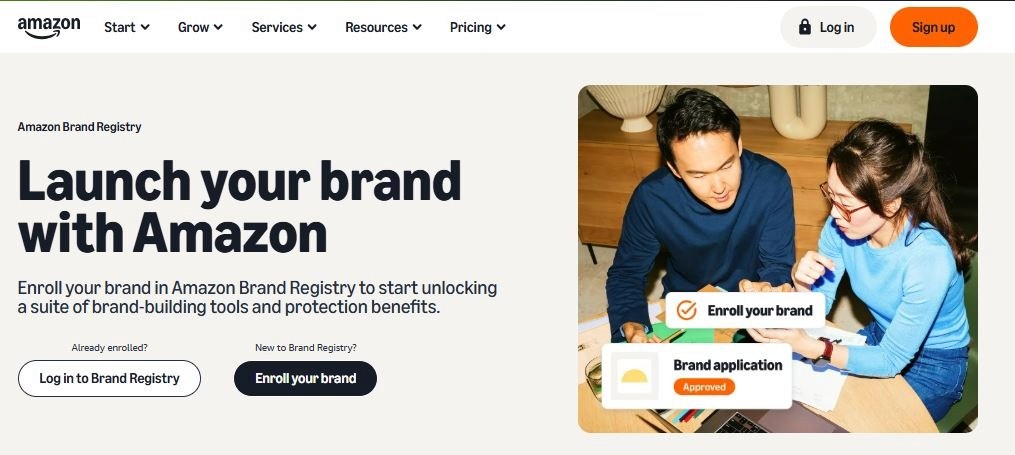
Go to brandservices.amazon.com and click "Enroll." You'll need to sign in with your Amazon Seller Central account or create one if you don't have one yet.
Step 3: Enter your trademark information
Fill in your trademark details exactly as they appear on your trademark registration certificate:
Trademark office (e.g., USPTO, EUIPO)
Trademark registration number
Brand name exactly as registered
Trademark type (word mark or design mark)
Step 4: Provide brand information
Answer questions about your brand:
What product categories do you sell?
Where are your products manufactured?
Where do you distribute your products?
Do you have a website? (Not required but helpful)
Step 5: Verification process
Amazon's verification system will review your application. In 2026, this process will become much faster thanks to AI-powered verification systems. Most applications are reviewed within 24-48 hours, though complex cases may take up to 5 business days. You might receive a verification code via:
Email sent to your brand's domain (e.g., info@yourbrand.com)
Phone call to your registered business number
Physical mail to your registered business address
Step 6: Complete verification and gain access
Once verified, you'll receive confirmation and immediate access to your Brand Registry dashboard. From here, you can start using all the tools and protections immediately.
Pro tip: If you sell in multiple Amazon marketplaces (like the US, UK, and Canada), you only need to enroll once. Your Brand Registry protection automatically extends across all Amazon stores where you're registered as a seller.
Benefits of Amazon Brand Registry for new sellers
For new sellers, Amazon Brand Registry is less about “extra features” and more about building a clean foundation early, so your listings stay stable, your brand looks legitimate, and your growth doesn’t get derailed by copycats or content issues. Here are the benefits that matter most when you’re still in the launch and early-scaling stage
#1 Stronger brand protection from day one
New brands are often the easiest targets for hijackers and copycats because they don’t have many reviews or a large customer base watching for problems. Brand Registry gives you access to Amazon’s brand protection tools so you can report infringement faster and reduce the risk of counterfeit or misleading listings damaging your reputation.
#2 More control over your listing content
When you’re new, your product detail page is doing the heavy lifting as every image, bullet, and detail matters for conversion. Brand Registry adds stronger safeguards that help keep your listing information accurate and reduce unauthorized changes that confuse shoppers and hurt conversion.
#3 Higher conversion potential with premium content options
Brand-registered sellers can use tools like A+ Content to improve how the listing presents the product, such as better visuals, clearer comparisons, and a stronger brand story. For new sellers, this helps you look established even before you have hundreds of reviews, which can lift conversion and reduce hesitation.
#4 Access to brand-building ad placements
If you plan to run PPC seriously, Brand Registry is a key unlock. It’s required to run Sponsored Brands and to build a Store, which are two of the most effective ways to grow beyond a single SKU and drive more branded search over time.
#5 Better decision-making with brand-level insights
New sellers usually waste money early by guessing which keywords drive sales, which products shoppers compare you to, and where your demand is coming from. Brand tools and analytics available to registered brands can reduce that guesswork and help you make smarter listing and PPC decisions.
#6 A cleaner path to scaling your catalog
As you add more ASINs, brand consistency becomes harder to manage. Brand Registry makes it easier to build a unified brand presence (Storefront, brand modules, consistent merchandising), which improves cross-selling and makes your catalog feel like a real brand, not random products.
Ready to protect and grow your brand?
If you haven't enrolled in Amazon Brand Registry yet, make it a priority this week. The enrollment process is straightforward, free, and the benefits begin immediately.
Working with an experienced Amazon consulting agency can help ensure your brand is fully protected and positioned for success. You deserve Amazon brand protection. Your products deserve the best possible presentation, and your business deserves access to the tools that can accelerate growth.
TL;DR
Amazon Brand Registry in 2026 is the foundation for brand protection, listing control, and access to powerful brand-building and advertising tools on Amazon.
It helps prevent listing hijacks, unauthorized content changes, and counterfeit activity while giving sellers stronger control over how their brand appears.
Enrollment requires a valid or pending trademark, consistent brand and logo usage, product or packaging proof, and an active Seller Central account.
The enrollment process is straightforward and faster in 2026, with most applications approved within a few days after verification.
New sellers benefit from higher conversion tools like A+ Content, access to Sponsored Brands and Stores, and better brand-level insights.
Brand Registry makes it easier to scale confidently by creating a consistent, protected brand presence across multiple products and marketplaces.
If you’re building a real brand on Amazon in 2026, Amazon Brand Registry isn't just another optional feature; it's become one of the most powerful tools for protecting your brand and growing your business on Amazon.
It's the foundation for brand protection, stronger conversion tools, and access to key brand ads. Without it, selling becomes much harder. Your listing content can be changed without notice, look-alike sellers may appear on your product pages, and you lose access to brand-exclusive tools that are designed to support growth and long-term control.
This complete guide walks you through everything you need to know about Amazon Brand Registry in 2026, from eligibility requirements to the step-by-step enrollment process, and most importantly, the concrete brand registry benefits that can transform your Amazon business.
What is Amazon Brand Registry 3.0?
Amazon Brand Registry is a free program designed to help brand owners protect and grow their brands on Amazon. Think of it as your VIP pass to Amazon's most powerful seller tools. When you enroll in Amazon Brand Registry, you're essentially telling Amazon: This is my brand, and I need brand protection and tools to manage it properly.
In return, Amazon gives you access to advanced search features, predictive automation, and a suite of tools designed to help you control how your brand appears on their platform. In 2026, it’s best to think of Brand Registry as a control center that unlocks:
Better brand protection tools to fight hijackers, counterfeits, and IP abuse
Advanced listing control and content tools like A+ Content, testing tools
Upgraded brand-building and advertising options, including Stores, Sponsored Brands access
Amazon doesn’t officially market “Brand Registry 3.0” as a separate product you toggle on; it’s more of a seller term for the modern Brand Registry experience: stronger verification, more tools, and tighter brand control.
Amazon Brand Registry eligibility requirements (2026)
To enroll in Amazon Brand Registry in 2026, Amazon wants to confirm one thing: you’re the real brand owner, and your brand identity is consistent across your trademark, your products, and your Amazon presence. Here’s what sellers need to have in place before applying.
The first requirement is a trademark. You’ll typically need either an active registered trademark or a pending trademark application. Amazon accepts both common trademark types, including a word mark (text-based) or a design mark (image-based, as long as it includes words/letters/numbers). Make sure your trademark comes from an approved government trademark office connected to the marketplace you sell in.
Next is brand name and logo consistency. Your brand name on the Brand Registry application must match the trademark record closely. Small differences like missing spaces, extra symbols, or alternate spellings can slow down approval. If you’re applying with a design mark, the logo file you upload should match what’s on the trademark record (not a redesigned version).
Amazon also requires proof that the brand exists on the actual product or packaging. You’ll need to upload at least one clear, real photo showing your brand name/logo permanently affixed to the product or packaging. This is how Amazon verifies that the brand isn’t only “on paper” but is actually used in commerce.
Ownership matters as well. Brand Registry enrollment must be submitted by the trademark owner. If you’re working with an agency, employee, or virtual assistant, the trademark owner should enroll first and then grant access to others through Brand Registry user roles.
Finally, there are a few account-level conditions. It’s best practice to create your Brand Registry account using the same login as Seller Central, so your tools connect correctly. If you want full access to brand-building features, especially advertising and brand profiles, your selling account should be active and in good standing. You’ll also be asked to provide a list of product categories where your brand will be listed.
Amazon sellers need to consider country-specific rules. Accepted trademark offices and “pending trademark” eligibility can differ by region, and Amazon provides the official country list inside the Brand Registry portal.
If you’re wondering, Brand Registry is not required just to sell on Amazon or create basic listings. Many sellers can list products through standard catalog processes, but Brand Registry is what unlocks the deeper protection and brand tools most serious sellers want.
How to enroll in the Amazon Brand Registry 2026
The process has been streamlined significantly, making it easier than ever.
Step 1: Prepare your information
Your registered trademark number
The country where your trademark is registered
Images of your products showing your brand name
Product categories you sell in
Your brand's official website
A list of countries where you distribute products
Step 2: Visit the Brand Registry portal
Go to brandservices.amazon.com and click "Enroll." You'll need to sign in with your Amazon Seller Central account or create one if you don't have one yet.
Step 3: Enter your trademark information
Fill in your trademark details exactly as they appear on your trademark registration certificate:
Trademark office (e.g., USPTO, EUIPO)
Trademark registration number
Brand name exactly as registered
Trademark type (word mark or design mark)
Step 4: Provide brand information
Answer questions about your brand:
What product categories do you sell?
Where are your products manufactured?
Where do you distribute your products?
Do you have a website? (Not required but helpful)
Step 5: Verification process
Amazon's verification system will review your application. In 2026, this process will become much faster thanks to AI-powered verification systems. Most applications are reviewed within 24-48 hours, though complex cases may take up to 5 business days. You might receive a verification code via:
Email sent to your brand's domain (e.g., info@yourbrand.com)
Phone call to your registered business number
Physical mail to your registered business address
Step 6: Complete verification and gain access
Once verified, you'll receive confirmation and immediate access to your Brand Registry dashboard. From here, you can start using all the tools and protections immediately.
Pro tip: If you sell in multiple Amazon marketplaces (like the US, UK, and Canada), you only need to enroll once. Your Brand Registry protection automatically extends across all Amazon stores where you're registered as a seller.
Benefits of Amazon Brand Registry for new sellers
For new sellers, Amazon Brand Registry is less about “extra features” and more about building a clean foundation early, so your listings stay stable, your brand looks legitimate, and your growth doesn’t get derailed by copycats or content issues. Here are the benefits that matter most when you’re still in the launch and early-scaling stage
#1 Stronger brand protection from day one
New brands are often the easiest targets for hijackers and copycats because they don’t have many reviews or a large customer base watching for problems. Brand Registry gives you access to Amazon’s brand protection tools so you can report infringement faster and reduce the risk of counterfeit or misleading listings damaging your reputation.
#2 More control over your listing content
When you’re new, your product detail page is doing the heavy lifting as every image, bullet, and detail matters for conversion. Brand Registry adds stronger safeguards that help keep your listing information accurate and reduce unauthorized changes that confuse shoppers and hurt conversion.
#3 Higher conversion potential with premium content options
Brand-registered sellers can use tools like A+ Content to improve how the listing presents the product, such as better visuals, clearer comparisons, and a stronger brand story. For new sellers, this helps you look established even before you have hundreds of reviews, which can lift conversion and reduce hesitation.
#4 Access to brand-building ad placements
If you plan to run PPC seriously, Brand Registry is a key unlock. It’s required to run Sponsored Brands and to build a Store, which are two of the most effective ways to grow beyond a single SKU and drive more branded search over time.
#5 Better decision-making with brand-level insights
New sellers usually waste money early by guessing which keywords drive sales, which products shoppers compare you to, and where your demand is coming from. Brand tools and analytics available to registered brands can reduce that guesswork and help you make smarter listing and PPC decisions.
#6 A cleaner path to scaling your catalog
As you add more ASINs, brand consistency becomes harder to manage. Brand Registry makes it easier to build a unified brand presence (Storefront, brand modules, consistent merchandising), which improves cross-selling and makes your catalog feel like a real brand, not random products.
Ready to protect and grow your brand?
If you haven't enrolled in Amazon Brand Registry yet, make it a priority this week. The enrollment process is straightforward, free, and the benefits begin immediately.
Working with an experienced Amazon consulting agency can help ensure your brand is fully protected and positioned for success. You deserve Amazon brand protection. Your products deserve the best possible presentation, and your business deserves access to the tools that can accelerate growth.
TL;DR
Amazon Brand Registry in 2026 is the foundation for brand protection, listing control, and access to powerful brand-building and advertising tools on Amazon.
It helps prevent listing hijacks, unauthorized content changes, and counterfeit activity while giving sellers stronger control over how their brand appears.
Enrollment requires a valid or pending trademark, consistent brand and logo usage, product or packaging proof, and an active Seller Central account.
The enrollment process is straightforward and faster in 2026, with most applications approved within a few days after verification.
New sellers benefit from higher conversion tools like A+ Content, access to Sponsored Brands and Stores, and better brand-level insights.
Brand Registry makes it easier to scale confidently by creating a consistent, protected brand presence across multiple products and marketplaces.
If you’re building a real brand on Amazon in 2026, Amazon Brand Registry isn't just another optional feature; it's become one of the most powerful tools for protecting your brand and growing your business on Amazon.
It's the foundation for brand protection, stronger conversion tools, and access to key brand ads. Without it, selling becomes much harder. Your listing content can be changed without notice, look-alike sellers may appear on your product pages, and you lose access to brand-exclusive tools that are designed to support growth and long-term control.
This complete guide walks you through everything you need to know about Amazon Brand Registry in 2026, from eligibility requirements to the step-by-step enrollment process, and most importantly, the concrete brand registry benefits that can transform your Amazon business.
What is Amazon Brand Registry 3.0?
Amazon Brand Registry is a free program designed to help brand owners protect and grow their brands on Amazon. Think of it as your VIP pass to Amazon's most powerful seller tools. When you enroll in Amazon Brand Registry, you're essentially telling Amazon: This is my brand, and I need brand protection and tools to manage it properly.
In return, Amazon gives you access to advanced search features, predictive automation, and a suite of tools designed to help you control how your brand appears on their platform. In 2026, it’s best to think of Brand Registry as a control center that unlocks:
Better brand protection tools to fight hijackers, counterfeits, and IP abuse
Advanced listing control and content tools like A+ Content, testing tools
Upgraded brand-building and advertising options, including Stores, Sponsored Brands access
Amazon doesn’t officially market “Brand Registry 3.0” as a separate product you toggle on; it’s more of a seller term for the modern Brand Registry experience: stronger verification, more tools, and tighter brand control.
Amazon Brand Registry eligibility requirements (2026)
To enroll in Amazon Brand Registry in 2026, Amazon wants to confirm one thing: you’re the real brand owner, and your brand identity is consistent across your trademark, your products, and your Amazon presence. Here’s what sellers need to have in place before applying.
The first requirement is a trademark. You’ll typically need either an active registered trademark or a pending trademark application. Amazon accepts both common trademark types, including a word mark (text-based) or a design mark (image-based, as long as it includes words/letters/numbers). Make sure your trademark comes from an approved government trademark office connected to the marketplace you sell in.
Next is brand name and logo consistency. Your brand name on the Brand Registry application must match the trademark record closely. Small differences like missing spaces, extra symbols, or alternate spellings can slow down approval. If you’re applying with a design mark, the logo file you upload should match what’s on the trademark record (not a redesigned version).
Amazon also requires proof that the brand exists on the actual product or packaging. You’ll need to upload at least one clear, real photo showing your brand name/logo permanently affixed to the product or packaging. This is how Amazon verifies that the brand isn’t only “on paper” but is actually used in commerce.
Ownership matters as well. Brand Registry enrollment must be submitted by the trademark owner. If you’re working with an agency, employee, or virtual assistant, the trademark owner should enroll first and then grant access to others through Brand Registry user roles.
Finally, there are a few account-level conditions. It’s best practice to create your Brand Registry account using the same login as Seller Central, so your tools connect correctly. If you want full access to brand-building features, especially advertising and brand profiles, your selling account should be active and in good standing. You’ll also be asked to provide a list of product categories where your brand will be listed.
Amazon sellers need to consider country-specific rules. Accepted trademark offices and “pending trademark” eligibility can differ by region, and Amazon provides the official country list inside the Brand Registry portal.
If you’re wondering, Brand Registry is not required just to sell on Amazon or create basic listings. Many sellers can list products through standard catalog processes, but Brand Registry is what unlocks the deeper protection and brand tools most serious sellers want.
How to enroll in the Amazon Brand Registry 2026
The process has been streamlined significantly, making it easier than ever.
Step 1: Prepare your information
Your registered trademark number
The country where your trademark is registered
Images of your products showing your brand name
Product categories you sell in
Your brand's official website
A list of countries where you distribute products
Step 2: Visit the Brand Registry portal
Go to brandservices.amazon.com and click "Enroll." You'll need to sign in with your Amazon Seller Central account or create one if you don't have one yet.
Step 3: Enter your trademark information
Fill in your trademark details exactly as they appear on your trademark registration certificate:
Trademark office (e.g., USPTO, EUIPO)
Trademark registration number
Brand name exactly as registered
Trademark type (word mark or design mark)
Step 4: Provide brand information
Answer questions about your brand:
What product categories do you sell?
Where are your products manufactured?
Where do you distribute your products?
Do you have a website? (Not required but helpful)
Step 5: Verification process
Amazon's verification system will review your application. In 2026, this process will become much faster thanks to AI-powered verification systems. Most applications are reviewed within 24-48 hours, though complex cases may take up to 5 business days. You might receive a verification code via:
Email sent to your brand's domain (e.g., info@yourbrand.com)
Phone call to your registered business number
Physical mail to your registered business address
Step 6: Complete verification and gain access
Once verified, you'll receive confirmation and immediate access to your Brand Registry dashboard. From here, you can start using all the tools and protections immediately.
Pro tip: If you sell in multiple Amazon marketplaces (like the US, UK, and Canada), you only need to enroll once. Your Brand Registry protection automatically extends across all Amazon stores where you're registered as a seller.
Benefits of Amazon Brand Registry for new sellers
For new sellers, Amazon Brand Registry is less about “extra features” and more about building a clean foundation early, so your listings stay stable, your brand looks legitimate, and your growth doesn’t get derailed by copycats or content issues. Here are the benefits that matter most when you’re still in the launch and early-scaling stage
#1 Stronger brand protection from day one
New brands are often the easiest targets for hijackers and copycats because they don’t have many reviews or a large customer base watching for problems. Brand Registry gives you access to Amazon’s brand protection tools so you can report infringement faster and reduce the risk of counterfeit or misleading listings damaging your reputation.
#2 More control over your listing content
When you’re new, your product detail page is doing the heavy lifting as every image, bullet, and detail matters for conversion. Brand Registry adds stronger safeguards that help keep your listing information accurate and reduce unauthorized changes that confuse shoppers and hurt conversion.
#3 Higher conversion potential with premium content options
Brand-registered sellers can use tools like A+ Content to improve how the listing presents the product, such as better visuals, clearer comparisons, and a stronger brand story. For new sellers, this helps you look established even before you have hundreds of reviews, which can lift conversion and reduce hesitation.
#4 Access to brand-building ad placements
If you plan to run PPC seriously, Brand Registry is a key unlock. It’s required to run Sponsored Brands and to build a Store, which are two of the most effective ways to grow beyond a single SKU and drive more branded search over time.
#5 Better decision-making with brand-level insights
New sellers usually waste money early by guessing which keywords drive sales, which products shoppers compare you to, and where your demand is coming from. Brand tools and analytics available to registered brands can reduce that guesswork and help you make smarter listing and PPC decisions.
#6 A cleaner path to scaling your catalog
As you add more ASINs, brand consistency becomes harder to manage. Brand Registry makes it easier to build a unified brand presence (Storefront, brand modules, consistent merchandising), which improves cross-selling and makes your catalog feel like a real brand, not random products.
Ready to protect and grow your brand?
If you haven't enrolled in Amazon Brand Registry yet, make it a priority this week. The enrollment process is straightforward, free, and the benefits begin immediately.
Working with an experienced Amazon consulting agency can help ensure your brand is fully protected and positioned for success. You deserve Amazon brand protection. Your products deserve the best possible presentation, and your business deserves access to the tools that can accelerate growth.





eStore Factory is a full-service Amazon agency dedicated to building end-to-end strategies for brands of all sizes.


SERVICES FOR AMAZON
Product Setup ON AMAZON
GRAPHICS & BRANDING SERVICES
PPC MANAGEMENT
© Copyright 2014 - 2026. All Rights Reserved.
eStore Factory is a full-service Amazon agency dedicated to building end-to-end strategies for brands of all sizes.
SERVICES FOR AMAZON
Product Setup ON AMAZON
GRAPHICS & BRANDING SERVICES
PPC MANAGEMENT
© Copyright 2014 - 2026. All Rights Reserved.
eStore Factory is a full-service Amazon agency dedicated to building end-to-end strategies for brands of all sizes.
SERVICES FOR AMAZON
Product Setup ON AMAZON
GRAPHICS & BRANDING SERVICES
PPC MANAGEMENT
© Copyright 2014 - 2026. All Rights Reserved.