

Back to Page
Amazon Seller Guide
Amazon FBA fee changes in 2026: A seller's guide to real profitability
Amazon FBA fee changes in 2026: A seller's guide to real profitability

Back to Page
Amazon Seller Guide
Amazon FBA fee changes in 2026: A seller's guide to real profitability
TL;DR
Amazon FBA fee changes in 2026 affect profitability at the unit level, not just on average across categories.
Referral and fulfillment fees are only part of the cost, inbound placement, returns, storage, ads, and operating expenses must be included.
Storage and aged inventory fees quietly destroy margins on slow-moving or oversized products.
Returns and inbound placement fees are major blind spots that many sellers fail to model correctly.
True Amazon FBA profitability comes from calculating net profit per unit, not partial fee math.
Sellers who model costs early and adjust pricing, packaging, and inventory strategy will protect margins in 2026.
If you’re selling on Amazon, you already know fees decide your profit. A product can look like a winner on paper until Amazon fees, returns, and storage eat the margin. That’s why sellers are searching for Amazon FBA fees for 2026 right now.
The “average change” headline doesn’t help you unless you can translate it into your cost per unit and your net profit. This blog discusses the Amazon FBA fee structure breakdown, how to calculate Amazon FBA profitability, the difference between Amazon storage fees vs. fulfillment fees, and what to do next if your margin is getting tight.
What’s happening with Amazon FBA fees in 2026?
Amazon announced updates to U.S. selling fees for 2026, including changes that take effect January 15, 2026, for many programs. Amazon positioned the changes as relatively small on average, but your actual impact depends on your product’s size tier, weight, return rate, and inbound shipping plan choices.
The two areas that most often surprise sellers are:
Inbound placement fees (especially if you prefer sending inventory to fewer locations)
Returns processing fees (especially if you have a high return rate or you sell apparel/shoes)
So instead of guessing, let’s break the full fee stack down and show you how to calculate it.
Amazon FBA fee structure breakdown (2026)
When people say “Amazon fees,” they usually mean two things: referral fees and fulfillment fees. But in reality, your costs are a stack of fees and operational expenses. Here’s the simple breakdown of Amazon seller fees you should understand:
Referral fee: This is a percentage of your selling price (varies by category). You pay it when you make a sale. Think of it as: Amazon’s “platform commission.”
FBA fulfillment fee (pick, pack, ship, customer service): This is the classic FBA fee based on product category type (apparel vs non-apparel matters), size tier, and shipping weight. You pay it when your order ships to the customer. Think of it as: Amazon’s cost to handle the order for you.
Storage fees (monthly): If your inventory sits in Amazon warehouses, you pay monthly storage based on cubic feet. Think of it as rent for your inventory.
Aged inventory surcharge (extra charge for inventory sitting too long): If units sit too long (Amazon uses an age threshold), you can be charged an additional fee on top of monthly storage. Think of it as Amazon pushing you to keep inventory healthy and moving.
Inbound placement service fee (shipping plan choice can trigger this): When you create shipments, Amazon offers inbound options. If you choose the easiest route, send to fewer locations. Amazon may charge an inbound placement fee. Think of it as paying extra for the convenience of shipping to fewer receiving locations.
Returns-related fees (this can be huge): Amazon’s returns processing fee rules vary, but in 2026, fees apply when return rates exceed category thresholds. For apparel and shoes, fees can apply per returned unit. Think of it as you pay for reverse logistics when returns are high.
Not an “Amazon fee,” but still real: ads and operational costs. If you’re running PPC (most sellers are), advertising becomes part of your unit economics. Same with COGS, inbound freight from supplier to Amazon, prep/packaging, 3PL handling.
Amazon storage fees vs. fulfillment fees: What’s the difference?
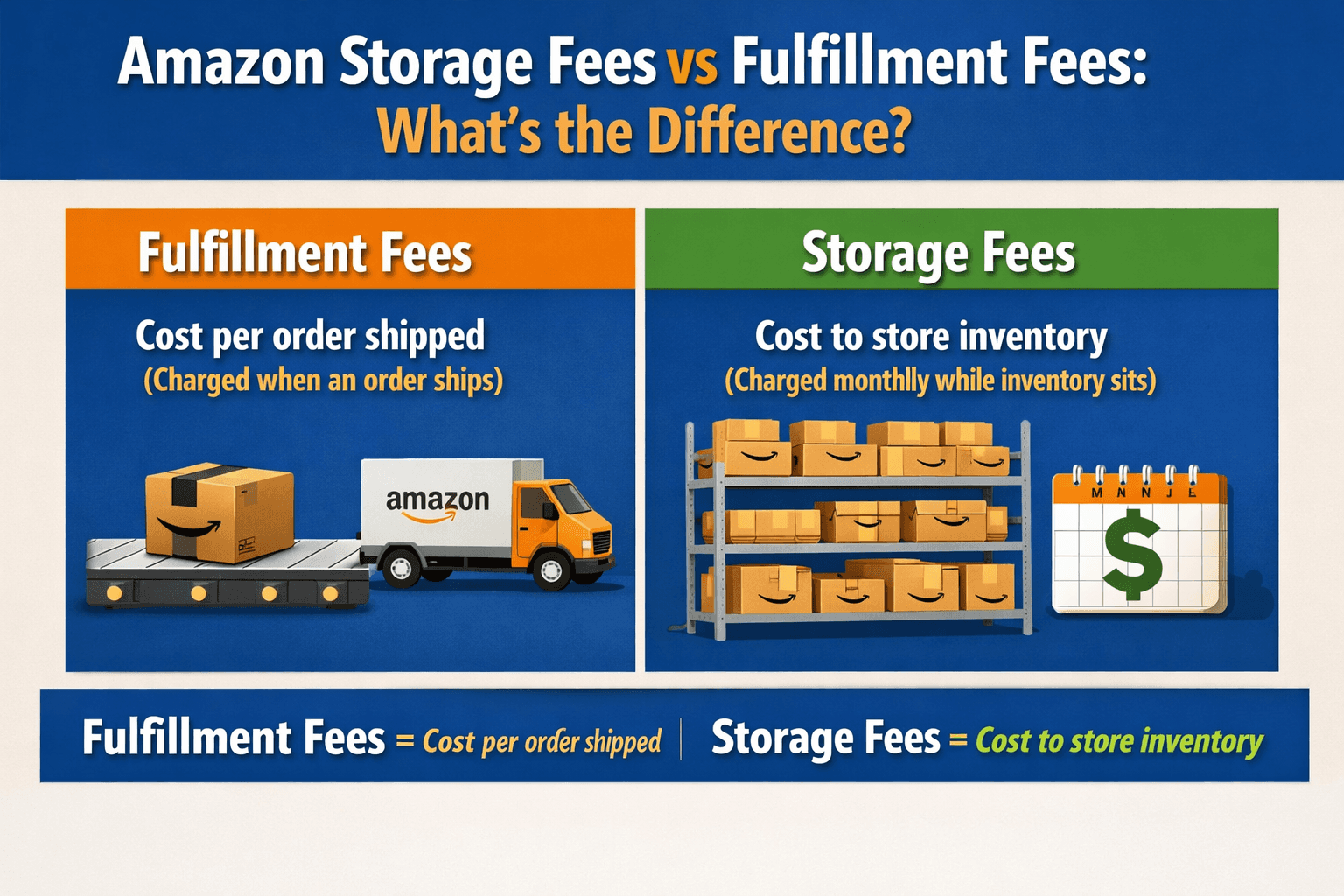
This question comes up a lot, so here’s the simplest explanation:
Fulfillment fees: Cost per order shipped (charged when an order ships)
Storage fees: Cost to store inventory (charged monthly while inventory sits)
So, storage fees punish slow-moving inventory. Fulfillment fees affect every sale, every time. If your product sells fast and stays in stock, storage fees may be small. If your product sells slowly (or you overstock), storage and aged inventory surcharges can destroy profitability even if your per-order margin looks fine.
How to calculate Amazon FBA profitability?
Here’s the mistake we see constantly: sellers calculate profit using only referral & fulfillment fees.
That’s not profitability. That’s partial math. If you want clean unit economics, use this framework:
Start with your selling price
Subtract the two core Amazon seller fees
Deduct your product cost and operating expenses
Add the inbound placement fee per unit, if applicable, and the expected returns processing cost
Include the storage cost per unit sold, even if estimated as an average
What remains is your true net profit per unit
Where sellers lose money in 2026 and what matters most
Inbound placement fees are ignored: Many sellers pick the simplest inbound option and don’t model the fee impact. If you ship a high volume, even pennies matter. If you ship bulky items, it can be far more than pennies.
Return costs aren’t treated as a real COGS line: Returns aren’t just annoying and they’re expensive. If your category tends to return, it must be baked into profitability.
Storage gets overlooked (until it’s too late): Storage fees build quietly and then show up as a nasty surprise, especially on slow-moving inventory or oversized items.
Advertising is treated separately: If you’re spending $3 to $6 per order on ads, that’s not “marketing.” That's the cost of sale. Put it in the calculator.
How to reduce the impact of Amazon FBA fees in 2026
#1 Fix packaging before you touch PPC
Packaging affects size tier and dimensional weight. That impacts fulfillment fees and sometimes inbound handling too. Small packaging changes can create permanent fee savings.
#2 Audit inbound shipment strategy
If you can qualify more often for Amazon’s fee-free inbound option (when available), you reduce inbound placement fees. If you can’t, at least model the cost and price accordingly.
#3 Reduce returns with better listing clarity
Returns often drop when you improve images (show scale, usage, compatibility), A+ content (set expectations), variation structure (reduce confusion), sizing charts (apparel), or compatibility charts (parts/accessories). Lower returns protect margin and improve account health metrics over time.
#4 Clear aging inventory early
If inventory isn’t moving, run a controlled price test, use coupons strategically, consider removals or liquidation before aged fees stack up. Keeping dead stock in FBA is rarely a winning strategy.
#5 Re-price based on real unit economics, not fear
Don’t blindly raise prices. Instead, find SKUs where conversion can handle a small increase, or competitors are already priced higher, or your differentiation supports a premium. For other SKUs, focus on cost reduction, conversion improvement, or ad efficiency.
Final takeaways
Amazon FBA fees 2026 are not just a small update; they change how profit behaves at the unit level. A few cents in fulfillment, inbound placement, or returns can quietly turn a good-looking SKU into a weak one at scale.
The sellers who win in 2026 will not be the ones reacting late; they will be the ones calculating early and pricing with confidence. If your margins feel tighter than they should, it’s time to stop guessing and start modeling real costs.
A clear calculator, clean data, and the right decisions make all the difference. If you want help breaking this down for your catalog, working with an experienced Amazon FBA consultant can help you protect profit before fees eat it away.
FAQs
When do the 2026 Amazon FBA fee changes start?
Most U.S. selling fee changes discussed here are effective January 15, 2026, with aged inventory surcharge updates effective January 16, 2026. You can confirm in Seller Central for your exact program and marketplace.
Are there new Amazon fee types in 2026?
Amazon stated there are no new FBA fee types introduced in the 2026 update; however, existing fees and rate cards were updated.
How do I calculate my exact profit impact?
Use Amazon’s Revenue Calculator for baseline fees, then add inbound placement fees, returns processing fees (where applicable), storage, ads, and COGS in a simple unit economics spreadsheet.
Do these 2026 Amazon FBA fee changes apply to all marketplaces?
No. It is specific to the U.S. marketplace, and other regions (UK/EU/CA/AU) have their own fee schedules and effective dates.
TL;DR
Amazon FBA fee changes in 2026 affect profitability at the unit level, not just on average across categories.
Referral and fulfillment fees are only part of the cost, inbound placement, returns, storage, ads, and operating expenses must be included.
Storage and aged inventory fees quietly destroy margins on slow-moving or oversized products.
Returns and inbound placement fees are major blind spots that many sellers fail to model correctly.
True Amazon FBA profitability comes from calculating net profit per unit, not partial fee math.
Sellers who model costs early and adjust pricing, packaging, and inventory strategy will protect margins in 2026.
If you’re selling on Amazon, you already know fees decide your profit. A product can look like a winner on paper until Amazon fees, returns, and storage eat the margin. That’s why sellers are searching for Amazon FBA fees for 2026 right now.
The “average change” headline doesn’t help you unless you can translate it into your cost per unit and your net profit. This blog discusses the Amazon FBA fee structure breakdown, how to calculate Amazon FBA profitability, the difference between Amazon storage fees vs. fulfillment fees, and what to do next if your margin is getting tight.
What’s happening with Amazon FBA fees in 2026?
Amazon announced updates to U.S. selling fees for 2026, including changes that take effect January 15, 2026, for many programs. Amazon positioned the changes as relatively small on average, but your actual impact depends on your product’s size tier, weight, return rate, and inbound shipping plan choices.
The two areas that most often surprise sellers are:
Inbound placement fees (especially if you prefer sending inventory to fewer locations)
Returns processing fees (especially if you have a high return rate or you sell apparel/shoes)
So instead of guessing, let’s break the full fee stack down and show you how to calculate it.
Amazon FBA fee structure breakdown (2026)
When people say “Amazon fees,” they usually mean two things: referral fees and fulfillment fees. But in reality, your costs are a stack of fees and operational expenses. Here’s the simple breakdown of Amazon seller fees you should understand:
Referral fee: This is a percentage of your selling price (varies by category). You pay it when you make a sale. Think of it as: Amazon’s “platform commission.”
FBA fulfillment fee (pick, pack, ship, customer service): This is the classic FBA fee based on product category type (apparel vs non-apparel matters), size tier, and shipping weight. You pay it when your order ships to the customer. Think of it as: Amazon’s cost to handle the order for you.
Storage fees (monthly): If your inventory sits in Amazon warehouses, you pay monthly storage based on cubic feet. Think of it as rent for your inventory.
Aged inventory surcharge (extra charge for inventory sitting too long): If units sit too long (Amazon uses an age threshold), you can be charged an additional fee on top of monthly storage. Think of it as Amazon pushing you to keep inventory healthy and moving.
Inbound placement service fee (shipping plan choice can trigger this): When you create shipments, Amazon offers inbound options. If you choose the easiest route, send to fewer locations. Amazon may charge an inbound placement fee. Think of it as paying extra for the convenience of shipping to fewer receiving locations.
Returns-related fees (this can be huge): Amazon’s returns processing fee rules vary, but in 2026, fees apply when return rates exceed category thresholds. For apparel and shoes, fees can apply per returned unit. Think of it as you pay for reverse logistics when returns are high.
Not an “Amazon fee,” but still real: ads and operational costs. If you’re running PPC (most sellers are), advertising becomes part of your unit economics. Same with COGS, inbound freight from supplier to Amazon, prep/packaging, 3PL handling.
Amazon storage fees vs. fulfillment fees: What’s the difference?
This question comes up a lot, so here’s the simplest explanation:
Fulfillment fees: Cost per order shipped (charged when an order ships)
Storage fees: Cost to store inventory (charged monthly while inventory sits)
So, storage fees punish slow-moving inventory. Fulfillment fees affect every sale, every time. If your product sells fast and stays in stock, storage fees may be small. If your product sells slowly (or you overstock), storage and aged inventory surcharges can destroy profitability even if your per-order margin looks fine.
How to calculate Amazon FBA profitability?
Here’s the mistake we see constantly: sellers calculate profit using only referral & fulfillment fees.
That’s not profitability. That’s partial math. If you want clean unit economics, use this framework:
Start with your selling price
Subtract the two core Amazon seller fees
Deduct your product cost and operating expenses
Add the inbound placement fee per unit, if applicable, and the expected returns processing cost
Include the storage cost per unit sold, even if estimated as an average
What remains is your true net profit per unit
Where sellers lose money in 2026 and what matters most
Inbound placement fees are ignored: Many sellers pick the simplest inbound option and don’t model the fee impact. If you ship a high volume, even pennies matter. If you ship bulky items, it can be far more than pennies.
Return costs aren’t treated as a real COGS line: Returns aren’t just annoying and they’re expensive. If your category tends to return, it must be baked into profitability.
Storage gets overlooked (until it’s too late): Storage fees build quietly and then show up as a nasty surprise, especially on slow-moving inventory or oversized items.
Advertising is treated separately: If you’re spending $3 to $6 per order on ads, that’s not “marketing.” That's the cost of sale. Put it in the calculator.
How to reduce the impact of Amazon FBA fees in 2026
#1 Fix packaging before you touch PPC
Packaging affects size tier and dimensional weight. That impacts fulfillment fees and sometimes inbound handling too. Small packaging changes can create permanent fee savings.
#2 Audit inbound shipment strategy
If you can qualify more often for Amazon’s fee-free inbound option (when available), you reduce inbound placement fees. If you can’t, at least model the cost and price accordingly.
#3 Reduce returns with better listing clarity
Returns often drop when you improve images (show scale, usage, compatibility), A+ content (set expectations), variation structure (reduce confusion), sizing charts (apparel), or compatibility charts (parts/accessories). Lower returns protect margin and improve account health metrics over time.
#4 Clear aging inventory early
If inventory isn’t moving, run a controlled price test, use coupons strategically, consider removals or liquidation before aged fees stack up. Keeping dead stock in FBA is rarely a winning strategy.
#5 Re-price based on real unit economics, not fear
Don’t blindly raise prices. Instead, find SKUs where conversion can handle a small increase, or competitors are already priced higher, or your differentiation supports a premium. For other SKUs, focus on cost reduction, conversion improvement, or ad efficiency.
Final takeaways
Amazon FBA fees 2026 are not just a small update; they change how profit behaves at the unit level. A few cents in fulfillment, inbound placement, or returns can quietly turn a good-looking SKU into a weak one at scale.
The sellers who win in 2026 will not be the ones reacting late; they will be the ones calculating early and pricing with confidence. If your margins feel tighter than they should, it’s time to stop guessing and start modeling real costs.
A clear calculator, clean data, and the right decisions make all the difference. If you want help breaking this down for your catalog, working with an experienced Amazon FBA consultant can help you protect profit before fees eat it away.
FAQs
When do the 2026 Amazon FBA fee changes start?
Most U.S. selling fee changes discussed here are effective January 15, 2026, with aged inventory surcharge updates effective January 16, 2026. You can confirm in Seller Central for your exact program and marketplace.
Are there new Amazon fee types in 2026?
Amazon stated there are no new FBA fee types introduced in the 2026 update; however, existing fees and rate cards were updated.
How do I calculate my exact profit impact?
Use Amazon’s Revenue Calculator for baseline fees, then add inbound placement fees, returns processing fees (where applicable), storage, ads, and COGS in a simple unit economics spreadsheet.
Do these 2026 Amazon FBA fee changes apply to all marketplaces?
No. It is specific to the U.S. marketplace, and other regions (UK/EU/CA/AU) have their own fee schedules and effective dates.
TL;DR
Amazon FBA fee changes in 2026 affect profitability at the unit level, not just on average across categories.
Referral and fulfillment fees are only part of the cost, inbound placement, returns, storage, ads, and operating expenses must be included.
Storage and aged inventory fees quietly destroy margins on slow-moving or oversized products.
Returns and inbound placement fees are major blind spots that many sellers fail to model correctly.
True Amazon FBA profitability comes from calculating net profit per unit, not partial fee math.
Sellers who model costs early and adjust pricing, packaging, and inventory strategy will protect margins in 2026.
If you’re selling on Amazon, you already know fees decide your profit. A product can look like a winner on paper until Amazon fees, returns, and storage eat the margin. That’s why sellers are searching for Amazon FBA fees for 2026 right now.
The “average change” headline doesn’t help you unless you can translate it into your cost per unit and your net profit. This blog discusses the Amazon FBA fee structure breakdown, how to calculate Amazon FBA profitability, the difference between Amazon storage fees vs. fulfillment fees, and what to do next if your margin is getting tight.
What’s happening with Amazon FBA fees in 2026?
Amazon announced updates to U.S. selling fees for 2026, including changes that take effect January 15, 2026, for many programs. Amazon positioned the changes as relatively small on average, but your actual impact depends on your product’s size tier, weight, return rate, and inbound shipping plan choices.
The two areas that most often surprise sellers are:
Inbound placement fees (especially if you prefer sending inventory to fewer locations)
Returns processing fees (especially if you have a high return rate or you sell apparel/shoes)
So instead of guessing, let’s break the full fee stack down and show you how to calculate it.
Amazon FBA fee structure breakdown (2026)
When people say “Amazon fees,” they usually mean two things: referral fees and fulfillment fees. But in reality, your costs are a stack of fees and operational expenses. Here’s the simple breakdown of Amazon seller fees you should understand:
Referral fee: This is a percentage of your selling price (varies by category). You pay it when you make a sale. Think of it as: Amazon’s “platform commission.”
FBA fulfillment fee (pick, pack, ship, customer service): This is the classic FBA fee based on product category type (apparel vs non-apparel matters), size tier, and shipping weight. You pay it when your order ships to the customer. Think of it as: Amazon’s cost to handle the order for you.
Storage fees (monthly): If your inventory sits in Amazon warehouses, you pay monthly storage based on cubic feet. Think of it as rent for your inventory.
Aged inventory surcharge (extra charge for inventory sitting too long): If units sit too long (Amazon uses an age threshold), you can be charged an additional fee on top of monthly storage. Think of it as Amazon pushing you to keep inventory healthy and moving.
Inbound placement service fee (shipping plan choice can trigger this): When you create shipments, Amazon offers inbound options. If you choose the easiest route, send to fewer locations. Amazon may charge an inbound placement fee. Think of it as paying extra for the convenience of shipping to fewer receiving locations.
Returns-related fees (this can be huge): Amazon’s returns processing fee rules vary, but in 2026, fees apply when return rates exceed category thresholds. For apparel and shoes, fees can apply per returned unit. Think of it as you pay for reverse logistics when returns are high.
Not an “Amazon fee,” but still real: ads and operational costs. If you’re running PPC (most sellers are), advertising becomes part of your unit economics. Same with COGS, inbound freight from supplier to Amazon, prep/packaging, 3PL handling.
Amazon storage fees vs. fulfillment fees: What’s the difference?
This question comes up a lot, so here’s the simplest explanation:
Fulfillment fees: Cost per order shipped (charged when an order ships)
Storage fees: Cost to store inventory (charged monthly while inventory sits)
So, storage fees punish slow-moving inventory. Fulfillment fees affect every sale, every time. If your product sells fast and stays in stock, storage fees may be small. If your product sells slowly (or you overstock), storage and aged inventory surcharges can destroy profitability even if your per-order margin looks fine.
How to calculate Amazon FBA profitability?
Here’s the mistake we see constantly: sellers calculate profit using only referral & fulfillment fees.
That’s not profitability. That’s partial math. If you want clean unit economics, use this framework:
Start with your selling price
Subtract the two core Amazon seller fees
Deduct your product cost and operating expenses
Add the inbound placement fee per unit, if applicable, and the expected returns processing cost
Include the storage cost per unit sold, even if estimated as an average
What remains is your true net profit per unit
Where sellers lose money in 2026 and what matters most
Inbound placement fees are ignored: Many sellers pick the simplest inbound option and don’t model the fee impact. If you ship a high volume, even pennies matter. If you ship bulky items, it can be far more than pennies.
Return costs aren’t treated as a real COGS line: Returns aren’t just annoying and they’re expensive. If your category tends to return, it must be baked into profitability.
Storage gets overlooked (until it’s too late): Storage fees build quietly and then show up as a nasty surprise, especially on slow-moving inventory or oversized items.
Advertising is treated separately: If you’re spending $3 to $6 per order on ads, that’s not “marketing.” That's the cost of sale. Put it in the calculator.
How to reduce the impact of Amazon FBA fees in 2026
#1 Fix packaging before you touch PPC
Packaging affects size tier and dimensional weight. That impacts fulfillment fees and sometimes inbound handling too. Small packaging changes can create permanent fee savings.
#2 Audit inbound shipment strategy
If you can qualify more often for Amazon’s fee-free inbound option (when available), you reduce inbound placement fees. If you can’t, at least model the cost and price accordingly.
#3 Reduce returns with better listing clarity
Returns often drop when you improve images (show scale, usage, compatibility), A+ content (set expectations), variation structure (reduce confusion), sizing charts (apparel), or compatibility charts (parts/accessories). Lower returns protect margin and improve account health metrics over time.
#4 Clear aging inventory early
If inventory isn’t moving, run a controlled price test, use coupons strategically, consider removals or liquidation before aged fees stack up. Keeping dead stock in FBA is rarely a winning strategy.
#5 Re-price based on real unit economics, not fear
Don’t blindly raise prices. Instead, find SKUs where conversion can handle a small increase, or competitors are already priced higher, or your differentiation supports a premium. For other SKUs, focus on cost reduction, conversion improvement, or ad efficiency.
Final takeaways
Amazon FBA fees 2026 are not just a small update; they change how profit behaves at the unit level. A few cents in fulfillment, inbound placement, or returns can quietly turn a good-looking SKU into a weak one at scale.
The sellers who win in 2026 will not be the ones reacting late; they will be the ones calculating early and pricing with confidence. If your margins feel tighter than they should, it’s time to stop guessing and start modeling real costs.
A clear calculator, clean data, and the right decisions make all the difference. If you want help breaking this down for your catalog, working with an experienced Amazon FBA consultant can help you protect profit before fees eat it away.
FAQs
When do the 2026 Amazon FBA fee changes start?
Most U.S. selling fee changes discussed here are effective January 15, 2026, with aged inventory surcharge updates effective January 16, 2026. You can confirm in Seller Central for your exact program and marketplace.
Are there new Amazon fee types in 2026?
Amazon stated there are no new FBA fee types introduced in the 2026 update; however, existing fees and rate cards were updated.
How do I calculate my exact profit impact?
Use Amazon’s Revenue Calculator for baseline fees, then add inbound placement fees, returns processing fees (where applicable), storage, ads, and COGS in a simple unit economics spreadsheet.
Do these 2026 Amazon FBA fee changes apply to all marketplaces?
No. It is specific to the U.S. marketplace, and other regions (UK/EU/CA/AU) have their own fee schedules and effective dates.





eStore Factory is a full-service Amazon agency dedicated to building end-to-end strategies for brands of all sizes.


SERVICES FOR AMAZON
Product Setup ON AMAZON
GRAPHICS & BRANDING SERVICES
PPC MANAGEMENT
© Copyright 2014 - 2026. All Rights Reserved.
eStore Factory is a full-service Amazon agency dedicated to building end-to-end strategies for brands of all sizes.
SERVICES FOR AMAZON
Product Setup ON AMAZON
GRAPHICS & BRANDING SERVICES
PPC MANAGEMENT
© Copyright 2014 - 2026. All Rights Reserved.
eStore Factory is a full-service Amazon agency dedicated to building end-to-end strategies for brands of all sizes.
SERVICES FOR AMAZON
Product Setup ON AMAZON
GRAPHICS & BRANDING SERVICES
PPC MANAGEMENT
© Copyright 2014 - 2026. All Rights Reserved.