

Back to Page
Amazon PPC
The 2026 Amazon PPC strategy guide: AI-powered campaigns that actually scale
The 2026 Amazon PPC strategy guide: AI-powered campaigns that actually scale
Back to Page
Amazon PPC
The 2026 Amazon PPC strategy guide: AI-powered campaigns that actually scale
TL;DR
Amazon PPC in 2026 is about smart spending, not bigger budgets, success comes from a clear, structured Amazon PPC strategy based on customer intent.
Sponsored Products drive most sales, while Sponsored Brands build visibility and protect your brand from competitors.
ACoS should be based on your real profit margins; tracking TACoS helps measure long-term organic growth.
High ACoS is usually caused by wasted keywords, poor campaign structure, or low-converting listings that fix these first.
AI tools like SellerQI help automate keyword optimization, reduce wasted spend, and scale winning campaigns faster than manual management.
The winning formula: structured campaigns, data-driven decisions, and AI-powered optimization for consistent growth.
Amazon advertising in 2026 is not what it was two years ago. CPCs are rising, competition is fiercer, and Amazon's own AI (Rufus) now shapes which products get shown to which shoppers, sometimes before a single keyword is typed.
The sellers who are winning aren't necessarily spending more. They're spending smarter. They have built campaign structures that actually make sense, they know exactly what's draining their budget, and they've stopped trying to manually manage decisions that AI can make faster and more accurately.
Whether you're running your first campaign or managing an account that needs attention, this guide gives you a clear, practical Amazon PPC strategy for 2026, just what actually works.
Amazon Sponsored Brands Vs Sponsored Products: Which one do you actually need?
These two ad types do completely different jobs, and understanding that changes how you budget for them.
Ad Type | Where It Appears | Purpose | Key Benefit |
Sponsored Products | Search results & product detail pages | Direct conversions | Targets high-intent shoppers ready to buy; acts as your primary conversion engine |
Sponsored Brands | Top of search results (banner ads) | Brand awareness & visibility | Builds brand presence and prevents competitors from dominating search results |
The real difference in 2026 comes down to video. Sponsored Brand Video ads have become essential in competitive categories, delivering significantly higher click-through rates than static image ads.
The practical split for most sellers:
Put 70 to 80% of your ad budget into Sponsored Products. This is where your sales come from.
Use Sponsored Brands for brand defense and top-of-funnel visibility, especially if competitors are running ads against your brand name.
Start Sponsored Brand Video with a simple 30-second demo that outperforms static creative.
What is a good ACoS for Amazon PPC in 2026?
Your ACoS target needs to be built around your profit margin. Here's the simple way to think about it:
Break-even ACoS = Profit margin after Amazon fees and cost of goods
If your margin is 35%, then any ACoS below 35% means your ads are profitable. If your ACoS is 40%, you're losing money on every ad-driven sale. That said, here's how the targets shift depending on your situation:
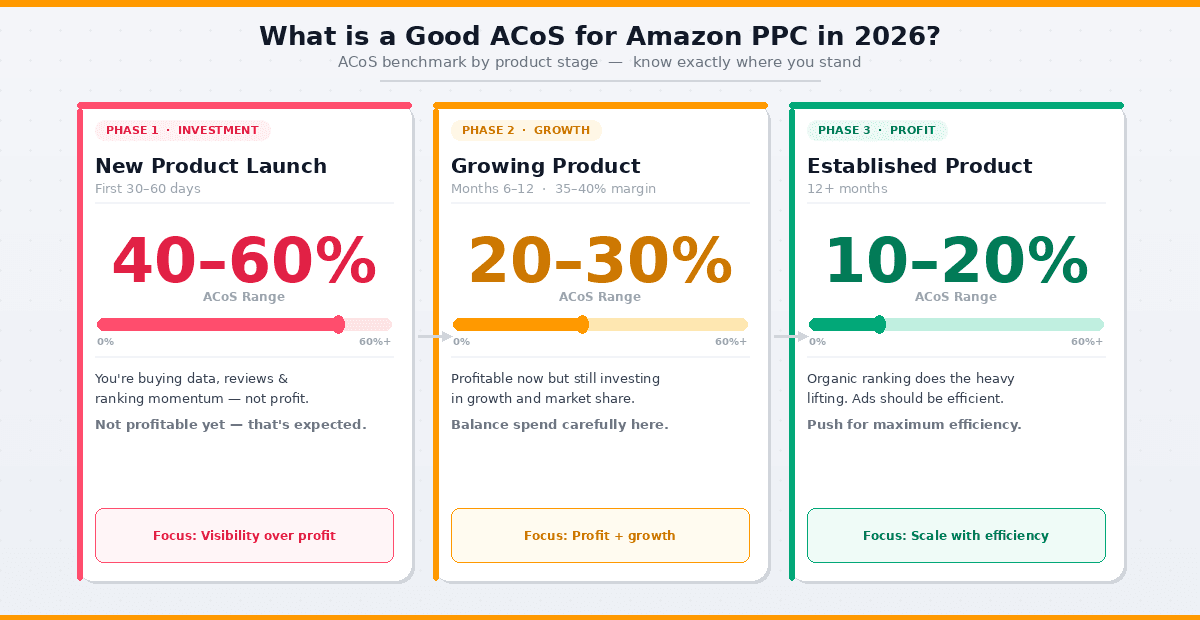
New product launch: 40 to 60% ACoS is acceptable. You're buying data, reviews, and ranking momentum not pure profit. Expect this phase to last 30 to 60 days.
Growing product (6 to 12 months): Target 20 to 30% ACoS, assuming a 35 to 40% margin. You should be profitable by now but still investing in growth.
Established product: Push for 10 to 20% ACoS. At this stage, your organic ranking does the heavy lifting and your ads should be highly efficient.
One more metric to know in 2026: TACoS (Total Advertising Cost of Sales). This measures ad spend against your total revenue including organic sales. A dropping TACoS over time means your ads are building organic momentum. A rising TACoS means you're becoming ad-dependent. Track both.
How to reduce Amazon ACoS in 2026?
High ACoS is often due to keywords that spend without converting, campaigns structured in a way that hides where the waste is occurring, or a listing that can't convert the traffic your ads are sending.
Fix 1:Identify wasted keywords
Pull your Search Term Report every week. Filter for any search term that has spent more than your target cost-per-acquisition with zero orders in the past 14 days. Add every single one as a negative keyword immediately.
Fix 2: Separate your campaigns by intent
If you're mixing branded keywords, competitor targets, and generic category keywords in the same campaign, you can't optimize any of them properly. Branded searches should convert at an ACoS of 8 to 15%. Competitors should run at 30 to 40% ACoS.
Fix 3: Check your listing
If your conversion rate is low, lowering bids is not the ultimate option. Before touching bids, ask: Is my main image competitive? Is my price reasonable versus alternatives on the same page? Do I have enough reviews to build trust? A weak listing is the most common reason ACoS stays high despite every bid optimization attempt.
How does AI optimize Amazon PPC campaigns?
Manual PPC management has a hard ceiling. A human can review 10 to 20 campaigns with any real depth in a day. Meanwhile, your ads are running 24/7, keywords are spending money every hour, and problems compound silently until your next audit.
This is exactly where AI changes the game. An AI-powered Amazon seller software like SellerQI processes every keyword, every bid, every placement, and every performance pattern across your entire account continuously, not once a week when you finally have time to log in. Watch how SelellerQI manages your bids in real time and try it free for 7 days.
How does SellerQI help?
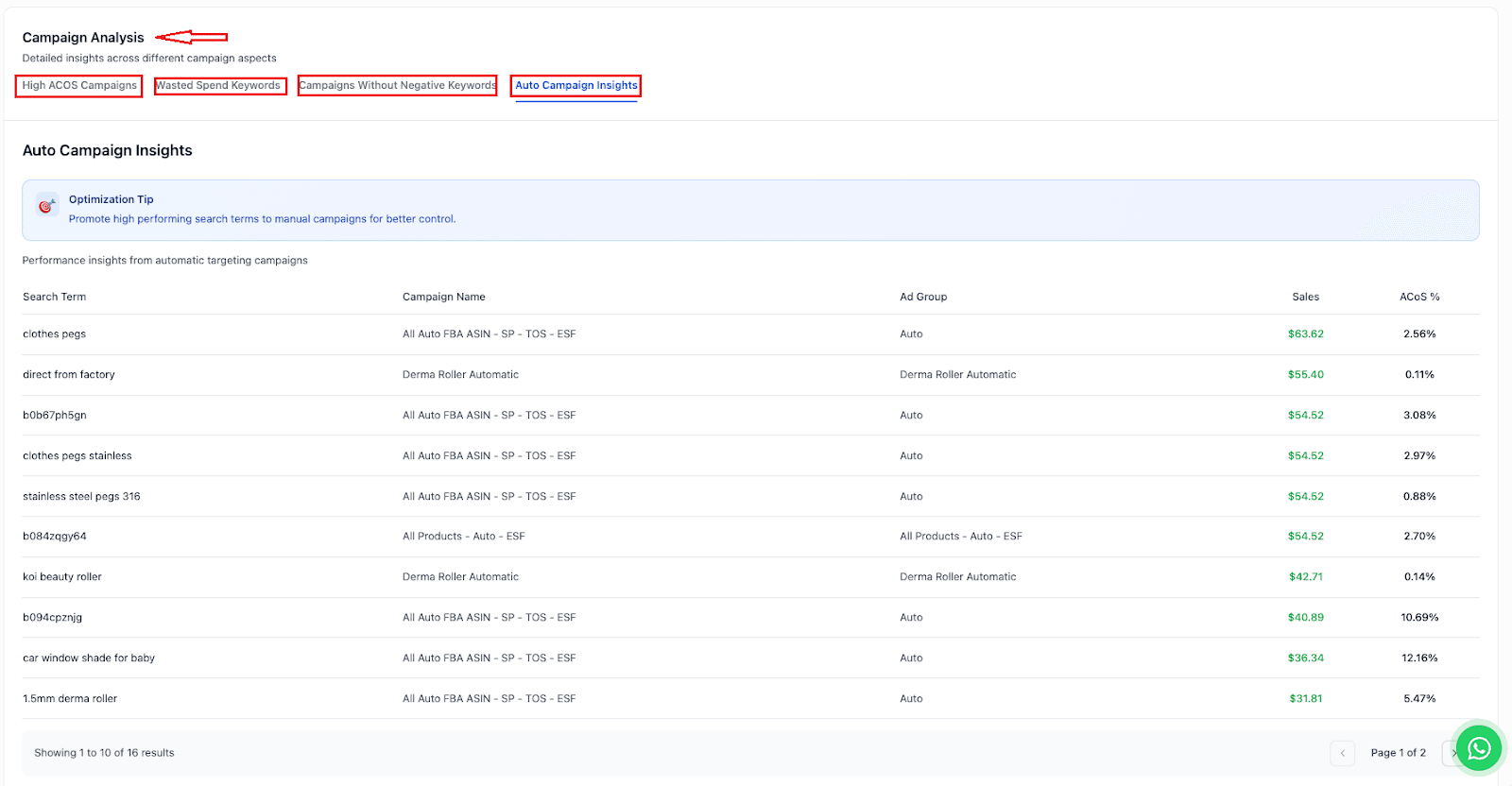
High ACoS campaigns: Most sellers know they have a problem campaign. They just don't know which keywords inside that campaign are causing it. SellerQI finds keyword level and flags exactly which terms have ACoS above your break-even threshold.
Campaigns running without the Buy Box: If you're not winning the Buy Box and your ads are still running, you're paying for clicks that send shoppers to a competitor's buy button. Here for every click, zero chance of a sale. SellerQI acts as Amazon seller analytics surface these campaigns immediately so you can pause them before another dollar goes out.
Keywords burning budget with zero returns: Broad match terms that look relevant, increase clicks, but no sale. SellerQI identifies every search term that has crossed your spend threshold without a single conversion, before it compounds into hundreds of wasted dollars.
Top performers worth scaling: SellerQI shows you which keywords are converting well below your target ACoS. These are the terms you should be bidding more aggressively on, not maintaining at the same level. Most sellers under-invest in their winners because they're too busy firefighting their losers.
Search terms with clicks but zero sales: This is different from high ACoS, these terms haven't converted at all. They might be discovery terms, informational searches, or just the wrong audience. SellerQI identifies them cleanly in an actionable table so you can decide: negate them, or give them more time with a lower bid.
Winning search terms: Your automatic campaigns are finding gold you don't know about yet. SellerQI scans your auto campaign search term data, identifies the terms that are converting profitably, and flags them to add to your manual exact match campaigns for your Amazon PPC strategy.
What is the best Amazon PPC strategy for beginners in 2026?
Start with one automatic campaign and one manual exact match campaign running together. Your auto campaign discovers what real shoppers are actually searching. Your manual campaign controls the keywords you already know to convert. This two-campaign setup is the foundation of any solid Amazon PPC strategy, and it works whether you are brand new or scaling an existing catalog.
For new products specifically, Amazon PPC bid strategies for new products have shifted in 2026. You're not just buying clicks, you're feeding Amazon's algorithm with conversion signals. Use Dynamic Bids Up and Down on your manual campaign so Amazon's AI can push harder when a conversion looks likely.
Set a realistic daily budget of $20 to $30. Mine your auto campaign search terms every week. Move proven converters to manual. Add non-converters as negative keywords. The difference in 2026 is that AI tools like SellerQI handle this harvesting and optimization automatically, so even beginners get the execution speed of an experienced PPC manager from week one.
Wrapping up
Amazon PPC in 2026 is about spending smart. Sellers who get the best results follow a clear and structured Amazon PPC strategy. They organize campaigns based on customer intent, helping them reach the right audience at the right time.
Instead of guessing, they set ACoS targets based on real profit margins, not industry averages. They use AI tools to handle frequent optimizations, something that’s hard to manage manually every day. Here, experienced Sponsored Ads experts help sellers scale efficiently.
In simple terms, success in 2026 comes down to three things: better structure, smarter spending, and using AI to keep campaigns optimized at all times.
FAQs
How much should I spend on Amazon PPC per day?
Beginners should start with $15 to $30 per day, enough to collect real data without burning a budget, before they can optimize. For established products in competitive categories, $50–$150 per campaign per day is more realistic.
What is the difference between ACoS and ROAS on Amazon?
ACoS is your ad spend as a percentage of ad revenue, if you spent $100 and made $400 in sales, your ACoS is 25%. ROAS is the inverse multiplier of the same math that gives you a 4x ROAS.
Should I use automatic or manual campaigns on Amazon in 2026?
Use automatic campaigns to discover converting search terms, then move proven winners into manual exact match campaigns for full bid control. Running both together is the standard approach; never rely on just one.
What are the best Amazon PPC tools for automation in 2026?
SellerQI stands out for identifying wasted ad spend, flagging zero-sale keywords, and giving you actionable campaign fixes in one dashboard.
TL;DR
Amazon PPC in 2026 is about smart spending, not bigger budgets, success comes from a clear, structured Amazon PPC strategy based on customer intent.
Sponsored Products drive most sales, while Sponsored Brands build visibility and protect your brand from competitors.
ACoS should be based on your real profit margins; tracking TACoS helps measure long-term organic growth.
High ACoS is usually caused by wasted keywords, poor campaign structure, or low-converting listings that fix these first.
AI tools like SellerQI help automate keyword optimization, reduce wasted spend, and scale winning campaigns faster than manual management.
The winning formula: structured campaigns, data-driven decisions, and AI-powered optimization for consistent growth.
Amazon advertising in 2026 is not what it was two years ago. CPCs are rising, competition is fiercer, and Amazon's own AI (Rufus) now shapes which products get shown to which shoppers, sometimes before a single keyword is typed.
The sellers who are winning aren't necessarily spending more. They're spending smarter. They have built campaign structures that actually make sense, they know exactly what's draining their budget, and they've stopped trying to manually manage decisions that AI can make faster and more accurately.
Whether you're running your first campaign or managing an account that needs attention, this guide gives you a clear, practical Amazon PPC strategy for 2026, just what actually works.
Amazon Sponsored Brands Vs Sponsored Products: Which one do you actually need?
These two ad types do completely different jobs, and understanding that changes how you budget for them.
Ad Type | Where It Appears | Purpose | Key Benefit |
Sponsored Products | Search results & product detail pages | Direct conversions | Targets high-intent shoppers ready to buy; acts as your primary conversion engine |
Sponsored Brands | Top of search results (banner ads) | Brand awareness & visibility | Builds brand presence and prevents competitors from dominating search results |
The real difference in 2026 comes down to video. Sponsored Brand Video ads have become essential in competitive categories, delivering significantly higher click-through rates than static image ads.
The practical split for most sellers:
Put 70 to 80% of your ad budget into Sponsored Products. This is where your sales come from.
Use Sponsored Brands for brand defense and top-of-funnel visibility, especially if competitors are running ads against your brand name.
Start Sponsored Brand Video with a simple 30-second demo that outperforms static creative.
What is a good ACoS for Amazon PPC in 2026?
Your ACoS target needs to be built around your profit margin. Here's the simple way to think about it:
Break-even ACoS = Profit margin after Amazon fees and cost of goods
If your margin is 35%, then any ACoS below 35% means your ads are profitable. If your ACoS is 40%, you're losing money on every ad-driven sale. That said, here's how the targets shift depending on your situation:
New product launch: 40 to 60% ACoS is acceptable. You're buying data, reviews, and ranking momentum not pure profit. Expect this phase to last 30 to 60 days.
Growing product (6 to 12 months): Target 20 to 30% ACoS, assuming a 35 to 40% margin. You should be profitable by now but still investing in growth.
Established product: Push for 10 to 20% ACoS. At this stage, your organic ranking does the heavy lifting and your ads should be highly efficient.
One more metric to know in 2026: TACoS (Total Advertising Cost of Sales). This measures ad spend against your total revenue including organic sales. A dropping TACoS over time means your ads are building organic momentum. A rising TACoS means you're becoming ad-dependent. Track both.
How to reduce Amazon ACoS in 2026?
High ACoS is often due to keywords that spend without converting, campaigns structured in a way that hides where the waste is occurring, or a listing that can't convert the traffic your ads are sending.
Fix 1:Identify wasted keywords
Pull your Search Term Report every week. Filter for any search term that has spent more than your target cost-per-acquisition with zero orders in the past 14 days. Add every single one as a negative keyword immediately.
Fix 2: Separate your campaigns by intent
If you're mixing branded keywords, competitor targets, and generic category keywords in the same campaign, you can't optimize any of them properly. Branded searches should convert at an ACoS of 8 to 15%. Competitors should run at 30 to 40% ACoS.
Fix 3: Check your listing
If your conversion rate is low, lowering bids is not the ultimate option. Before touching bids, ask: Is my main image competitive? Is my price reasonable versus alternatives on the same page? Do I have enough reviews to build trust? A weak listing is the most common reason ACoS stays high despite every bid optimization attempt.
How does AI optimize Amazon PPC campaigns?
Manual PPC management has a hard ceiling. A human can review 10 to 20 campaigns with any real depth in a day. Meanwhile, your ads are running 24/7, keywords are spending money every hour, and problems compound silently until your next audit.
This is exactly where AI changes the game. An AI-powered Amazon seller software like SellerQI processes every keyword, every bid, every placement, and every performance pattern across your entire account continuously, not once a week when you finally have time to log in. Watch how SelellerQI manages your bids in real time and try it free for 7 days.
How does SellerQI help?
High ACoS campaigns: Most sellers know they have a problem campaign. They just don't know which keywords inside that campaign are causing it. SellerQI finds keyword level and flags exactly which terms have ACoS above your break-even threshold.
Campaigns running without the Buy Box: If you're not winning the Buy Box and your ads are still running, you're paying for clicks that send shoppers to a competitor's buy button. Here for every click, zero chance of a sale. SellerQI acts as Amazon seller analytics surface these campaigns immediately so you can pause them before another dollar goes out.
Keywords burning budget with zero returns: Broad match terms that look relevant, increase clicks, but no sale. SellerQI identifies every search term that has crossed your spend threshold without a single conversion, before it compounds into hundreds of wasted dollars.
Top performers worth scaling: SellerQI shows you which keywords are converting well below your target ACoS. These are the terms you should be bidding more aggressively on, not maintaining at the same level. Most sellers under-invest in their winners because they're too busy firefighting their losers.
Search terms with clicks but zero sales: This is different from high ACoS, these terms haven't converted at all. They might be discovery terms, informational searches, or just the wrong audience. SellerQI identifies them cleanly in an actionable table so you can decide: negate them, or give them more time with a lower bid.
Winning search terms: Your automatic campaigns are finding gold you don't know about yet. SellerQI scans your auto campaign search term data, identifies the terms that are converting profitably, and flags them to add to your manual exact match campaigns for your Amazon PPC strategy.
What is the best Amazon PPC strategy for beginners in 2026?
Start with one automatic campaign and one manual exact match campaign running together. Your auto campaign discovers what real shoppers are actually searching. Your manual campaign controls the keywords you already know to convert. This two-campaign setup is the foundation of any solid Amazon PPC strategy, and it works whether you are brand new or scaling an existing catalog.
For new products specifically, Amazon PPC bid strategies for new products have shifted in 2026. You're not just buying clicks, you're feeding Amazon's algorithm with conversion signals. Use Dynamic Bids Up and Down on your manual campaign so Amazon's AI can push harder when a conversion looks likely.
Set a realistic daily budget of $20 to $30. Mine your auto campaign search terms every week. Move proven converters to manual. Add non-converters as negative keywords. The difference in 2026 is that AI tools like SellerQI handle this harvesting and optimization automatically, so even beginners get the execution speed of an experienced PPC manager from week one.
Wrapping up
Amazon PPC in 2026 is about spending smart. Sellers who get the best results follow a clear and structured Amazon PPC strategy. They organize campaigns based on customer intent, helping them reach the right audience at the right time.
Instead of guessing, they set ACoS targets based on real profit margins, not industry averages. They use AI tools to handle frequent optimizations, something that’s hard to manage manually every day. Here, experienced Sponsored Ads experts help sellers scale efficiently.
In simple terms, success in 2026 comes down to three things: better structure, smarter spending, and using AI to keep campaigns optimized at all times.
FAQs
How much should I spend on Amazon PPC per day?
Beginners should start with $15 to $30 per day, enough to collect real data without burning a budget, before they can optimize. For established products in competitive categories, $50–$150 per campaign per day is more realistic.
What is the difference between ACoS and ROAS on Amazon?
ACoS is your ad spend as a percentage of ad revenue, if you spent $100 and made $400 in sales, your ACoS is 25%. ROAS is the inverse multiplier of the same math that gives you a 4x ROAS.
Should I use automatic or manual campaigns on Amazon in 2026?
Use automatic campaigns to discover converting search terms, then move proven winners into manual exact match campaigns for full bid control. Running both together is the standard approach; never rely on just one.
What are the best Amazon PPC tools for automation in 2026?
SellerQI stands out for identifying wasted ad spend, flagging zero-sale keywords, and giving you actionable campaign fixes in one dashboard.
TL;DR
Amazon PPC in 2026 is about smart spending, not bigger budgets, success comes from a clear, structured Amazon PPC strategy based on customer intent.
Sponsored Products drive most sales, while Sponsored Brands build visibility and protect your brand from competitors.
ACoS should be based on your real profit margins; tracking TACoS helps measure long-term organic growth.
High ACoS is usually caused by wasted keywords, poor campaign structure, or low-converting listings that fix these first.
AI tools like SellerQI help automate keyword optimization, reduce wasted spend, and scale winning campaigns faster than manual management.
The winning formula: structured campaigns, data-driven decisions, and AI-powered optimization for consistent growth.
Amazon advertising in 2026 is not what it was two years ago. CPCs are rising, competition is fiercer, and Amazon's own AI (Rufus) now shapes which products get shown to which shoppers, sometimes before a single keyword is typed.
The sellers who are winning aren't necessarily spending more. They're spending smarter. They have built campaign structures that actually make sense, they know exactly what's draining their budget, and they've stopped trying to manually manage decisions that AI can make faster and more accurately.
Whether you're running your first campaign or managing an account that needs attention, this guide gives you a clear, practical Amazon PPC strategy for 2026, just what actually works.
Amazon Sponsored Brands Vs Sponsored Products: Which one do you actually need?
These two ad types do completely different jobs, and understanding that changes how you budget for them.
Ad Type | Where It Appears | Purpose | Key Benefit |
Sponsored Products | Search results & product detail pages | Direct conversions | Targets high-intent shoppers ready to buy; acts as your primary conversion engine |
Sponsored Brands | Top of search results (banner ads) | Brand awareness & visibility | Builds brand presence and prevents competitors from dominating search results |
The real difference in 2026 comes down to video. Sponsored Brand Video ads have become essential in competitive categories, delivering significantly higher click-through rates than static image ads.
The practical split for most sellers:
Put 70 to 80% of your ad budget into Sponsored Products. This is where your sales come from.
Use Sponsored Brands for brand defense and top-of-funnel visibility, especially if competitors are running ads against your brand name.
Start Sponsored Brand Video with a simple 30-second demo that outperforms static creative.
What is a good ACoS for Amazon PPC in 2026?
Your ACoS target needs to be built around your profit margin. Here's the simple way to think about it:
Break-even ACoS = Profit margin after Amazon fees and cost of goods
If your margin is 35%, then any ACoS below 35% means your ads are profitable. If your ACoS is 40%, you're losing money on every ad-driven sale. That said, here's how the targets shift depending on your situation:
New product launch: 40 to 60% ACoS is acceptable. You're buying data, reviews, and ranking momentum not pure profit. Expect this phase to last 30 to 60 days.
Growing product (6 to 12 months): Target 20 to 30% ACoS, assuming a 35 to 40% margin. You should be profitable by now but still investing in growth.
Established product: Push for 10 to 20% ACoS. At this stage, your organic ranking does the heavy lifting and your ads should be highly efficient.
One more metric to know in 2026: TACoS (Total Advertising Cost of Sales). This measures ad spend against your total revenue including organic sales. A dropping TACoS over time means your ads are building organic momentum. A rising TACoS means you're becoming ad-dependent. Track both.
How to reduce Amazon ACoS in 2026?
High ACoS is often due to keywords that spend without converting, campaigns structured in a way that hides where the waste is occurring, or a listing that can't convert the traffic your ads are sending.
Fix 1:Identify wasted keywords
Pull your Search Term Report every week. Filter for any search term that has spent more than your target cost-per-acquisition with zero orders in the past 14 days. Add every single one as a negative keyword immediately.
Fix 2: Separate your campaigns by intent
If you're mixing branded keywords, competitor targets, and generic category keywords in the same campaign, you can't optimize any of them properly. Branded searches should convert at an ACoS of 8 to 15%. Competitors should run at 30 to 40% ACoS.
Fix 3: Check your listing
If your conversion rate is low, lowering bids is not the ultimate option. Before touching bids, ask: Is my main image competitive? Is my price reasonable versus alternatives on the same page? Do I have enough reviews to build trust? A weak listing is the most common reason ACoS stays high despite every bid optimization attempt.
How does AI optimize Amazon PPC campaigns?
Manual PPC management has a hard ceiling. A human can review 10 to 20 campaigns with any real depth in a day. Meanwhile, your ads are running 24/7, keywords are spending money every hour, and problems compound silently until your next audit.
This is exactly where AI changes the game. An AI-powered Amazon seller software like SellerQI processes every keyword, every bid, every placement, and every performance pattern across your entire account continuously, not once a week when you finally have time to log in. Watch how SelellerQI manages your bids in real time and try it free for 7 days.
How does SellerQI help?
High ACoS campaigns: Most sellers know they have a problem campaign. They just don't know which keywords inside that campaign are causing it. SellerQI finds keyword level and flags exactly which terms have ACoS above your break-even threshold.
Campaigns running without the Buy Box: If you're not winning the Buy Box and your ads are still running, you're paying for clicks that send shoppers to a competitor's buy button. Here for every click, zero chance of a sale. SellerQI acts as Amazon seller analytics surface these campaigns immediately so you can pause them before another dollar goes out.
Keywords burning budget with zero returns: Broad match terms that look relevant, increase clicks, but no sale. SellerQI identifies every search term that has crossed your spend threshold without a single conversion, before it compounds into hundreds of wasted dollars.
Top performers worth scaling: SellerQI shows you which keywords are converting well below your target ACoS. These are the terms you should be bidding more aggressively on, not maintaining at the same level. Most sellers under-invest in their winners because they're too busy firefighting their losers.
Search terms with clicks but zero sales: This is different from high ACoS, these terms haven't converted at all. They might be discovery terms, informational searches, or just the wrong audience. SellerQI identifies them cleanly in an actionable table so you can decide: negate them, or give them more time with a lower bid.
Winning search terms: Your automatic campaigns are finding gold you don't know about yet. SellerQI scans your auto campaign search term data, identifies the terms that are converting profitably, and flags them to add to your manual exact match campaigns for your Amazon PPC strategy.
What is the best Amazon PPC strategy for beginners in 2026?
Start with one automatic campaign and one manual exact match campaign running together. Your auto campaign discovers what real shoppers are actually searching. Your manual campaign controls the keywords you already know to convert. This two-campaign setup is the foundation of any solid Amazon PPC strategy, and it works whether you are brand new or scaling an existing catalog.
For new products specifically, Amazon PPC bid strategies for new products have shifted in 2026. You're not just buying clicks, you're feeding Amazon's algorithm with conversion signals. Use Dynamic Bids Up and Down on your manual campaign so Amazon's AI can push harder when a conversion looks likely.
Set a realistic daily budget of $20 to $30. Mine your auto campaign search terms every week. Move proven converters to manual. Add non-converters as negative keywords. The difference in 2026 is that AI tools like SellerQI handle this harvesting and optimization automatically, so even beginners get the execution speed of an experienced PPC manager from week one.
Wrapping up
Amazon PPC in 2026 is about spending smart. Sellers who get the best results follow a clear and structured Amazon PPC strategy. They organize campaigns based on customer intent, helping them reach the right audience at the right time.
Instead of guessing, they set ACoS targets based on real profit margins, not industry averages. They use AI tools to handle frequent optimizations, something that’s hard to manage manually every day. Here, experienced Sponsored Ads experts help sellers scale efficiently.
In simple terms, success in 2026 comes down to three things: better structure, smarter spending, and using AI to keep campaigns optimized at all times.
FAQs
How much should I spend on Amazon PPC per day?
Beginners should start with $15 to $30 per day, enough to collect real data without burning a budget, before they can optimize. For established products in competitive categories, $50–$150 per campaign per day is more realistic.
What is the difference between ACoS and ROAS on Amazon?
ACoS is your ad spend as a percentage of ad revenue, if you spent $100 and made $400 in sales, your ACoS is 25%. ROAS is the inverse multiplier of the same math that gives you a 4x ROAS.
Should I use automatic or manual campaigns on Amazon in 2026?
Use automatic campaigns to discover converting search terms, then move proven winners into manual exact match campaigns for full bid control. Running both together is the standard approach; never rely on just one.
What are the best Amazon PPC tools for automation in 2026?
SellerQI stands out for identifying wasted ad spend, flagging zero-sale keywords, and giving you actionable campaign fixes in one dashboard.





eStore Factory is a full-service Amazon agency dedicated to building end-to-end strategies for brands of all sizes.


SERVICES FOR AMAZON
Product Setup ON AMAZON
GRAPHICS & BRANDING SERVICES
PPC MANAGEMENT
© Copyright 2014 - 2026. All Rights Reserved.
eStore Factory is a full-service Amazon agency dedicated to building end-to-end strategies for brands of all sizes.
SERVICES FOR AMAZON
Product Setup ON AMAZON
GRAPHICS & BRANDING SERVICES
PPC MANAGEMENT
© Copyright 2014 - 2026. All Rights Reserved.
eStore Factory is a full-service Amazon agency dedicated to building end-to-end strategies for brands of all sizes.
SERVICES FOR AMAZON
Product Setup ON AMAZON
GRAPHICS & BRANDING SERVICES
PPC MANAGEMENT
© Copyright 2014 - 2026. All Rights Reserved.