

Back to Page
Amazon Ads
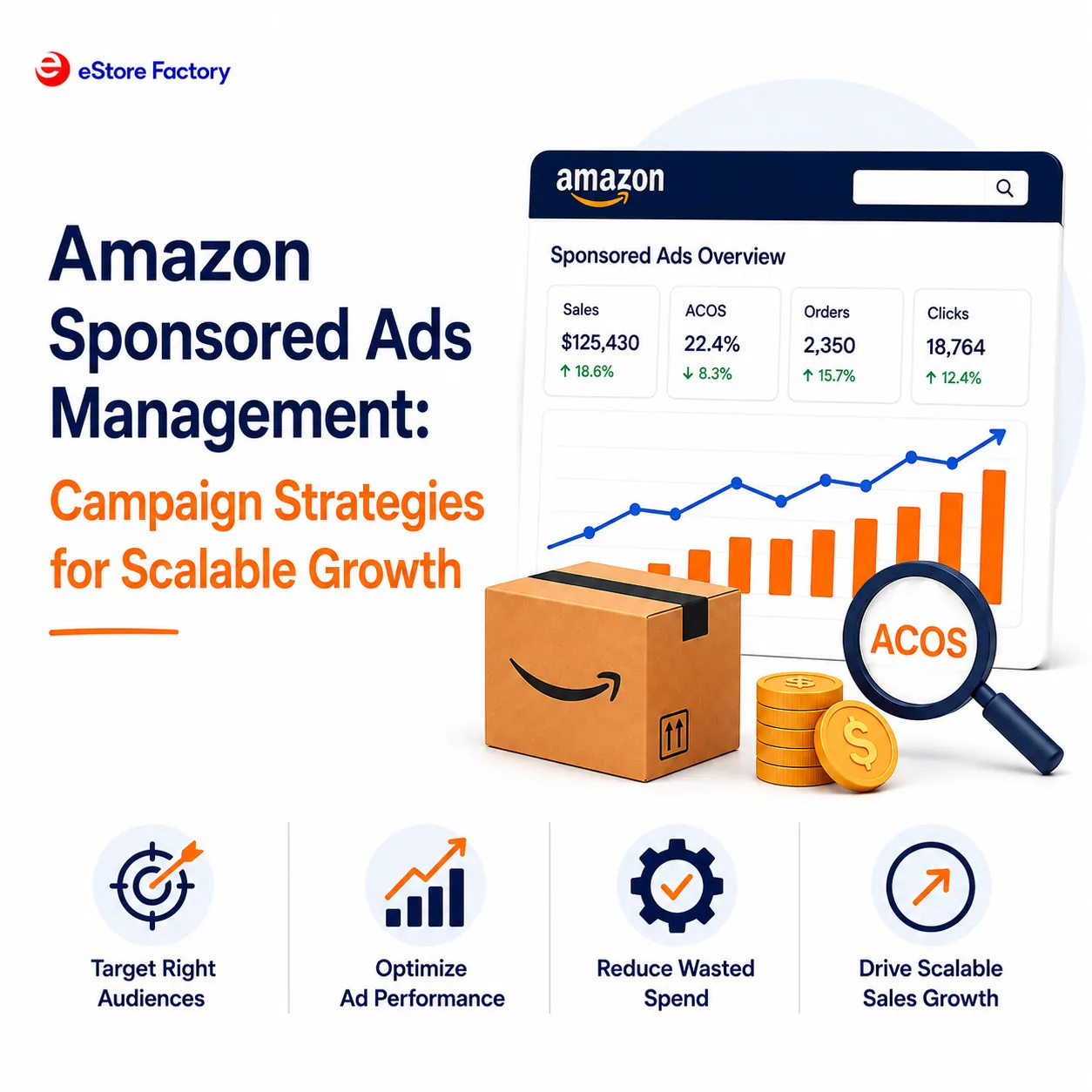
Amazon Sponsored Ads Management: Campaign Strategies for Scalable Growth
Amazon Sponsored Ads Management: Campaign Strategies for Scalable Growth
Back to Page
Amazon Ads
Amazon Sponsored Ads Management: Campaign Strategies for Scalable Growth
When was the last time you checked your Amazon ad campaigns and actually felt confident about where your money was going? Most sellers set up their campaigns, assign a budget, and hope the results follow. But hope is not a strategy. Without structured Amazon sponsored ads management, ad spend grows faster than revenue, bids go unchecked, and campaigns that should be driving growth end up draining it. The problem is rarely the product. It is almost always the absence of a system behind the ads.
Working with a results-focused Amazon PPC agency like eStore Factory gives sellers something more valuable than active campaigns. It gives them a strategy built to scale, with every decision tied to performance data and long-term growth.
Why Do Most Amazon Ad Campaigns Stall Before They Scale?
Amazon ad campaigns stall when they are built to launch, not built to grow. There is a significant difference between the two, and most sellers never realize it until the budget is already gone.
There are three root causes that consistently hold campaigns back:
No separation between discovery and performance campaigns: Auto and manual campaigns running under the same structure and budget make it nearly impossible to tell which targeting is actually bringing in results and which is just spending.
Keyword overlap across ad groups: The same keywords appearing across multiple campaigns without a clear priority system will compete against each other, pushing cost per click up without any real improvement in performance.
Bids that are set once and never revisited: Amazon's auction changes daily. A bid strategy that made sense at launch can actively work against you within weeks.
Poor Amazon campaign management means these issues pile up quietly. Campaigns keep running, spending keeps going out, but growth stops.
What Does a Scalable Campaign Architecture Actually Look Like?
Scalable campaign architecture means every campaign has a defined role and a logical place within the overall account structure. It is not about running more campaigns. It is about running the right ones, organized in a way that makes growth manageable.
1. Auto campaigns as discovery tools, not permanent homes
Auto campaigns are where keyword discovery starts. Amazon matches ads to search terms based on the product listing, which brings up real search language that sellers may never have considered targeting on their own. Once strong-performing search terms show up consistently, they get moved into manual campaigns where bids can be controlled with precision.
2. Manual campaigns built around match type logic
This is where Amazon sponsored ads management becomes a real growth lever. Manual campaigns work best when separated by match type: broad for reaching new audiences, phrase for capturing category intent, and exact for driving conversions. Mixing all three without clear separation leads to bid overlap and wasted spend across the account.
3. Portfolio-level organization for growing accounts
As a product catalog expands, how campaigns are organized matters just as much as how they are set up. Grouping campaigns by product line, margin level, or growth stage makes budget decisions more focused and performance reviews far less time-consuming.
How Does Keyword Research Shape Campaign Performance From Day One?
Keyword research is not a setup task. It is an ongoing input that determines how well every campaign performs, from the first click to the hundredth conversion.
The type of keyword chosen, the match type it is assigned to, and the bid placed behind it all work together. When any one of these is off, the entire campaign feels the impact. The table below breaks down how different keyword types should be approached inside a structured campaign:
Keyword Type | Search Intent | Match Type | Best Used For |
Broad seed keywords | Exploratory | Broad | Building awareness, finding new search terms |
Category keywords | Comparative | Phrase | Reaching shoppers actively browsing a product type |
Long-tail keywords | High purchase intent | Exact | Driving conversions at a lower cost per click |
Competitor keywords | Conquest intent | Exact / Phrase | Capturing demand from rival product pages |
Negative keywords | Filtering irrelevant traffic | Negative exact | Protecting budget from unqualified clicks |
Thorough Amazon keyword research does not stop at finding search volume. It identifies where each keyword belongs in the campaign structure and what role it should play at each stage of the funnel.
Which Bid Optimization Moves Actually Protect Your Margins?
Bid optimization is not about bidding high enough to win. It is about bidding smart enough to win profitably. Every dollar placed behind the wrong keyword or the wrong placement is a dollar pulled away from one that could be building real growth.
Amazon offers three core bid strategies inside Campaign Manager, and each one serves a different purpose:
1. Dynamic bids – down only
For sellers who want to protect their budget without giving up too much control, this is the most practical starting point. Amazon pulls the bid down when a conversion is unlikely, making it a good fit for broad and phrase campaigns where the audience is wide and purchase intent varies from click to click.
2. Dynamic bids – up and down
Here, Amazon gets more flexibility to move bids in either direction depending on how strong the conversion signal is at that moment. This works well once a campaign has collected enough real performance data, because without it, Amazon is essentially adjusting bids in the dark.
3. Fixed bids
With fixed bids, the bid amount stays the same no matter the placement or competition level. Sellers typically use this during a product launch or a ranking push where showing up consistently matters more than keeping costs low in the short term. Since there is less built-in spend control, it needs a defined goal and a set timeframe to avoid runaway costs.
Beyond bid strategy, placement multipliers are one of the most underused controls in Amazon PPC bid optimization. Setting separate percentage adjustments for top-of-search versus product page placements gives precise control over where the budget actually lands.
How Should You Scale Campaigns Without Inflating Ad Spend?
Scaling Amazon campaigns does not mean spending more. It means spending more deliberately, on campaigns that have already proven they deserve the budget.
Before increasing any budget, three signals should be consistently present:
Conversion rate is stable above category baseline: If clicks are converting at a healthy rate over a sustained period, the listing and the campaign targeting are aligned. That alignment is what makes scaling safe.
TACoS is trending downward: When TACoS drops while revenue stays the same or goes up, it means paid campaigns are doing more than just generating clicks. They are helping products rank organically, which is the clearest sign that Amazon sponsored ads management is functioning as a growth system rather than just an ad spend cycle.
New-to-brand percentage is growing: When a growing share of orders are coming from first-time buyers, campaigns are pulling in customers from outside the existing base. That kind of reach is what makes increased investment worthwhile rather than just expensive.
What Separates a One-Time Campaign Win From Consistent Growth?
One strong campaign result does not build a business. Growth on Amazon comes from different ad formats working together, each handling a specific part of the customer journey.
Sponsored Products: The conversion engine
Sponsored Products go after shoppers who are already close to a buying decision and account for the bulk of direct sales. Within any Amazon ads management agency strategy, these campaigns need the sharpest keyword focus and the most regular bid attention.
Sponsored Brands: Visibility and new customer acquisition
Sponsored Brands get in front of shoppers before they have fully made up their mind, which is where brand recall starts to build. Video ads within this format tend to work especially well for products that benefit from being seen in action before someone decides to buy.
Sponsored Display: Retargeting and audience expansion
Sponsored Display brings back shoppers who looked at a product but left without purchasing, keeping the brand in view while they are still deciding. For a well-rounded Amazon PPC agency strategy, this format fills the gap that Sponsored Products and Sponsored Brands alone cannot cover.
How Does eStore Factory's Amazon Sponsored Ads Management Turn Campaign Strategy Into Real Growth?
Most agencies run ads. eStore Factory builds the underlying system that makes those ads work harder over time. As a 3x SPN Award-winning Amazon PPC agency, eStore Factory has helped over 5,000 brands move from inconsistent ad results to structured, scalable campaign performance.
Campaign Architecture Built for Scale: Every account starts with a clean separation of auto and manual campaigns, match type logic, and portfolio-level organization designed to grow with the business, not against it.
Keyword Research That Feeds Every Campaign Decision: eStore Factory maps every keyword from its Amazon keyword research process to the right match type, funnel stage, and bid level so that budget is going after the right traffic from day one.
Bid Optimization Tied to Margin, Not Just Metrics: Bids are reviewed regularly using TACoS, placement performance, and conversion data so that spend stays efficient and organic rank continues to improve over time.
Full-Funnel Ad Management Across Every Format: Sponsored Products, Sponsored Brands, and Sponsored Display are run as one connected system so the brand stays in front of the right shoppers at every point in their buying journey.
Ready to Turn Your Ad Spend Into Scalable Revenue?
Scalable growth on Amazon is not the result of a bigger budget. It is the result of better Amazon campaign management, where every campaign has a defined role, every bid is tied to a performance signal, and every decision is backed by data.
Brands that treat their ad account as a system rather than a collection of live campaigns are the ones that build lasting momentum on the platform. If your current campaigns are running but not growing, the structure behind them is worth examining. eStore Factory works with brands at every stage to build that structure from the ground up, turning ad spend into a reliable growth engine. Book a free strategy call today and find out exactly what your campaigns are missing with a trusted Amazon ads management agency.
FAQs
What is Amazon sponsored ads management?
How does an Amazon PPC agency help sellers scale faster?
What is the difference between ACoS and TACoS?
How often should Amazon PPC bids be optimized?
Why is Amazon keyword research important for campaign performance?
When was the last time you checked your Amazon ad campaigns and actually felt confident about where your money was going? Most sellers set up their campaigns, assign a budget, and hope the results follow. But hope is not a strategy. Without structured Amazon sponsored ads management, ad spend grows faster than revenue, bids go unchecked, and campaigns that should be driving growth end up draining it. The problem is rarely the product. It is almost always the absence of a system behind the ads.
Working with a results-focused Amazon PPC agency like eStore Factory gives sellers something more valuable than active campaigns. It gives them a strategy built to scale, with every decision tied to performance data and long-term growth.
Why Do Most Amazon Ad Campaigns Stall Before They Scale?
Amazon ad campaigns stall when they are built to launch, not built to grow. There is a significant difference between the two, and most sellers never realize it until the budget is already gone.
There are three root causes that consistently hold campaigns back:
No separation between discovery and performance campaigns: Auto and manual campaigns running under the same structure and budget make it nearly impossible to tell which targeting is actually bringing in results and which is just spending.
Keyword overlap across ad groups: The same keywords appearing across multiple campaigns without a clear priority system will compete against each other, pushing cost per click up without any real improvement in performance.
Bids that are set once and never revisited: Amazon's auction changes daily. A bid strategy that made sense at launch can actively work against you within weeks.
Poor Amazon campaign management means these issues pile up quietly. Campaigns keep running, spending keeps going out, but growth stops.
What Does a Scalable Campaign Architecture Actually Look Like?
Scalable campaign architecture means every campaign has a defined role and a logical place within the overall account structure. It is not about running more campaigns. It is about running the right ones, organized in a way that makes growth manageable.
1. Auto campaigns as discovery tools, not permanent homes
Auto campaigns are where keyword discovery starts. Amazon matches ads to search terms based on the product listing, which brings up real search language that sellers may never have considered targeting on their own. Once strong-performing search terms show up consistently, they get moved into manual campaigns where bids can be controlled with precision.
2. Manual campaigns built around match type logic
This is where Amazon sponsored ads management becomes a real growth lever. Manual campaigns work best when separated by match type: broad for reaching new audiences, phrase for capturing category intent, and exact for driving conversions. Mixing all three without clear separation leads to bid overlap and wasted spend across the account.
3. Portfolio-level organization for growing accounts
As a product catalog expands, how campaigns are organized matters just as much as how they are set up. Grouping campaigns by product line, margin level, or growth stage makes budget decisions more focused and performance reviews far less time-consuming.
How Does Keyword Research Shape Campaign Performance From Day One?
Keyword research is not a setup task. It is an ongoing input that determines how well every campaign performs, from the first click to the hundredth conversion.
The type of keyword chosen, the match type it is assigned to, and the bid placed behind it all work together. When any one of these is off, the entire campaign feels the impact. The table below breaks down how different keyword types should be approached inside a structured campaign:
Keyword Type | Search Intent | Match Type | Best Used For |
Broad seed keywords | Exploratory | Broad | Building awareness, finding new search terms |
Category keywords | Comparative | Phrase | Reaching shoppers actively browsing a product type |
Long-tail keywords | High purchase intent | Exact | Driving conversions at a lower cost per click |
Competitor keywords | Conquest intent | Exact / Phrase | Capturing demand from rival product pages |
Negative keywords | Filtering irrelevant traffic | Negative exact | Protecting budget from unqualified clicks |
Thorough Amazon keyword research does not stop at finding search volume. It identifies where each keyword belongs in the campaign structure and what role it should play at each stage of the funnel.
Which Bid Optimization Moves Actually Protect Your Margins?
Bid optimization is not about bidding high enough to win. It is about bidding smart enough to win profitably. Every dollar placed behind the wrong keyword or the wrong placement is a dollar pulled away from one that could be building real growth.
Amazon offers three core bid strategies inside Campaign Manager, and each one serves a different purpose:
1. Dynamic bids – down only
For sellers who want to protect their budget without giving up too much control, this is the most practical starting point. Amazon pulls the bid down when a conversion is unlikely, making it a good fit for broad and phrase campaigns where the audience is wide and purchase intent varies from click to click.
2. Dynamic bids – up and down
Here, Amazon gets more flexibility to move bids in either direction depending on how strong the conversion signal is at that moment. This works well once a campaign has collected enough real performance data, because without it, Amazon is essentially adjusting bids in the dark.
3. Fixed bids
With fixed bids, the bid amount stays the same no matter the placement or competition level. Sellers typically use this during a product launch or a ranking push where showing up consistently matters more than keeping costs low in the short term. Since there is less built-in spend control, it needs a defined goal and a set timeframe to avoid runaway costs.
Beyond bid strategy, placement multipliers are one of the most underused controls in Amazon PPC bid optimization. Setting separate percentage adjustments for top-of-search versus product page placements gives precise control over where the budget actually lands.
How Should You Scale Campaigns Without Inflating Ad Spend?
Scaling Amazon campaigns does not mean spending more. It means spending more deliberately, on campaigns that have already proven they deserve the budget.
Before increasing any budget, three signals should be consistently present:
Conversion rate is stable above category baseline: If clicks are converting at a healthy rate over a sustained period, the listing and the campaign targeting are aligned. That alignment is what makes scaling safe.
TACoS is trending downward: When TACoS drops while revenue stays the same or goes up, it means paid campaigns are doing more than just generating clicks. They are helping products rank organically, which is the clearest sign that Amazon sponsored ads management is functioning as a growth system rather than just an ad spend cycle.
New-to-brand percentage is growing: When a growing share of orders are coming from first-time buyers, campaigns are pulling in customers from outside the existing base. That kind of reach is what makes increased investment worthwhile rather than just expensive.
What Separates a One-Time Campaign Win From Consistent Growth?
One strong campaign result does not build a business. Growth on Amazon comes from different ad formats working together, each handling a specific part of the customer journey.
Sponsored Products: The conversion engine
Sponsored Products go after shoppers who are already close to a buying decision and account for the bulk of direct sales. Within any Amazon ads management agency strategy, these campaigns need the sharpest keyword focus and the most regular bid attention.
Sponsored Brands: Visibility and new customer acquisition
Sponsored Brands get in front of shoppers before they have fully made up their mind, which is where brand recall starts to build. Video ads within this format tend to work especially well for products that benefit from being seen in action before someone decides to buy.
Sponsored Display: Retargeting and audience expansion
Sponsored Display brings back shoppers who looked at a product but left without purchasing, keeping the brand in view while they are still deciding. For a well-rounded Amazon PPC agency strategy, this format fills the gap that Sponsored Products and Sponsored Brands alone cannot cover.
How Does eStore Factory's Amazon Sponsored Ads Management Turn Campaign Strategy Into Real Growth?
Most agencies run ads. eStore Factory builds the underlying system that makes those ads work harder over time. As a 3x SPN Award-winning Amazon PPC agency, eStore Factory has helped over 5,000 brands move from inconsistent ad results to structured, scalable campaign performance.
Campaign Architecture Built for Scale: Every account starts with a clean separation of auto and manual campaigns, match type logic, and portfolio-level organization designed to grow with the business, not against it.
Keyword Research That Feeds Every Campaign Decision: eStore Factory maps every keyword from its Amazon keyword research process to the right match type, funnel stage, and bid level so that budget is going after the right traffic from day one.
Bid Optimization Tied to Margin, Not Just Metrics: Bids are reviewed regularly using TACoS, placement performance, and conversion data so that spend stays efficient and organic rank continues to improve over time.
Full-Funnel Ad Management Across Every Format: Sponsored Products, Sponsored Brands, and Sponsored Display are run as one connected system so the brand stays in front of the right shoppers at every point in their buying journey.
Ready to Turn Your Ad Spend Into Scalable Revenue?
Scalable growth on Amazon is not the result of a bigger budget. It is the result of better Amazon campaign management, where every campaign has a defined role, every bid is tied to a performance signal, and every decision is backed by data.
Brands that treat their ad account as a system rather than a collection of live campaigns are the ones that build lasting momentum on the platform. If your current campaigns are running but not growing, the structure behind them is worth examining. eStore Factory works with brands at every stage to build that structure from the ground up, turning ad spend into a reliable growth engine. Book a free strategy call today and find out exactly what your campaigns are missing with a trusted Amazon ads management agency.
FAQs
What is Amazon sponsored ads management?
How does an Amazon PPC agency help sellers scale faster?
What is the difference between ACoS and TACoS?
How often should Amazon PPC bids be optimized?
Why is Amazon keyword research important for campaign performance?
When was the last time you checked your Amazon ad campaigns and actually felt confident about where your money was going? Most sellers set up their campaigns, assign a budget, and hope the results follow. But hope is not a strategy. Without structured Amazon sponsored ads management, ad spend grows faster than revenue, bids go unchecked, and campaigns that should be driving growth end up draining it. The problem is rarely the product. It is almost always the absence of a system behind the ads.
Working with a results-focused Amazon PPC agency like eStore Factory gives sellers something more valuable than active campaigns. It gives them a strategy built to scale, with every decision tied to performance data and long-term growth.
Why Do Most Amazon Ad Campaigns Stall Before They Scale?
Amazon ad campaigns stall when they are built to launch, not built to grow. There is a significant difference between the two, and most sellers never realize it until the budget is already gone.
There are three root causes that consistently hold campaigns back:
No separation between discovery and performance campaigns: Auto and manual campaigns running under the same structure and budget make it nearly impossible to tell which targeting is actually bringing in results and which is just spending.
Keyword overlap across ad groups: The same keywords appearing across multiple campaigns without a clear priority system will compete against each other, pushing cost per click up without any real improvement in performance.
Bids that are set once and never revisited: Amazon's auction changes daily. A bid strategy that made sense at launch can actively work against you within weeks.
Poor Amazon campaign management means these issues pile up quietly. Campaigns keep running, spending keeps going out, but growth stops.
What Does a Scalable Campaign Architecture Actually Look Like?
Scalable campaign architecture means every campaign has a defined role and a logical place within the overall account structure. It is not about running more campaigns. It is about running the right ones, organized in a way that makes growth manageable.
1. Auto campaigns as discovery tools, not permanent homes
Auto campaigns are where keyword discovery starts. Amazon matches ads to search terms based on the product listing, which brings up real search language that sellers may never have considered targeting on their own. Once strong-performing search terms show up consistently, they get moved into manual campaigns where bids can be controlled with precision.
2. Manual campaigns built around match type logic
This is where Amazon sponsored ads management becomes a real growth lever. Manual campaigns work best when separated by match type: broad for reaching new audiences, phrase for capturing category intent, and exact for driving conversions. Mixing all three without clear separation leads to bid overlap and wasted spend across the account.
3. Portfolio-level organization for growing accounts
As a product catalog expands, how campaigns are organized matters just as much as how they are set up. Grouping campaigns by product line, margin level, or growth stage makes budget decisions more focused and performance reviews far less time-consuming.
How Does Keyword Research Shape Campaign Performance From Day One?
Keyword research is not a setup task. It is an ongoing input that determines how well every campaign performs, from the first click to the hundredth conversion.
The type of keyword chosen, the match type it is assigned to, and the bid placed behind it all work together. When any one of these is off, the entire campaign feels the impact. The table below breaks down how different keyword types should be approached inside a structured campaign:
Keyword Type | Search Intent | Match Type | Best Used For |
Broad seed keywords | Exploratory | Broad | Building awareness, finding new search terms |
Category keywords | Comparative | Phrase | Reaching shoppers actively browsing a product type |
Long-tail keywords | High purchase intent | Exact | Driving conversions at a lower cost per click |
Competitor keywords | Conquest intent | Exact / Phrase | Capturing demand from rival product pages |
Negative keywords | Filtering irrelevant traffic | Negative exact | Protecting budget from unqualified clicks |
Thorough Amazon keyword research does not stop at finding search volume. It identifies where each keyword belongs in the campaign structure and what role it should play at each stage of the funnel.
Which Bid Optimization Moves Actually Protect Your Margins?
Bid optimization is not about bidding high enough to win. It is about bidding smart enough to win profitably. Every dollar placed behind the wrong keyword or the wrong placement is a dollar pulled away from one that could be building real growth.
Amazon offers three core bid strategies inside Campaign Manager, and each one serves a different purpose:
1. Dynamic bids – down only
For sellers who want to protect their budget without giving up too much control, this is the most practical starting point. Amazon pulls the bid down when a conversion is unlikely, making it a good fit for broad and phrase campaigns where the audience is wide and purchase intent varies from click to click.
2. Dynamic bids – up and down
Here, Amazon gets more flexibility to move bids in either direction depending on how strong the conversion signal is at that moment. This works well once a campaign has collected enough real performance data, because without it, Amazon is essentially adjusting bids in the dark.
3. Fixed bids
With fixed bids, the bid amount stays the same no matter the placement or competition level. Sellers typically use this during a product launch or a ranking push where showing up consistently matters more than keeping costs low in the short term. Since there is less built-in spend control, it needs a defined goal and a set timeframe to avoid runaway costs.
Beyond bid strategy, placement multipliers are one of the most underused controls in Amazon PPC bid optimization. Setting separate percentage adjustments for top-of-search versus product page placements gives precise control over where the budget actually lands.
How Should You Scale Campaigns Without Inflating Ad Spend?
Scaling Amazon campaigns does not mean spending more. It means spending more deliberately, on campaigns that have already proven they deserve the budget.
Before increasing any budget, three signals should be consistently present:
Conversion rate is stable above category baseline: If clicks are converting at a healthy rate over a sustained period, the listing and the campaign targeting are aligned. That alignment is what makes scaling safe.
TACoS is trending downward: When TACoS drops while revenue stays the same or goes up, it means paid campaigns are doing more than just generating clicks. They are helping products rank organically, which is the clearest sign that Amazon sponsored ads management is functioning as a growth system rather than just an ad spend cycle.
New-to-brand percentage is growing: When a growing share of orders are coming from first-time buyers, campaigns are pulling in customers from outside the existing base. That kind of reach is what makes increased investment worthwhile rather than just expensive.
What Separates a One-Time Campaign Win From Consistent Growth?
One strong campaign result does not build a business. Growth on Amazon comes from different ad formats working together, each handling a specific part of the customer journey.
Sponsored Products: The conversion engine
Sponsored Products go after shoppers who are already close to a buying decision and account for the bulk of direct sales. Within any Amazon ads management agency strategy, these campaigns need the sharpest keyword focus and the most regular bid attention.
Sponsored Brands: Visibility and new customer acquisition
Sponsored Brands get in front of shoppers before they have fully made up their mind, which is where brand recall starts to build. Video ads within this format tend to work especially well for products that benefit from being seen in action before someone decides to buy.
Sponsored Display: Retargeting and audience expansion
Sponsored Display brings back shoppers who looked at a product but left without purchasing, keeping the brand in view while they are still deciding. For a well-rounded Amazon PPC agency strategy, this format fills the gap that Sponsored Products and Sponsored Brands alone cannot cover.
How Does eStore Factory's Amazon Sponsored Ads Management Turn Campaign Strategy Into Real Growth?
Most agencies run ads. eStore Factory builds the underlying system that makes those ads work harder over time. As a 3x SPN Award-winning Amazon PPC agency, eStore Factory has helped over 5,000 brands move from inconsistent ad results to structured, scalable campaign performance.
Campaign Architecture Built for Scale: Every account starts with a clean separation of auto and manual campaigns, match type logic, and portfolio-level organization designed to grow with the business, not against it.
Keyword Research That Feeds Every Campaign Decision: eStore Factory maps every keyword from its Amazon keyword research process to the right match type, funnel stage, and bid level so that budget is going after the right traffic from day one.
Bid Optimization Tied to Margin, Not Just Metrics: Bids are reviewed regularly using TACoS, placement performance, and conversion data so that spend stays efficient and organic rank continues to improve over time.
Full-Funnel Ad Management Across Every Format: Sponsored Products, Sponsored Brands, and Sponsored Display are run as one connected system so the brand stays in front of the right shoppers at every point in their buying journey.
Ready to Turn Your Ad Spend Into Scalable Revenue?
Scalable growth on Amazon is not the result of a bigger budget. It is the result of better Amazon campaign management, where every campaign has a defined role, every bid is tied to a performance signal, and every decision is backed by data.
Brands that treat their ad account as a system rather than a collection of live campaigns are the ones that build lasting momentum on the platform. If your current campaigns are running but not growing, the structure behind them is worth examining. eStore Factory works with brands at every stage to build that structure from the ground up, turning ad spend into a reliable growth engine. Book a free strategy call today and find out exactly what your campaigns are missing with a trusted Amazon ads management agency.
FAQs
What is Amazon sponsored ads management?
How does an Amazon PPC agency help sellers scale faster?
What is the difference between ACoS and TACoS?
How often should Amazon PPC bids be optimized?
Why is Amazon keyword research important for campaign performance?





eStore Factory is a full-service agency for Amazon Sellers dedicated to building end-to-end strategies for brands of all sizes.


SERVICES FOR AMAZON
Product Setup ON AMAZON
GRAPHICS & BRANDING SERVICES
PPC MANAGEMENT
© Copyright 2014 - 2026. All Rights Reserved.
eStore Factory is a full-service agency for Amazon Sellers dedicated to building end-to-end strategies for brands of all sizes.
SERVICES FOR AMAZON
Product Setup ON AMAZON
GRAPHICS & BRANDING SERVICES
PPC MANAGEMENT
© Copyright 2014 - 2026. All Rights Reserved.
eStore Factory is a full-service agency for Amazon Sellers dedicated to building end-to-end strategies for brands of all sizes.
SERVICES FOR AMAZON
Product Setup ON AMAZON
GRAPHICS & BRANDING SERVICES
PPC MANAGEMENT
© Copyright 2014 - 2026. All Rights Reserved.