

Back to Page
eCommerce Marketing
eCommerce Conversion Optimization Strategies to Improve Sales Performance
eCommerce Conversion Optimization Strategies to Improve Sales Performance
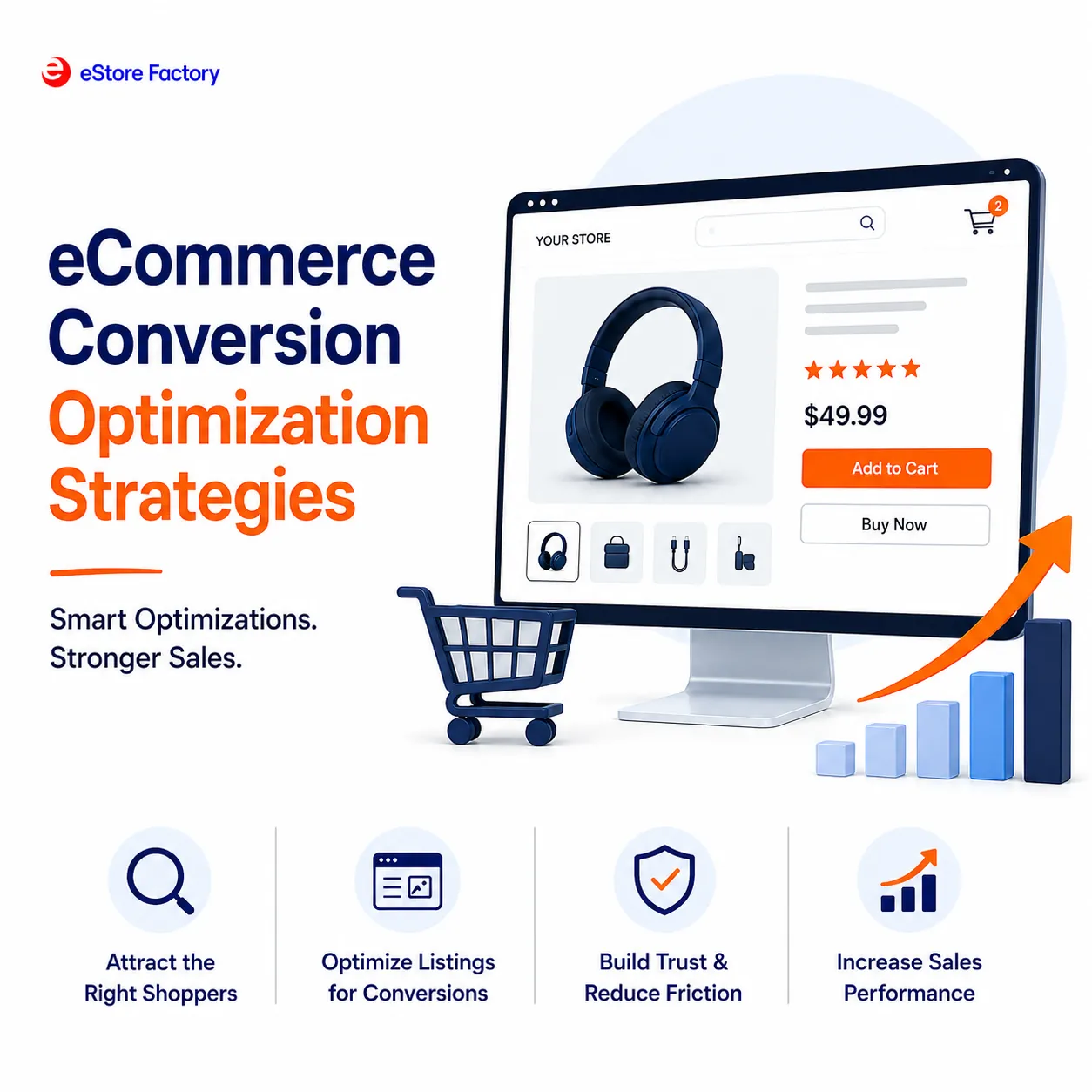
Back to Page
eCommerce Marketing
eCommerce Conversion Optimization Strategies to Improve Sales Performance
If your traffic numbers look healthy but your sales tell a different story, the problem is rarely the traffic itself. Most sellers running eCommerce businesses pour their energy into getting more clicks, more impressions, more reach, without ever stopping to ask what happens once a shopper actually lands on their page. The ability to optimize conversion rate is what determines whether that traffic turns into revenue or simply turns away.
Conversion performance is shaped by everything a shopper sees, reads, and feels from the first search result to the final purchase step. Every listing element, every image, every trust signal plays a role. That is why conversion rate optimization ecommerce requires a structured approach across the full buyer journey, not a one-time fix. eStore Factory has helped thousands of brands build that structure and grow sales consistently. This blog breaks down exactly how to do the same.
Why Are Shoppers Leaving Without Buying?
Most sellers look at their total sales numbers and immediately think about running more ads or lowering prices. What they rarely do is look at where exactly in the buying process they are losing people. A proper sales funnel analysis does not just tell you that conversions are low, it tells you at which stage buyers are dropping off and why. Without that clarity, every fix is just a guess.
The table below maps each stage of the buying journey, what sellers typically observe, and what is actually happening beneath the surface.
Funnel Stage | What Sellers See | What Is Actually Happening | What It Costs You |
Search Visibility | Low impressions or clicks | Listing is not indexed for the right keywords | Buyers never find your product |
Listing Click | Low click-through rate | Main image or title is not compelling enough to earn the click | Traffic goes to competitors instead |
Product Page | High visits, low engagement | Listing copy, images, or layout is not building enough interest or trust | Shoppers scroll past or bounce |
Add to Cart | Page views without cart adds | Pricing, reviews, or product details are creating hesitation | Purchase intent drops before action |
Purchase | Cart abandons at checkout | Friction in the final step or a lack of confidence in the seller | Revenue was lost at the last moment |
Every stage in this table is a separate conversion problem. Treating them all the same way is one of the most common and costly mistakes in sales funnel analysis for eCommerce businesses. Fixing the right stage with the right solution is what actually moves the numbers.
Is Your Product Listing Helping or Hurting Your Sales?
A product listing that is not built for conversion will quietly cost you sales every single day, even when your ads are running, and your traffic looks fine. The listing itself is either doing the selling or undoing it.
How Search Placement Decides Who Buys, Not Just Who Visits
Ranking higher does not automatically mean selling more. The real question is whether the right shopper is finding your product in the first place.
SEO for Amazon listing is not about stuffing keywords to gain visibility. It is about matching your listing to the exact search terms buyers use when they are ready to purchase. When a listing ranks for broad or mismatched keywords, it pulls in browsers rather than buyers. That is a conversion problem, not a traffic problem.
A well-planned ecommerce search engine optimization strategy ensures that the shoppers arriving on your listing already have purchase intent, which makes every other element on the page work harder.
What a Listing Built for Conversion Actually Looks Like
Getting the right shopper to your page is only half the job. Once they land, the listing itself has to close the gap between interest and purchase.
Title structure: A title that leads with the most relevant keyword and clearly states the product benefit gives shoppers an immediate reason to click. Titles that are too vague or too packed with keywords do neither.
Hero image: The first image a shopper sees needs to communicate what the product is within a fraction of a second, with no text required. Poor image quality or a cluttered background at this stage costs you the click before the listing even gets a chance.
Image sequence: After the hero image, each additional photo should address a specific question a buyer is likely to have about the product. Think of it as a visual walkthrough that builds confidence with every scroll.
Bullet points: Buyers scan bullet points looking for reasons to trust a product, not a list of its technical details. Lead with what the product does for the buyer before getting into what the product is made of.
A+ Content: Well-executed A+ content fills in the gaps that bullet points cannot cover and gives the brand a more credible, professional presence on the page. When A+ content is treated as a box-ticking exercise, it adds length without moving a buyer any closer to a decision.
Backend keyword indexing: This part of the listing is invisible to shoppers but plays a significant role in how broadly a listing gets indexed. Gaps, repetitions, or irrelevant terms here directly affect how well SEO for Amazon listing performs in search.
What Actually Moves Shoppers From Browsing to Buying?
Getting traffic to a listing is one challenge. Getting that traffic to convert is a different one entirely. The sellers who grow consistently are not always spending more, they are paying closer attention to what makes a shopper feel confident enough to complete a purchase.
1. Buyer Trust Signals
Review volume, recency, and how negative feedback is handled all shape how credible a listing feels to a first-time buyer. A product with 4.3 stars and 600 reviews will almost always outconvert one with 4.7 stars and 12 reviews. In conversion rate optimization ecommerce, credibility is a conversion lever, not just a reputation metric.
2. Pricing Perception
How a price is presented affects buying decisions before a shopper even reads the listing. Variant options, bundle framing, and clear value signals all reduce the hesitation that an isolated price point creates in a buyer's mind.
3. Listing Information Order
Visual hierarchy determines what a shopper notices, what they trust, and what finally convinces them. A conversion optimizer builds that sequence intentionally, presenting information in a logical, buyer-led order consistently outperforms listings assembled without that structure.
4. Ad and Listing Alignment
Driving paid traffic to a listing that is not built to convert is one of the most common ways ad budgets get wasted. When ad creative aligns with what the listing promises and the listing is already optimized, a skilled conversion optimizer sees results compound naturally.
How eStore Factory Helps You Optimize Conversion Rate at Every Stage?
Most brands struggle with conversion, not because they lack effort, but because each part of their selling strategy works in isolation rather than as a connected system. eStore Factory builds that connected system for you, aligning every layer of your eCommerce presence around one measurable outcome, more sales from the traffic you already have. With a team of over 70 specialists and ecommerce search engine optimization expertise built into every strategy, eStore Factory ensures that nothing in your conversion journey is left to guesswork.
Listing Optimization: eStore Factory goes through every part of your listing, titles, bullet points, and backend keywords and fixes what is quietly pushing buyers away, so the right shoppers find you and actually stick around long enough to buy.
A+ Content and Storefront Design: Buyers do not commit to a purchase when they have unanswered questions, so every content module and storefront page is written and designed to address exactly what holds a shopper back from clicking that buy button.
Sponsored Ads Management: There is no point paying for clicks from shoppers who were never going to buy, which is why every campaign is built around search terms that signal real buying intent rather than just broad interest.
360° Account Management: Conversion performance rarely stays strong without someone keeping a close eye on it, so eStore Factory stays involved in your account month after month, catching drops early and making the adjustments that keep your sales moving forward.
Let's Build a Conversion Strategy That Works for Your Brand
Conversion growth does not come from fixing one thing and hoping the rest falls into place. It comes from making sure that every stage of the buyer journey, from search visibility to listing quality to post-click experience, is working together toward the same goal. Building that kind of alignment is what it truly means to optimize conversion rate in a competitive eCommerce market.
eStore Factory works with brands to build and manage that full-funnel strategy, so that every element of your selling presence is contributing to real, measurable sales growth. If your traffic is healthy but your conversions are not, that gap has a solution. Book a free strategy call with eStore Factory today and find out exactly where your conversion opportunities are.
FAQS
What is a good conversion rate for an eCommerce store?
How does SEO affect conversion rate on Amazon?
What is the fastest way to improve eCommerce conversion rates?
How does sales funnel analysis help improve conversions?
Do sponsored ads improve conversion rate?
If your traffic numbers look healthy but your sales tell a different story, the problem is rarely the traffic itself. Most sellers running eCommerce businesses pour their energy into getting more clicks, more impressions, more reach, without ever stopping to ask what happens once a shopper actually lands on their page. The ability to optimize conversion rate is what determines whether that traffic turns into revenue or simply turns away.
Conversion performance is shaped by everything a shopper sees, reads, and feels from the first search result to the final purchase step. Every listing element, every image, every trust signal plays a role. That is why conversion rate optimization ecommerce requires a structured approach across the full buyer journey, not a one-time fix. eStore Factory has helped thousands of brands build that structure and grow sales consistently. This blog breaks down exactly how to do the same.
Why Are Shoppers Leaving Without Buying?
Most sellers look at their total sales numbers and immediately think about running more ads or lowering prices. What they rarely do is look at where exactly in the buying process they are losing people. A proper sales funnel analysis does not just tell you that conversions are low, it tells you at which stage buyers are dropping off and why. Without that clarity, every fix is just a guess.
The table below maps each stage of the buying journey, what sellers typically observe, and what is actually happening beneath the surface.
Funnel Stage | What Sellers See | What Is Actually Happening | What It Costs You |
Search Visibility | Low impressions or clicks | Listing is not indexed for the right keywords | Buyers never find your product |
Listing Click | Low click-through rate | Main image or title is not compelling enough to earn the click | Traffic goes to competitors instead |
Product Page | High visits, low engagement | Listing copy, images, or layout is not building enough interest or trust | Shoppers scroll past or bounce |
Add to Cart | Page views without cart adds | Pricing, reviews, or product details are creating hesitation | Purchase intent drops before action |
Purchase | Cart abandons at checkout | Friction in the final step or a lack of confidence in the seller | Revenue was lost at the last moment |
Every stage in this table is a separate conversion problem. Treating them all the same way is one of the most common and costly mistakes in sales funnel analysis for eCommerce businesses. Fixing the right stage with the right solution is what actually moves the numbers.
Is Your Product Listing Helping or Hurting Your Sales?
A product listing that is not built for conversion will quietly cost you sales every single day, even when your ads are running, and your traffic looks fine. The listing itself is either doing the selling or undoing it.
How Search Placement Decides Who Buys, Not Just Who Visits
Ranking higher does not automatically mean selling more. The real question is whether the right shopper is finding your product in the first place.
SEO for Amazon listing is not about stuffing keywords to gain visibility. It is about matching your listing to the exact search terms buyers use when they are ready to purchase. When a listing ranks for broad or mismatched keywords, it pulls in browsers rather than buyers. That is a conversion problem, not a traffic problem.
A well-planned ecommerce search engine optimization strategy ensures that the shoppers arriving on your listing already have purchase intent, which makes every other element on the page work harder.
What a Listing Built for Conversion Actually Looks Like
Getting the right shopper to your page is only half the job. Once they land, the listing itself has to close the gap between interest and purchase.
Title structure: A title that leads with the most relevant keyword and clearly states the product benefit gives shoppers an immediate reason to click. Titles that are too vague or too packed with keywords do neither.
Hero image: The first image a shopper sees needs to communicate what the product is within a fraction of a second, with no text required. Poor image quality or a cluttered background at this stage costs you the click before the listing even gets a chance.
Image sequence: After the hero image, each additional photo should address a specific question a buyer is likely to have about the product. Think of it as a visual walkthrough that builds confidence with every scroll.
Bullet points: Buyers scan bullet points looking for reasons to trust a product, not a list of its technical details. Lead with what the product does for the buyer before getting into what the product is made of.
A+ Content: Well-executed A+ content fills in the gaps that bullet points cannot cover and gives the brand a more credible, professional presence on the page. When A+ content is treated as a box-ticking exercise, it adds length without moving a buyer any closer to a decision.
Backend keyword indexing: This part of the listing is invisible to shoppers but plays a significant role in how broadly a listing gets indexed. Gaps, repetitions, or irrelevant terms here directly affect how well SEO for Amazon listing performs in search.
What Actually Moves Shoppers From Browsing to Buying?
Getting traffic to a listing is one challenge. Getting that traffic to convert is a different one entirely. The sellers who grow consistently are not always spending more, they are paying closer attention to what makes a shopper feel confident enough to complete a purchase.
1. Buyer Trust Signals
Review volume, recency, and how negative feedback is handled all shape how credible a listing feels to a first-time buyer. A product with 4.3 stars and 600 reviews will almost always outconvert one with 4.7 stars and 12 reviews. In conversion rate optimization ecommerce, credibility is a conversion lever, not just a reputation metric.
2. Pricing Perception
How a price is presented affects buying decisions before a shopper even reads the listing. Variant options, bundle framing, and clear value signals all reduce the hesitation that an isolated price point creates in a buyer's mind.
3. Listing Information Order
Visual hierarchy determines what a shopper notices, what they trust, and what finally convinces them. A conversion optimizer builds that sequence intentionally, presenting information in a logical, buyer-led order consistently outperforms listings assembled without that structure.
4. Ad and Listing Alignment
Driving paid traffic to a listing that is not built to convert is one of the most common ways ad budgets get wasted. When ad creative aligns with what the listing promises and the listing is already optimized, a skilled conversion optimizer sees results compound naturally.
How eStore Factory Helps You Optimize Conversion Rate at Every Stage?
Most brands struggle with conversion, not because they lack effort, but because each part of their selling strategy works in isolation rather than as a connected system. eStore Factory builds that connected system for you, aligning every layer of your eCommerce presence around one measurable outcome, more sales from the traffic you already have. With a team of over 70 specialists and ecommerce search engine optimization expertise built into every strategy, eStore Factory ensures that nothing in your conversion journey is left to guesswork.
Listing Optimization: eStore Factory goes through every part of your listing, titles, bullet points, and backend keywords and fixes what is quietly pushing buyers away, so the right shoppers find you and actually stick around long enough to buy.
A+ Content and Storefront Design: Buyers do not commit to a purchase when they have unanswered questions, so every content module and storefront page is written and designed to address exactly what holds a shopper back from clicking that buy button.
Sponsored Ads Management: There is no point paying for clicks from shoppers who were never going to buy, which is why every campaign is built around search terms that signal real buying intent rather than just broad interest.
360° Account Management: Conversion performance rarely stays strong without someone keeping a close eye on it, so eStore Factory stays involved in your account month after month, catching drops early and making the adjustments that keep your sales moving forward.
Let's Build a Conversion Strategy That Works for Your Brand
Conversion growth does not come from fixing one thing and hoping the rest falls into place. It comes from making sure that every stage of the buyer journey, from search visibility to listing quality to post-click experience, is working together toward the same goal. Building that kind of alignment is what it truly means to optimize conversion rate in a competitive eCommerce market.
eStore Factory works with brands to build and manage that full-funnel strategy, so that every element of your selling presence is contributing to real, measurable sales growth. If your traffic is healthy but your conversions are not, that gap has a solution. Book a free strategy call with eStore Factory today and find out exactly where your conversion opportunities are.
FAQS
What is a good conversion rate for an eCommerce store?
How does SEO affect conversion rate on Amazon?
What is the fastest way to improve eCommerce conversion rates?
How does sales funnel analysis help improve conversions?
Do sponsored ads improve conversion rate?
If your traffic numbers look healthy but your sales tell a different story, the problem is rarely the traffic itself. Most sellers running eCommerce businesses pour their energy into getting more clicks, more impressions, more reach, without ever stopping to ask what happens once a shopper actually lands on their page. The ability to optimize conversion rate is what determines whether that traffic turns into revenue or simply turns away.
Conversion performance is shaped by everything a shopper sees, reads, and feels from the first search result to the final purchase step. Every listing element, every image, every trust signal plays a role. That is why conversion rate optimization ecommerce requires a structured approach across the full buyer journey, not a one-time fix. eStore Factory has helped thousands of brands build that structure and grow sales consistently. This blog breaks down exactly how to do the same.
Why Are Shoppers Leaving Without Buying?
Most sellers look at their total sales numbers and immediately think about running more ads or lowering prices. What they rarely do is look at where exactly in the buying process they are losing people. A proper sales funnel analysis does not just tell you that conversions are low, it tells you at which stage buyers are dropping off and why. Without that clarity, every fix is just a guess.
The table below maps each stage of the buying journey, what sellers typically observe, and what is actually happening beneath the surface.
Funnel Stage | What Sellers See | What Is Actually Happening | What It Costs You |
Search Visibility | Low impressions or clicks | Listing is not indexed for the right keywords | Buyers never find your product |
Listing Click | Low click-through rate | Main image or title is not compelling enough to earn the click | Traffic goes to competitors instead |
Product Page | High visits, low engagement | Listing copy, images, or layout is not building enough interest or trust | Shoppers scroll past or bounce |
Add to Cart | Page views without cart adds | Pricing, reviews, or product details are creating hesitation | Purchase intent drops before action |
Purchase | Cart abandons at checkout | Friction in the final step or a lack of confidence in the seller | Revenue was lost at the last moment |
Every stage in this table is a separate conversion problem. Treating them all the same way is one of the most common and costly mistakes in sales funnel analysis for eCommerce businesses. Fixing the right stage with the right solution is what actually moves the numbers.
Is Your Product Listing Helping or Hurting Your Sales?
A product listing that is not built for conversion will quietly cost you sales every single day, even when your ads are running, and your traffic looks fine. The listing itself is either doing the selling or undoing it.
How Search Placement Decides Who Buys, Not Just Who Visits
Ranking higher does not automatically mean selling more. The real question is whether the right shopper is finding your product in the first place.
SEO for Amazon listing is not about stuffing keywords to gain visibility. It is about matching your listing to the exact search terms buyers use when they are ready to purchase. When a listing ranks for broad or mismatched keywords, it pulls in browsers rather than buyers. That is a conversion problem, not a traffic problem.
A well-planned ecommerce search engine optimization strategy ensures that the shoppers arriving on your listing already have purchase intent, which makes every other element on the page work harder.
What a Listing Built for Conversion Actually Looks Like
Getting the right shopper to your page is only half the job. Once they land, the listing itself has to close the gap between interest and purchase.
Title structure: A title that leads with the most relevant keyword and clearly states the product benefit gives shoppers an immediate reason to click. Titles that are too vague or too packed with keywords do neither.
Hero image: The first image a shopper sees needs to communicate what the product is within a fraction of a second, with no text required. Poor image quality or a cluttered background at this stage costs you the click before the listing even gets a chance.
Image sequence: After the hero image, each additional photo should address a specific question a buyer is likely to have about the product. Think of it as a visual walkthrough that builds confidence with every scroll.
Bullet points: Buyers scan bullet points looking for reasons to trust a product, not a list of its technical details. Lead with what the product does for the buyer before getting into what the product is made of.
A+ Content: Well-executed A+ content fills in the gaps that bullet points cannot cover and gives the brand a more credible, professional presence on the page. When A+ content is treated as a box-ticking exercise, it adds length without moving a buyer any closer to a decision.
Backend keyword indexing: This part of the listing is invisible to shoppers but plays a significant role in how broadly a listing gets indexed. Gaps, repetitions, or irrelevant terms here directly affect how well SEO for Amazon listing performs in search.
What Actually Moves Shoppers From Browsing to Buying?
Getting traffic to a listing is one challenge. Getting that traffic to convert is a different one entirely. The sellers who grow consistently are not always spending more, they are paying closer attention to what makes a shopper feel confident enough to complete a purchase.
1. Buyer Trust Signals
Review volume, recency, and how negative feedback is handled all shape how credible a listing feels to a first-time buyer. A product with 4.3 stars and 600 reviews will almost always outconvert one with 4.7 stars and 12 reviews. In conversion rate optimization ecommerce, credibility is a conversion lever, not just a reputation metric.
2. Pricing Perception
How a price is presented affects buying decisions before a shopper even reads the listing. Variant options, bundle framing, and clear value signals all reduce the hesitation that an isolated price point creates in a buyer's mind.
3. Listing Information Order
Visual hierarchy determines what a shopper notices, what they trust, and what finally convinces them. A conversion optimizer builds that sequence intentionally, presenting information in a logical, buyer-led order consistently outperforms listings assembled without that structure.
4. Ad and Listing Alignment
Driving paid traffic to a listing that is not built to convert is one of the most common ways ad budgets get wasted. When ad creative aligns with what the listing promises and the listing is already optimized, a skilled conversion optimizer sees results compound naturally.
How eStore Factory Helps You Optimize Conversion Rate at Every Stage?
Most brands struggle with conversion, not because they lack effort, but because each part of their selling strategy works in isolation rather than as a connected system. eStore Factory builds that connected system for you, aligning every layer of your eCommerce presence around one measurable outcome, more sales from the traffic you already have. With a team of over 70 specialists and ecommerce search engine optimization expertise built into every strategy, eStore Factory ensures that nothing in your conversion journey is left to guesswork.
Listing Optimization: eStore Factory goes through every part of your listing, titles, bullet points, and backend keywords and fixes what is quietly pushing buyers away, so the right shoppers find you and actually stick around long enough to buy.
A+ Content and Storefront Design: Buyers do not commit to a purchase when they have unanswered questions, so every content module and storefront page is written and designed to address exactly what holds a shopper back from clicking that buy button.
Sponsored Ads Management: There is no point paying for clicks from shoppers who were never going to buy, which is why every campaign is built around search terms that signal real buying intent rather than just broad interest.
360° Account Management: Conversion performance rarely stays strong without someone keeping a close eye on it, so eStore Factory stays involved in your account month after month, catching drops early and making the adjustments that keep your sales moving forward.
Let's Build a Conversion Strategy That Works for Your Brand
Conversion growth does not come from fixing one thing and hoping the rest falls into place. It comes from making sure that every stage of the buyer journey, from search visibility to listing quality to post-click experience, is working together toward the same goal. Building that kind of alignment is what it truly means to optimize conversion rate in a competitive eCommerce market.
eStore Factory works with brands to build and manage that full-funnel strategy, so that every element of your selling presence is contributing to real, measurable sales growth. If your traffic is healthy but your conversions are not, that gap has a solution. Book a free strategy call with eStore Factory today and find out exactly where your conversion opportunities are.
FAQS
What is a good conversion rate for an eCommerce store?
How does SEO affect conversion rate on Amazon?
What is the fastest way to improve eCommerce conversion rates?
How does sales funnel analysis help improve conversions?
Do sponsored ads improve conversion rate?





eStore Factory is a full-service agency for Amazon Sellers dedicated to building end-to-end strategies for brands of all sizes.


SERVICES FOR AMAZON
Product Setup ON AMAZON
GRAPHICS & BRANDING SERVICES
PPC MANAGEMENT
© Copyright 2014 - 2026. All Rights Reserved.
eStore Factory is a full-service agency for Amazon Sellers dedicated to building end-to-end strategies for brands of all sizes.
SERVICES FOR AMAZON
Product Setup ON AMAZON
GRAPHICS & BRANDING SERVICES
PPC MANAGEMENT
© Copyright 2014 - 2026. All Rights Reserved.
eStore Factory is a full-service agency for Amazon Sellers dedicated to building end-to-end strategies for brands of all sizes.
SERVICES FOR AMAZON
Product Setup ON AMAZON
GRAPHICS & BRANDING SERVICES
PPC MANAGEMENT
© Copyright 2014 - 2026. All Rights Reserved.