

Back to Page
AI SEO
The future of SEO with AI: Trends and the roadmap to AI search dominance in 2026
The future of SEO with AI: Trends and the roadmap to AI search dominance in 2026
Back to Page
AI SEO
The future of SEO with AI: Trends and the roadmap to AI search dominance in 2026
TL;DR
In 2026, SEO is no longer about ranking for keywords but about being recommended by AI tools like ChatGPT, Google AI Overviews, and voice assistants.
AI SEO focuses on intent, trust, and authority, helping brands get cited and mentioned inside AI-generated answers, not just shown as links.
E-E-A-T is now a core ranking factor, with AI prioritizing real human experience, verified authorship, external trust signals, and transparent brand credibility.
Multimodal optimization is essential, as AI connects text, images, videos, and audio into one unified brand trust profile.
Modern SEO strategies are intent-driven, omnichannel, and supported by digital PR, automation tools, and strong technical foundations.
Brands that combine AI tools with human expertise, consistent brand presence, and high-quality content are the ones that dominate AI search in 2026.
Search in 2026 doesn’t look like the Google we grew up with. People are no longer scrolling through ten blue links and picking a website. They’re asking questions and expecting instant, clear answers from AI tools like ChatGPT, Google AI Overviews, and voice assistants.
This marks a major shift from ranking for keywords to being recommended by AI. Today, visibility is not just about links or traffic. It’s about whether AI systems trust your brand enough to mention it as the best solution.
For brands in the USA and around the world, this changes everything. SEO is no longer optional or Google-only. To win in 2026, brands must optimize for AI-driven answers, intent, trust, and authority across every platform where search now happens.
What is AI SEO?
AI SEO (Artificial Intelligence Search Engine Optimization) is the practice of using machine learning, large language models (LLMs), and automated data analysis to improve a website’s visibility across modern search environments.
AI SEO helps brands show up where people actually search today. Instead of focusing only on traditional rankings, it looks at how AI-driven platforms interpret content, understand intent, and decide which sources to trust. This shift makes AI for SEO and marketing a core part of how brands build long-term visibility.
How does AI SEO actually work?
AI SEO works by helping search engines and AI platforms understand, evaluate, and prioritize content the same way a human would, but at scale. Instead of looking only at keywords or links, AI systems analyze meaning, intent, and credibility.
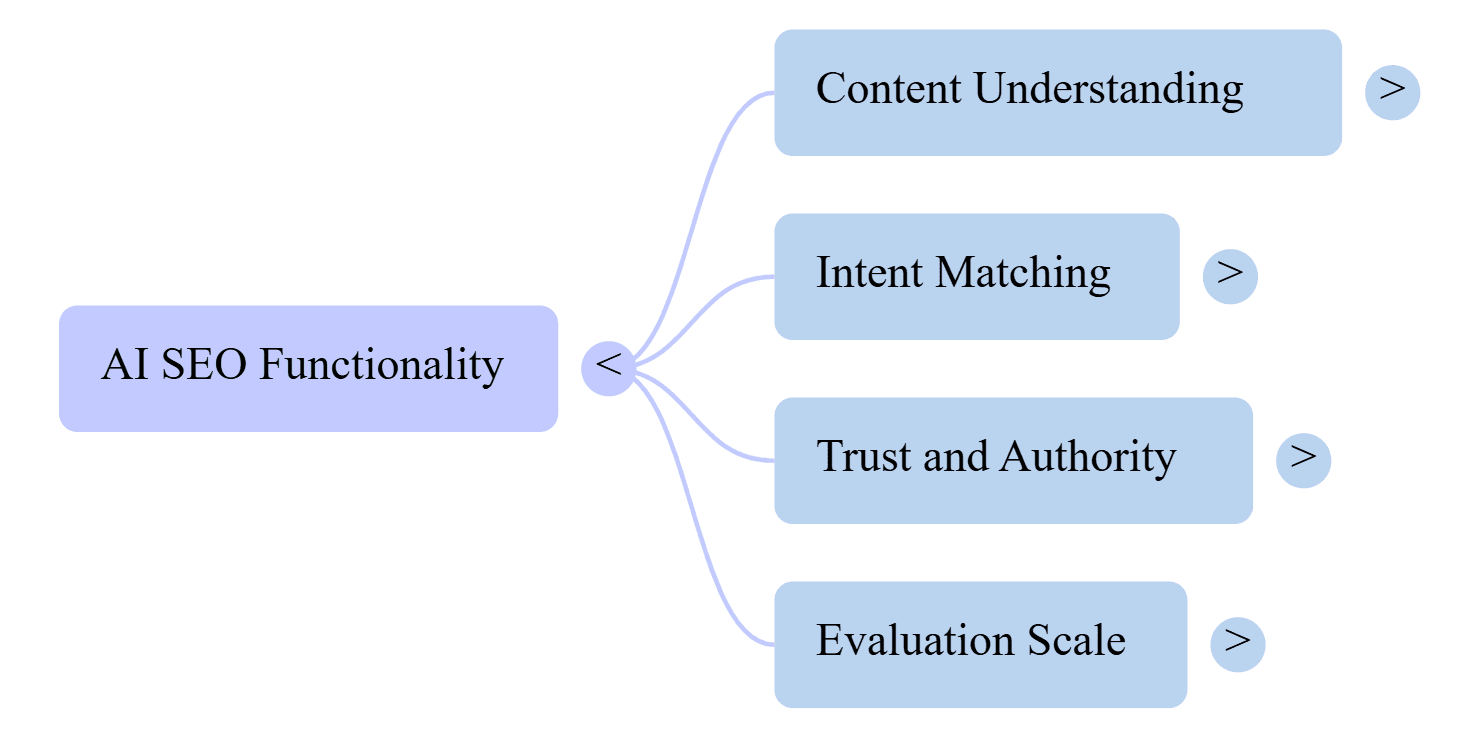
It reads content for context. They evaluate whether a page clearly answers a specific question, how well topics are connected, and whether the information is complete.
It relies heavily on intent matching. AI determines what the user is actually trying to solve and compares it with how well your content addresses that need. Pages written for real users, not just search engines, perform better in AI-driven search.
It looks at trust and authority signals. This includes consistency across platforms, topical depth, brand mentions, and historical performance.
When combined, these signals help AI engines decide which brands to cite, summarize, or recommend.
What is the difference between traditional SEO and AI SEO?
Feature | Traditional SEO | AI SEO |
Primary focus | Ranking for keywords in blue links | Being the cited answer in AI responses |
Content approach | Keyword usage and topic coverage | Clear, extractable answers at passage level |
Authority signals | Backlinks from other websites | Brand mentions, PR, forums, communities |
Technical focus | Site speed, indexing, crawlability | Structured data and intent clarity for AI |
Success metric | Click-through rate (CTR) | AI citations and brand mentions |
User journey | Search → click → website | Prompt → AI answer → recommendation |
How AI has changed the foundation of SEO for brands
Search is no longer just about matching keywords to queries. As we move into 2026, SEO has shifted from what users type to what they actually mean. AI search engines now focus on intent, context, and usefulness, reading content more like a human than a crawler.
This change is forcing brands to rethink how they create, structure, and distribute content. Today’s AI-powered search engines evaluate far more than on-page keywords. They analyze topical depth, consistency, authority signals, and real-world trust.
This is why traditional SEO alone is no longer enough. Ranking for a keyword does not guarantee visibility if AI engines do not recognize your brand as a credible source worth citing or recommending. Search behavior itself has changed.
Users no longer follow a single, linear path from Google to a website. They move across ChatGPT, Google AI Overviews, YouTube, social platforms, and marketplaces, often in the same buying journey. This shift has made “Search Everywhere Optimization” essential for modern brands.
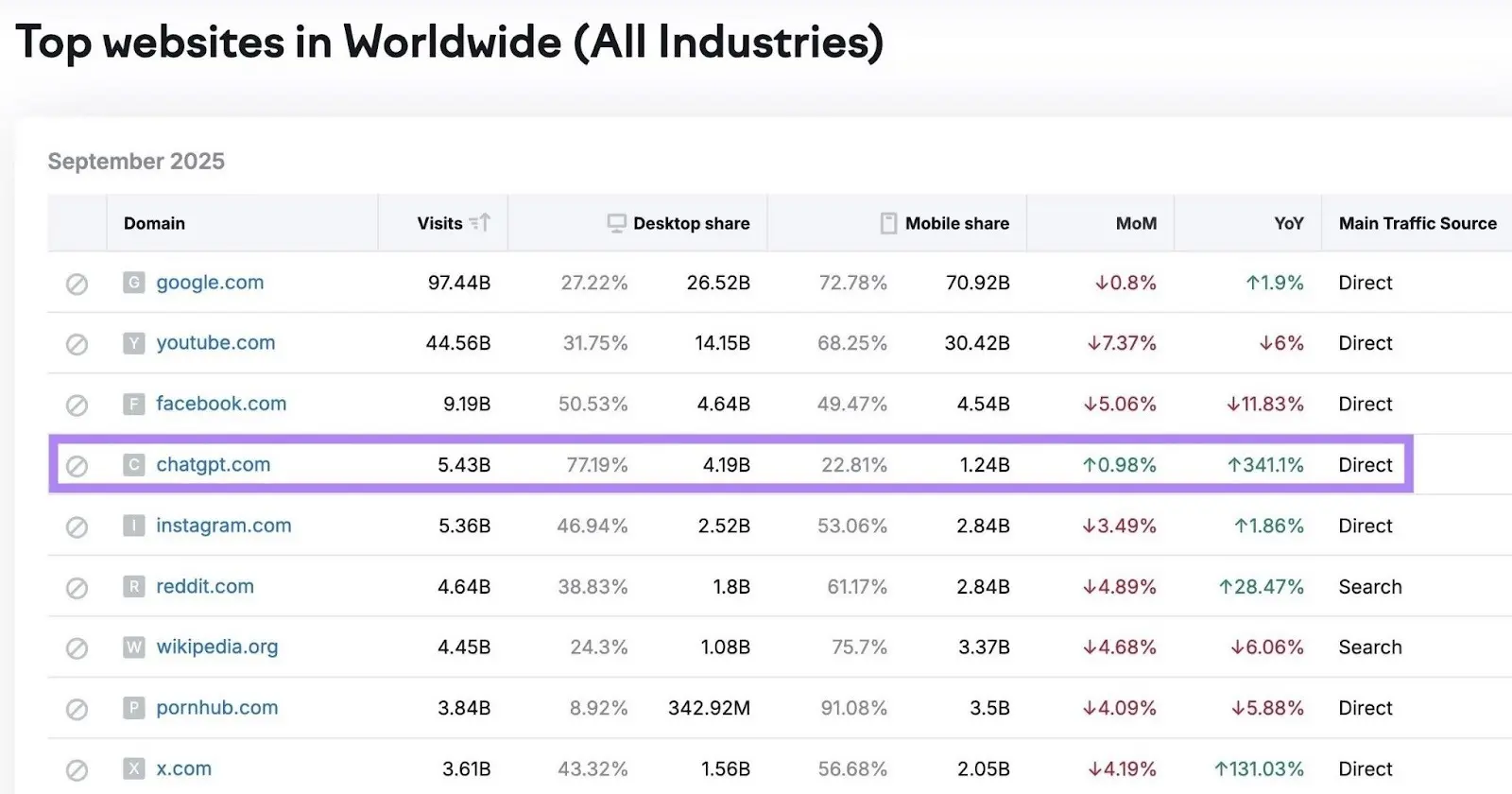
According to the Semrush research, AI search traffic has grown 527% year over year. ChatGPT receives over 5 billion monthly visits, ranking among the world’s most visited websites. Google AI Overviews now reach more than 2 billion users each month, redefining how search visibility is measured.
Brands that built strong SEO foundations and evolved them for the future of SEO with AI are leading in 2026. They’re not just ranking anymore; they’re being trusted, referenced, and chosen across AI search ecosystems.
AI SEO trends 2026: What every brand needs to know right now
#1 E-E-A-T is now a ranking factor
In 2026, E-E-A-T (Experience, Expertise, Authoritativeness, and Trustworthiness) is no longer a soft guideline. It has become a core ranking and recommendation signal. As AI-generated content floods the web, search engines and AI agents are actively filtering out information that does not show clear human involvement.
Experience is now the biggest differentiator: AI can summarize content, but it cannot use a product or visit a place. Search engines now favor content that shows first-hand experience, original photos or videos, real use cases, and insights that go beyond recycled information.
Verified authors matter more than anonymous content: Content is increasingly evaluated through digital author entities. Pages tied to real, identifiable experts, supported by author profiles and structured data, are more likely to be trusted and recommended by AI systems.
AI actively checks external trust signals: Before recommending a brand, AI looks for third-party validation, such as mentions from reputable media, government, or university sites, and genuine discussion on platforms like Reddit or Quora.
Humans still verify trust: Search quality raters now focus on transparency, clear ownership, and expert-reviewed content. In 2026, SEO success depends on proving a real human stands behind the information, not just publishing it.
Traditional E-E-A-T | AI-Driven E-E-A-T (2026) |
Keyword-focused author bios | Author identity verified through Knowledge Graphs |
Broad topic coverage with similar content | High information gain with original insights and real experience |
Backlinks from any high-DA websites | Citations from real human communities (Reddit, forums, expert discussions) |
Basic expertise and credential checks | Deep trust signals measured through real-time sentiment analysis |
Content optimized mainly for search engines | Content evaluated for helpfulness, authority, and real-world value |
#2 Increase in the multimodal search
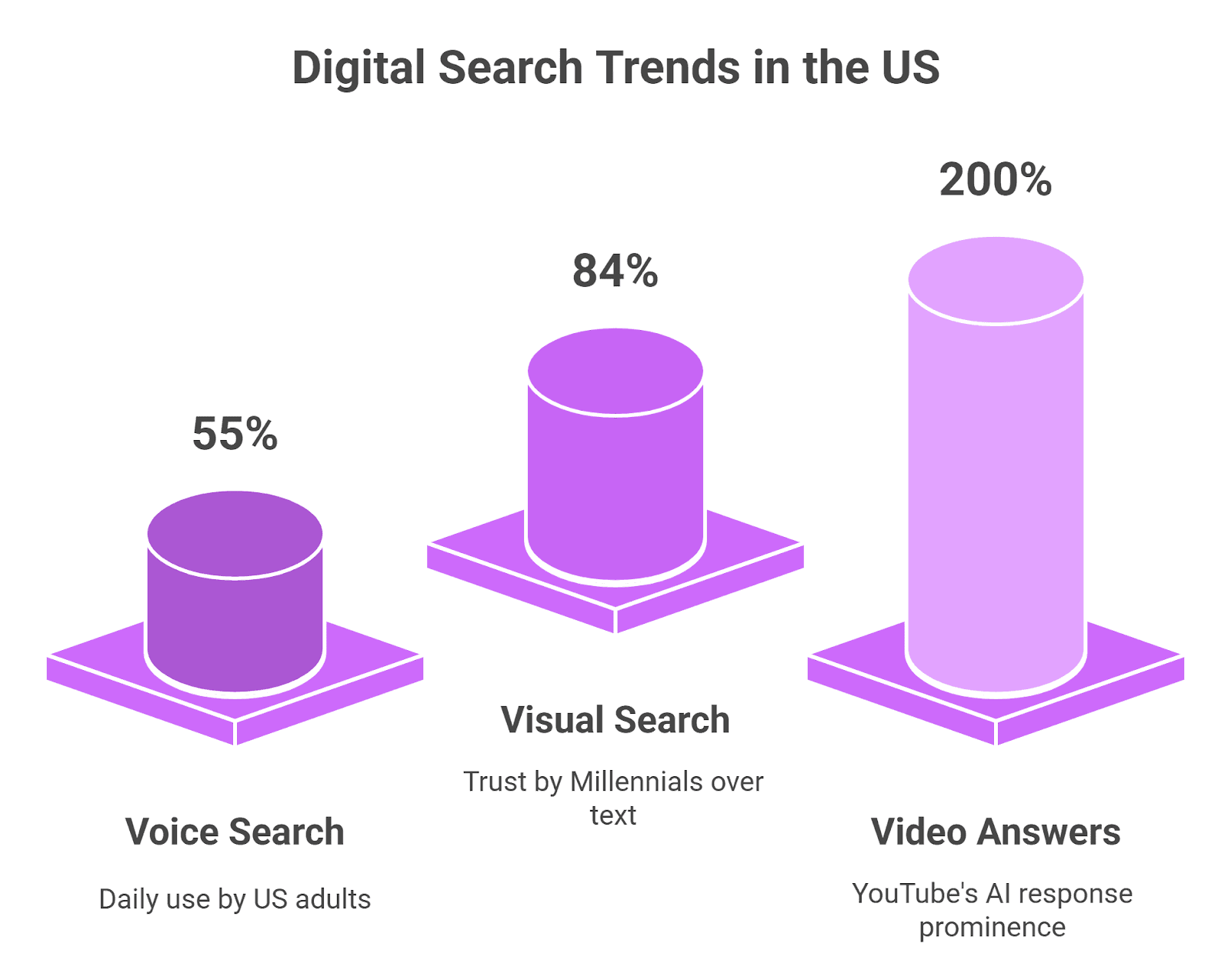
In 2026, search is no longer limited to typing a few words into a search bar. Users now search with images, voice, video, and text, often all in one interaction. This shift toward multimodal search has changed how brands are discovered and recommended.
People take photos and ask questions about what they see. They watch short videos and expect instant answers. They speak to AI assistants and want natural, spoken responses. For brands using AI SEO services in the USA, optimizing only written content is no longer enough.
Visual content now plays a major role. High-quality images, clear alt text, and proper image structuring help AI systems understand and index products visually. Video has become just as important. AI can analyze scenes, timestamps, and transcripts, which means well-structured video content directly supports AI for SEO and marketing.
Voice and audio search also continue to grow. Content must read smoothly when spoken aloud and feel conversational, not robotic. Most importantly, AI connects all of this together. It links images, videos, audio, and text into a single trust profile. Brands that maintain consistency across formats gain stronger visibility in AI-driven search.
Old SEO | Multimodal AI SEO (2026) |
Alt text added mainly for accessibility | Alt text helps AI recognize objects, context, and meaning in images |
Videos used only to boost engagement | Videos are analyzed by AI to pull direct answers |
Images treated as visual support only | Images act as starting points for search discovery |
SEO focused mostly on written keywords | SEO connects text, visuals, audio, and video into one clear message |
Content optimized channel by channel | Content understood as one unified experience across formats |
#3 Intent-based answer over keyword stuffing
In 2026, keyword stuffing is no longer just ineffective; it is ignored. AI-driven search engines do not rank pages based on how often a phrase appears. They rank content based on how well it answers the user’s intent. This marks a major shift in the future of SEO with AI.
AI agents can now accurately identify whether a user is looking to learn, compare, buy, or navigate to a specific brand. If your content does not clearly match that intent, no amount of repeated keywords will help. AI crawlers look for clear, snippet-ready answers that fit the user’s stage in the journey.
Search intent type | Example query | What content works best |
Informational | What is AI SEO? | Structured guides, clear definitions, statistics, and explanatory content |
Commercial | Best AI SEO services in USA | Comparison tables, case studies, proof of results, and expert insights |
Transactional | AI SEO agency pricing | Clear pricing context, service breakdowns, and next-step actions |
Navigational | eStore Factory AI SEO | Strong brand pages, authority signals, and easy-to-find business information |
Modern SEO strategies in digital marketing are built around intent mapping, not keyword density. AI for SEO and marketing rewards content that solves the right problem at the right moment, clearly and completely.
#4 Change the brand authority and its perception
SEO is no longer measured only by where your brand ranks, but by how your brand is talked about. As more users rely on AI assistants for early-stage questions, large language models have become the new awareness layer of search.
Instead of scrolling through results, users are listening to answers. That means brands now compete to be mentioned inside the response, not just listed on a page. AI systems favor brands they recognize, trust, and repeatedly see referenced by reliable sources.
What matters most is context. A brand mentioned as an expert, supported by credible articles, industry citations, and consistent messaging, is more likely to be included positively in AI-generated answers. On the other hand, brands that lack authority or have mixed signals may be ignored entirely.
This shifts how success is measured. Marketers are moving from tracking rankings to tracking influence. The goal is no longer just visibility, but credibility. In simple terms, the brands that teach, educate, and earn trust across the web become the brands AI recommends first.
For businesses, building brand authority is no longer optional; it is essential for AI-driven discovery.
Old SEO Strategy (2024) | 2026 Brand Perception Strategy |
Paying for guest posts just to get links | Getting organic mentions in trusted places like Reddit and Quora |
Chasing high Domain Authority scores | Tracking how people actually feel about your brand |
Targeting keywords with high search volume | Optimizing to be the brand AI recommends first |
Writing a basic “About Us” page | Building verified brand data using schema and knowledge graphs |
Measuring rankings only | Measuring visibility, trust, and recommendations across AI platforms |
#5 Rise of the omnichannel marketing
SEO no longer lives in isolation. It is deeply connected to how a brand shows up across every customer touchpoint. This is why omnichannel marketing has become a major AI SEO trend.
Unlike traditional multichannel marketing, where each platform works separately, omnichannel marketing creates one connected experience. A customer might see your brand on Instagram, visit your website, chat on WhatsApp, and later complete a purchase in-store or online.
AI systems track this entire journey as one signal of trust and relevance. For AI-driven search, consistency matters. When your messaging, tone, and expertise stay aligned across web, social media, email, and even offline interactions, AI engines recognize your brand as more reliable.
This directly supports the future of SEO with AI, where authority is built through repeated, consistent experiences rather than isolated rankings.
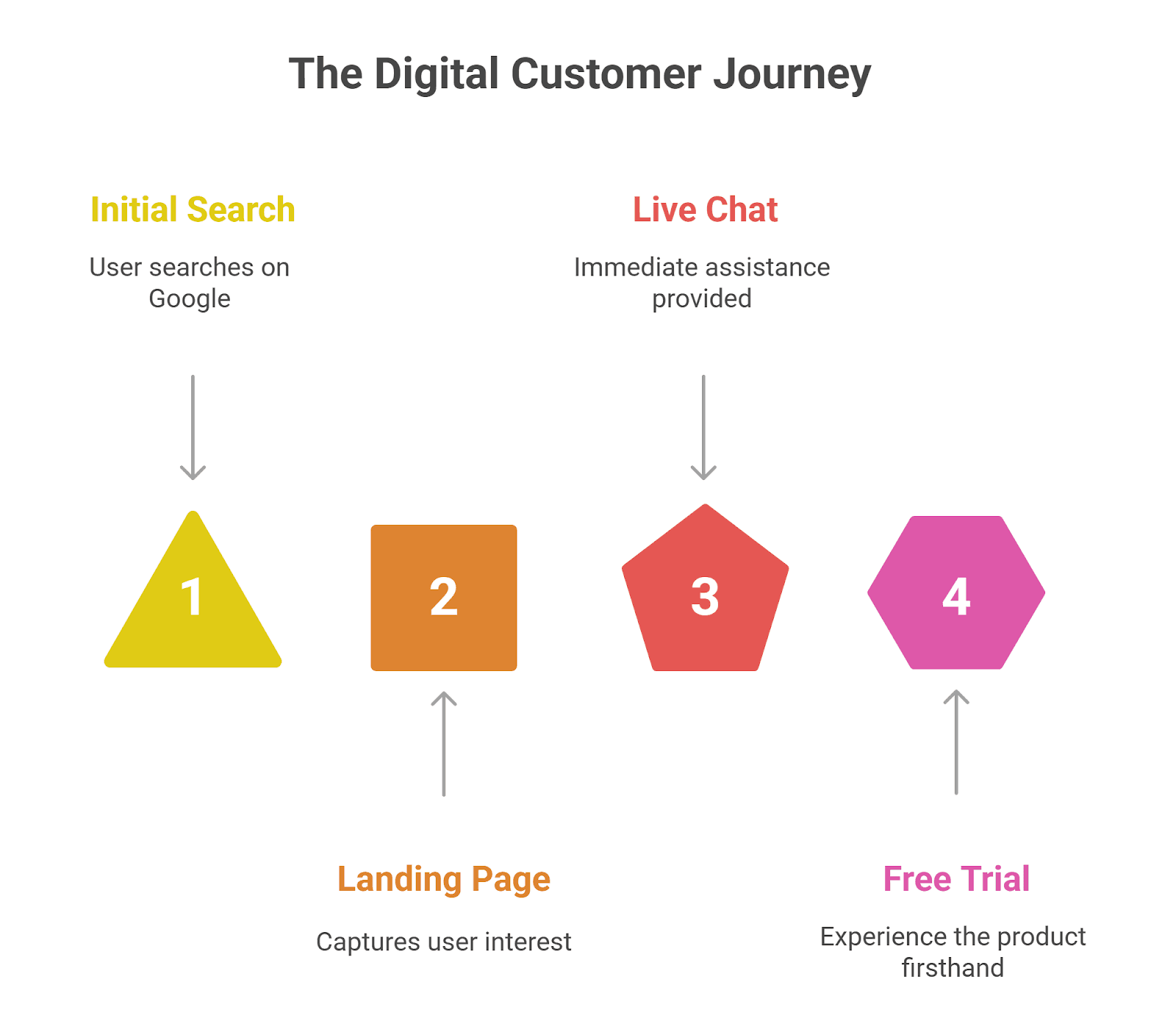
AI for SEO and marketing now evaluates how brands guide users smoothly across platforms. Brands that deliver clear, connected journeys earn stronger visibility, higher engagement, and better conversions. In simple terms, the more unified your presence feels, the more likely AI is to trust and recommend your business.
#7 Digital PR
In 2026, digital PR is no longer just about backlinks. It is about being recognized as a trusted source. As AI-driven search engines and generative models decide which brands to reference in their answers, earned media plays a much bigger role.
AI systems learn trust by observing where and how a brand is mentioned. Coverage in respected industry publications, expert roundups, and credible reviews signals authority far more clearly than mass link-building ever did. These mentions help AI understand who should be cited when users ask questions in your space.
For brands, this means shifting focus. Instead of chasing quantity, the goal is quality recognition. Thought leadership articles, expert commentary, and genuine media features build a reputation that AI can confidently rely on.
Simply put, the brands that consistently show up in high-quality editorial content become familiar to AI. Familiarity leads to trust, and trust leads to recommendations. In the age of AI search, digital PR is how brands earn their place inside the answer, not just on the page.
#8 Rise of automation tools for marketing
In 2026, managing SEO without automation is no longer practical. Brands are no longer optimizing for just Google. They are managing visibility across search engines, AI assistants, and generative platforms all at once. Doing this manually simply does not scale.
Automation has become a necessity, not a nice-to-have. AI visibility monitoring tools now track where and how a brand appears across AI platforms, something that is impossible to do by hand. Content optimization tools help identify gaps, improve structure, and ensure content is easy for AI systems to read and reference.
On the technical side, automation handles tasks like schema validation, site health checks, and fixes needed for agent-based crawling. Instead of reacting late, issues are flagged and resolved faster. Reporting has also evolved. Automated dashboards now combine traditional SEO data with AI citation and recommendation signals. This gives teams a clear, real-time view of performance.
How to get AI to recommend your business?
Use AI as a tool, not a replacement: Use AI for research, optimization, and scaling content, but keep humans in charge of strategy, accuracy, and brand voice. AI helps you move faster, but trust is built by real expertise and storytelling.
Build visibility through digital PR: Focus on being mentioned, not just linked. Earn coverage from industry publications, review platforms, and podcasts. Encourage internal experts to share insights through interviews and commentary. Track where and how your brand appears in AI answers.
Create a connected omnichannel presence: Align ads, content, and PR so messaging stays consistent everywhere. AI often sees paid ads and organic content side by side. Strong third-party mentions and influencer visibility reinforce trust.
Optimize for multimodal discovery: Repurpose content into videos, visuals, tools, and checklists. Share on platforms AI pulls from regularly, like YouTube, Reddit, and social networks. Use proper markup for images and videos.
Design content around intent, not keywords: Map user questions and create clear, connected content that answers them fully. Make your content easy for AI to extract, understand, and cite.
Get technical SEO right: Clean site structure, fast loading, proper indexing, and structured data make your content readable for AI systems.
Final thoughts
The digital landscape isn't just changing; it has already shifted. In 2026, the winners aren't those who rank highest on a list but those who become the trusted answer AI provides. Staying ahead requires more than just luck; it takes a specialized approach.
At eStore Factory, we provide the best AI SEO services in the USA to help your brand earn its place in the generative search era.
Ready to stop being a link and start being the answer? Partner with our AI SEO agency to dominate search in 2026.
FAQs
1. Is SEO still relevant with AI?
Yes. SEO hasn’t disappeared; it has evolved into Generative Engine Optimization (GEO). Traditional SEO helps users find links. AI SEO helps tools like ChatGPT and Gemini recommend your brand as the best answer, not just show your website.
2. What are the benefits of AI in SEO?
AI makes SEO faster and smarter. It spots trends early, finds technical issues, and removes guesswork. Instead of chasing keywords, you build real authority that AI trusts and cites.
3. How does AI provide personalized experiences?
AI understands user intent, behavior, and location in real time. Instead of showing the same results to everyone, it creates custom answers for each user, making your content feel more relevant and personal.
4. What is the role of AI in on-page SEO optimisation?
AI helps optimize titles, meta descriptions, headers, and internal links automatically. It also structures content so AI systems can easily pull and reuse it as answers or recommendations.
5. What kind of data does AI analyze for SEO?
AI looks at user sentiment (how people talk about your brand), search intent (what users actually mean)
multimodal data (text, images, and videos). This helps AI fully understand your brand.
6. How can AI improve digital marketing campaigns?
AI finds wasted ad spend and highlights keywords that actually convert. It tracks your overall digital presence, so your marketing builds long-term trust, not just short-term clicks.
TL;DR
In 2026, SEO is no longer about ranking for keywords but about being recommended by AI tools like ChatGPT, Google AI Overviews, and voice assistants.
AI SEO focuses on intent, trust, and authority, helping brands get cited and mentioned inside AI-generated answers, not just shown as links.
E-E-A-T is now a core ranking factor, with AI prioritizing real human experience, verified authorship, external trust signals, and transparent brand credibility.
Multimodal optimization is essential, as AI connects text, images, videos, and audio into one unified brand trust profile.
Modern SEO strategies are intent-driven, omnichannel, and supported by digital PR, automation tools, and strong technical foundations.
Brands that combine AI tools with human expertise, consistent brand presence, and high-quality content are the ones that dominate AI search in 2026.
Search in 2026 doesn’t look like the Google we grew up with. People are no longer scrolling through ten blue links and picking a website. They’re asking questions and expecting instant, clear answers from AI tools like ChatGPT, Google AI Overviews, and voice assistants.
This marks a major shift from ranking for keywords to being recommended by AI. Today, visibility is not just about links or traffic. It’s about whether AI systems trust your brand enough to mention it as the best solution.
For brands in the USA and around the world, this changes everything. SEO is no longer optional or Google-only. To win in 2026, brands must optimize for AI-driven answers, intent, trust, and authority across every platform where search now happens.
What is AI SEO?
AI SEO (Artificial Intelligence Search Engine Optimization) is the practice of using machine learning, large language models (LLMs), and automated data analysis to improve a website’s visibility across modern search environments.
AI SEO helps brands show up where people actually search today. Instead of focusing only on traditional rankings, it looks at how AI-driven platforms interpret content, understand intent, and decide which sources to trust. This shift makes AI for SEO and marketing a core part of how brands build long-term visibility.
How does AI SEO actually work?
AI SEO works by helping search engines and AI platforms understand, evaluate, and prioritize content the same way a human would, but at scale. Instead of looking only at keywords or links, AI systems analyze meaning, intent, and credibility.
It reads content for context. They evaluate whether a page clearly answers a specific question, how well topics are connected, and whether the information is complete.
It relies heavily on intent matching. AI determines what the user is actually trying to solve and compares it with how well your content addresses that need. Pages written for real users, not just search engines, perform better in AI-driven search.
It looks at trust and authority signals. This includes consistency across platforms, topical depth, brand mentions, and historical performance.
When combined, these signals help AI engines decide which brands to cite, summarize, or recommend.
What is the difference between traditional SEO and AI SEO?
Feature | Traditional SEO | AI SEO |
Primary focus | Ranking for keywords in blue links | Being the cited answer in AI responses |
Content approach | Keyword usage and topic coverage | Clear, extractable answers at passage level |
Authority signals | Backlinks from other websites | Brand mentions, PR, forums, communities |
Technical focus | Site speed, indexing, crawlability | Structured data and intent clarity for AI |
Success metric | Click-through rate (CTR) | AI citations and brand mentions |
User journey | Search → click → website | Prompt → AI answer → recommendation |
How AI has changed the foundation of SEO for brands
Search is no longer just about matching keywords to queries. As we move into 2026, SEO has shifted from what users type to what they actually mean. AI search engines now focus on intent, context, and usefulness, reading content more like a human than a crawler.
This change is forcing brands to rethink how they create, structure, and distribute content. Today’s AI-powered search engines evaluate far more than on-page keywords. They analyze topical depth, consistency, authority signals, and real-world trust.
This is why traditional SEO alone is no longer enough. Ranking for a keyword does not guarantee visibility if AI engines do not recognize your brand as a credible source worth citing or recommending. Search behavior itself has changed.
Users no longer follow a single, linear path from Google to a website. They move across ChatGPT, Google AI Overviews, YouTube, social platforms, and marketplaces, often in the same buying journey. This shift has made “Search Everywhere Optimization” essential for modern brands.
According to the Semrush research, AI search traffic has grown 527% year over year. ChatGPT receives over 5 billion monthly visits, ranking among the world’s most visited websites. Google AI Overviews now reach more than 2 billion users each month, redefining how search visibility is measured.
Brands that built strong SEO foundations and evolved them for the future of SEO with AI are leading in 2026. They’re not just ranking anymore; they’re being trusted, referenced, and chosen across AI search ecosystems.
AI SEO trends 2026: What every brand needs to know right now
#1 E-E-A-T is now a ranking factor
In 2026, E-E-A-T (Experience, Expertise, Authoritativeness, and Trustworthiness) is no longer a soft guideline. It has become a core ranking and recommendation signal. As AI-generated content floods the web, search engines and AI agents are actively filtering out information that does not show clear human involvement.
Experience is now the biggest differentiator: AI can summarize content, but it cannot use a product or visit a place. Search engines now favor content that shows first-hand experience, original photos or videos, real use cases, and insights that go beyond recycled information.
Verified authors matter more than anonymous content: Content is increasingly evaluated through digital author entities. Pages tied to real, identifiable experts, supported by author profiles and structured data, are more likely to be trusted and recommended by AI systems.
AI actively checks external trust signals: Before recommending a brand, AI looks for third-party validation, such as mentions from reputable media, government, or university sites, and genuine discussion on platforms like Reddit or Quora.
Humans still verify trust: Search quality raters now focus on transparency, clear ownership, and expert-reviewed content. In 2026, SEO success depends on proving a real human stands behind the information, not just publishing it.
Traditional E-E-A-T | AI-Driven E-E-A-T (2026) |
Keyword-focused author bios | Author identity verified through Knowledge Graphs |
Broad topic coverage with similar content | High information gain with original insights and real experience |
Backlinks from any high-DA websites | Citations from real human communities (Reddit, forums, expert discussions) |
Basic expertise and credential checks | Deep trust signals measured through real-time sentiment analysis |
Content optimized mainly for search engines | Content evaluated for helpfulness, authority, and real-world value |
#2 Increase in the multimodal search
In 2026, search is no longer limited to typing a few words into a search bar. Users now search with images, voice, video, and text, often all in one interaction. This shift toward multimodal search has changed how brands are discovered and recommended.
People take photos and ask questions about what they see. They watch short videos and expect instant answers. They speak to AI assistants and want natural, spoken responses. For brands using AI SEO services in the USA, optimizing only written content is no longer enough.
Visual content now plays a major role. High-quality images, clear alt text, and proper image structuring help AI systems understand and index products visually. Video has become just as important. AI can analyze scenes, timestamps, and transcripts, which means well-structured video content directly supports AI for SEO and marketing.
Voice and audio search also continue to grow. Content must read smoothly when spoken aloud and feel conversational, not robotic. Most importantly, AI connects all of this together. It links images, videos, audio, and text into a single trust profile. Brands that maintain consistency across formats gain stronger visibility in AI-driven search.
Old SEO | Multimodal AI SEO (2026) |
Alt text added mainly for accessibility | Alt text helps AI recognize objects, context, and meaning in images |
Videos used only to boost engagement | Videos are analyzed by AI to pull direct answers |
Images treated as visual support only | Images act as starting points for search discovery |
SEO focused mostly on written keywords | SEO connects text, visuals, audio, and video into one clear message |
Content optimized channel by channel | Content understood as one unified experience across formats |
#3 Intent-based answer over keyword stuffing
In 2026, keyword stuffing is no longer just ineffective; it is ignored. AI-driven search engines do not rank pages based on how often a phrase appears. They rank content based on how well it answers the user’s intent. This marks a major shift in the future of SEO with AI.
AI agents can now accurately identify whether a user is looking to learn, compare, buy, or navigate to a specific brand. If your content does not clearly match that intent, no amount of repeated keywords will help. AI crawlers look for clear, snippet-ready answers that fit the user’s stage in the journey.
Search intent type | Example query | What content works best |
Informational | What is AI SEO? | Structured guides, clear definitions, statistics, and explanatory content |
Commercial | Best AI SEO services in USA | Comparison tables, case studies, proof of results, and expert insights |
Transactional | AI SEO agency pricing | Clear pricing context, service breakdowns, and next-step actions |
Navigational | eStore Factory AI SEO | Strong brand pages, authority signals, and easy-to-find business information |
Modern SEO strategies in digital marketing are built around intent mapping, not keyword density. AI for SEO and marketing rewards content that solves the right problem at the right moment, clearly and completely.
#4 Change the brand authority and its perception
SEO is no longer measured only by where your brand ranks, but by how your brand is talked about. As more users rely on AI assistants for early-stage questions, large language models have become the new awareness layer of search.
Instead of scrolling through results, users are listening to answers. That means brands now compete to be mentioned inside the response, not just listed on a page. AI systems favor brands they recognize, trust, and repeatedly see referenced by reliable sources.
What matters most is context. A brand mentioned as an expert, supported by credible articles, industry citations, and consistent messaging, is more likely to be included positively in AI-generated answers. On the other hand, brands that lack authority or have mixed signals may be ignored entirely.
This shifts how success is measured. Marketers are moving from tracking rankings to tracking influence. The goal is no longer just visibility, but credibility. In simple terms, the brands that teach, educate, and earn trust across the web become the brands AI recommends first.
For businesses, building brand authority is no longer optional; it is essential for AI-driven discovery.
Old SEO Strategy (2024) | 2026 Brand Perception Strategy |
Paying for guest posts just to get links | Getting organic mentions in trusted places like Reddit and Quora |
Chasing high Domain Authority scores | Tracking how people actually feel about your brand |
Targeting keywords with high search volume | Optimizing to be the brand AI recommends first |
Writing a basic “About Us” page | Building verified brand data using schema and knowledge graphs |
Measuring rankings only | Measuring visibility, trust, and recommendations across AI platforms |
#5 Rise of the omnichannel marketing
SEO no longer lives in isolation. It is deeply connected to how a brand shows up across every customer touchpoint. This is why omnichannel marketing has become a major AI SEO trend.
Unlike traditional multichannel marketing, where each platform works separately, omnichannel marketing creates one connected experience. A customer might see your brand on Instagram, visit your website, chat on WhatsApp, and later complete a purchase in-store or online.
AI systems track this entire journey as one signal of trust and relevance. For AI-driven search, consistency matters. When your messaging, tone, and expertise stay aligned across web, social media, email, and even offline interactions, AI engines recognize your brand as more reliable.
This directly supports the future of SEO with AI, where authority is built through repeated, consistent experiences rather than isolated rankings.
AI for SEO and marketing now evaluates how brands guide users smoothly across platforms. Brands that deliver clear, connected journeys earn stronger visibility, higher engagement, and better conversions. In simple terms, the more unified your presence feels, the more likely AI is to trust and recommend your business.
#7 Digital PR
In 2026, digital PR is no longer just about backlinks. It is about being recognized as a trusted source. As AI-driven search engines and generative models decide which brands to reference in their answers, earned media plays a much bigger role.
AI systems learn trust by observing where and how a brand is mentioned. Coverage in respected industry publications, expert roundups, and credible reviews signals authority far more clearly than mass link-building ever did. These mentions help AI understand who should be cited when users ask questions in your space.
For brands, this means shifting focus. Instead of chasing quantity, the goal is quality recognition. Thought leadership articles, expert commentary, and genuine media features build a reputation that AI can confidently rely on.
Simply put, the brands that consistently show up in high-quality editorial content become familiar to AI. Familiarity leads to trust, and trust leads to recommendations. In the age of AI search, digital PR is how brands earn their place inside the answer, not just on the page.
#8 Rise of automation tools for marketing
In 2026, managing SEO without automation is no longer practical. Brands are no longer optimizing for just Google. They are managing visibility across search engines, AI assistants, and generative platforms all at once. Doing this manually simply does not scale.
Automation has become a necessity, not a nice-to-have. AI visibility monitoring tools now track where and how a brand appears across AI platforms, something that is impossible to do by hand. Content optimization tools help identify gaps, improve structure, and ensure content is easy for AI systems to read and reference.
On the technical side, automation handles tasks like schema validation, site health checks, and fixes needed for agent-based crawling. Instead of reacting late, issues are flagged and resolved faster. Reporting has also evolved. Automated dashboards now combine traditional SEO data with AI citation and recommendation signals. This gives teams a clear, real-time view of performance.
How to get AI to recommend your business?
Use AI as a tool, not a replacement: Use AI for research, optimization, and scaling content, but keep humans in charge of strategy, accuracy, and brand voice. AI helps you move faster, but trust is built by real expertise and storytelling.
Build visibility through digital PR: Focus on being mentioned, not just linked. Earn coverage from industry publications, review platforms, and podcasts. Encourage internal experts to share insights through interviews and commentary. Track where and how your brand appears in AI answers.
Create a connected omnichannel presence: Align ads, content, and PR so messaging stays consistent everywhere. AI often sees paid ads and organic content side by side. Strong third-party mentions and influencer visibility reinforce trust.
Optimize for multimodal discovery: Repurpose content into videos, visuals, tools, and checklists. Share on platforms AI pulls from regularly, like YouTube, Reddit, and social networks. Use proper markup for images and videos.
Design content around intent, not keywords: Map user questions and create clear, connected content that answers them fully. Make your content easy for AI to extract, understand, and cite.
Get technical SEO right: Clean site structure, fast loading, proper indexing, and structured data make your content readable for AI systems.
Final thoughts
The digital landscape isn't just changing; it has already shifted. In 2026, the winners aren't those who rank highest on a list but those who become the trusted answer AI provides. Staying ahead requires more than just luck; it takes a specialized approach.
At eStore Factory, we provide the best AI SEO services in the USA to help your brand earn its place in the generative search era.
Ready to stop being a link and start being the answer? Partner with our AI SEO agency to dominate search in 2026.
FAQs
1. Is SEO still relevant with AI?
Yes. SEO hasn’t disappeared; it has evolved into Generative Engine Optimization (GEO). Traditional SEO helps users find links. AI SEO helps tools like ChatGPT and Gemini recommend your brand as the best answer, not just show your website.
2. What are the benefits of AI in SEO?
AI makes SEO faster and smarter. It spots trends early, finds technical issues, and removes guesswork. Instead of chasing keywords, you build real authority that AI trusts and cites.
3. How does AI provide personalized experiences?
AI understands user intent, behavior, and location in real time. Instead of showing the same results to everyone, it creates custom answers for each user, making your content feel more relevant and personal.
4. What is the role of AI in on-page SEO optimisation?
AI helps optimize titles, meta descriptions, headers, and internal links automatically. It also structures content so AI systems can easily pull and reuse it as answers or recommendations.
5. What kind of data does AI analyze for SEO?
AI looks at user sentiment (how people talk about your brand), search intent (what users actually mean)
multimodal data (text, images, and videos). This helps AI fully understand your brand.
6. How can AI improve digital marketing campaigns?
AI finds wasted ad spend and highlights keywords that actually convert. It tracks your overall digital presence, so your marketing builds long-term trust, not just short-term clicks.
TL;DR
In 2026, SEO is no longer about ranking for keywords but about being recommended by AI tools like ChatGPT, Google AI Overviews, and voice assistants.
AI SEO focuses on intent, trust, and authority, helping brands get cited and mentioned inside AI-generated answers, not just shown as links.
E-E-A-T is now a core ranking factor, with AI prioritizing real human experience, verified authorship, external trust signals, and transparent brand credibility.
Multimodal optimization is essential, as AI connects text, images, videos, and audio into one unified brand trust profile.
Modern SEO strategies are intent-driven, omnichannel, and supported by digital PR, automation tools, and strong technical foundations.
Brands that combine AI tools with human expertise, consistent brand presence, and high-quality content are the ones that dominate AI search in 2026.
Search in 2026 doesn’t look like the Google we grew up with. People are no longer scrolling through ten blue links and picking a website. They’re asking questions and expecting instant, clear answers from AI tools like ChatGPT, Google AI Overviews, and voice assistants.
This marks a major shift from ranking for keywords to being recommended by AI. Today, visibility is not just about links or traffic. It’s about whether AI systems trust your brand enough to mention it as the best solution.
For brands in the USA and around the world, this changes everything. SEO is no longer optional or Google-only. To win in 2026, brands must optimize for AI-driven answers, intent, trust, and authority across every platform where search now happens.
What is AI SEO?
AI SEO (Artificial Intelligence Search Engine Optimization) is the practice of using machine learning, large language models (LLMs), and automated data analysis to improve a website’s visibility across modern search environments.
AI SEO helps brands show up where people actually search today. Instead of focusing only on traditional rankings, it looks at how AI-driven platforms interpret content, understand intent, and decide which sources to trust. This shift makes AI for SEO and marketing a core part of how brands build long-term visibility.
How does AI SEO actually work?
AI SEO works by helping search engines and AI platforms understand, evaluate, and prioritize content the same way a human would, but at scale. Instead of looking only at keywords or links, AI systems analyze meaning, intent, and credibility.
It reads content for context. They evaluate whether a page clearly answers a specific question, how well topics are connected, and whether the information is complete.
It relies heavily on intent matching. AI determines what the user is actually trying to solve and compares it with how well your content addresses that need. Pages written for real users, not just search engines, perform better in AI-driven search.
It looks at trust and authority signals. This includes consistency across platforms, topical depth, brand mentions, and historical performance.
When combined, these signals help AI engines decide which brands to cite, summarize, or recommend.
What is the difference between traditional SEO and AI SEO?
Feature | Traditional SEO | AI SEO |
Primary focus | Ranking for keywords in blue links | Being the cited answer in AI responses |
Content approach | Keyword usage and topic coverage | Clear, extractable answers at passage level |
Authority signals | Backlinks from other websites | Brand mentions, PR, forums, communities |
Technical focus | Site speed, indexing, crawlability | Structured data and intent clarity for AI |
Success metric | Click-through rate (CTR) | AI citations and brand mentions |
User journey | Search → click → website | Prompt → AI answer → recommendation |
How AI has changed the foundation of SEO for brands
Search is no longer just about matching keywords to queries. As we move into 2026, SEO has shifted from what users type to what they actually mean. AI search engines now focus on intent, context, and usefulness, reading content more like a human than a crawler.
This change is forcing brands to rethink how they create, structure, and distribute content. Today’s AI-powered search engines evaluate far more than on-page keywords. They analyze topical depth, consistency, authority signals, and real-world trust.
This is why traditional SEO alone is no longer enough. Ranking for a keyword does not guarantee visibility if AI engines do not recognize your brand as a credible source worth citing or recommending. Search behavior itself has changed.
Users no longer follow a single, linear path from Google to a website. They move across ChatGPT, Google AI Overviews, YouTube, social platforms, and marketplaces, often in the same buying journey. This shift has made “Search Everywhere Optimization” essential for modern brands.
According to the Semrush research, AI search traffic has grown 527% year over year. ChatGPT receives over 5 billion monthly visits, ranking among the world’s most visited websites. Google AI Overviews now reach more than 2 billion users each month, redefining how search visibility is measured.
Brands that built strong SEO foundations and evolved them for the future of SEO with AI are leading in 2026. They’re not just ranking anymore; they’re being trusted, referenced, and chosen across AI search ecosystems.
AI SEO trends 2026: What every brand needs to know right now
#1 E-E-A-T is now a ranking factor
In 2026, E-E-A-T (Experience, Expertise, Authoritativeness, and Trustworthiness) is no longer a soft guideline. It has become a core ranking and recommendation signal. As AI-generated content floods the web, search engines and AI agents are actively filtering out information that does not show clear human involvement.
Experience is now the biggest differentiator: AI can summarize content, but it cannot use a product or visit a place. Search engines now favor content that shows first-hand experience, original photos or videos, real use cases, and insights that go beyond recycled information.
Verified authors matter more than anonymous content: Content is increasingly evaluated through digital author entities. Pages tied to real, identifiable experts, supported by author profiles and structured data, are more likely to be trusted and recommended by AI systems.
AI actively checks external trust signals: Before recommending a brand, AI looks for third-party validation, such as mentions from reputable media, government, or university sites, and genuine discussion on platforms like Reddit or Quora.
Humans still verify trust: Search quality raters now focus on transparency, clear ownership, and expert-reviewed content. In 2026, SEO success depends on proving a real human stands behind the information, not just publishing it.
Traditional E-E-A-T | AI-Driven E-E-A-T (2026) |
Keyword-focused author bios | Author identity verified through Knowledge Graphs |
Broad topic coverage with similar content | High information gain with original insights and real experience |
Backlinks from any high-DA websites | Citations from real human communities (Reddit, forums, expert discussions) |
Basic expertise and credential checks | Deep trust signals measured through real-time sentiment analysis |
Content optimized mainly for search engines | Content evaluated for helpfulness, authority, and real-world value |
#2 Increase in the multimodal search
In 2026, search is no longer limited to typing a few words into a search bar. Users now search with images, voice, video, and text, often all in one interaction. This shift toward multimodal search has changed how brands are discovered and recommended.
People take photos and ask questions about what they see. They watch short videos and expect instant answers. They speak to AI assistants and want natural, spoken responses. For brands using AI SEO services in the USA, optimizing only written content is no longer enough.
Visual content now plays a major role. High-quality images, clear alt text, and proper image structuring help AI systems understand and index products visually. Video has become just as important. AI can analyze scenes, timestamps, and transcripts, which means well-structured video content directly supports AI for SEO and marketing.
Voice and audio search also continue to grow. Content must read smoothly when spoken aloud and feel conversational, not robotic. Most importantly, AI connects all of this together. It links images, videos, audio, and text into a single trust profile. Brands that maintain consistency across formats gain stronger visibility in AI-driven search.
Old SEO | Multimodal AI SEO (2026) |
Alt text added mainly for accessibility | Alt text helps AI recognize objects, context, and meaning in images |
Videos used only to boost engagement | Videos are analyzed by AI to pull direct answers |
Images treated as visual support only | Images act as starting points for search discovery |
SEO focused mostly on written keywords | SEO connects text, visuals, audio, and video into one clear message |
Content optimized channel by channel | Content understood as one unified experience across formats |
#3 Intent-based answer over keyword stuffing
In 2026, keyword stuffing is no longer just ineffective; it is ignored. AI-driven search engines do not rank pages based on how often a phrase appears. They rank content based on how well it answers the user’s intent. This marks a major shift in the future of SEO with AI.
AI agents can now accurately identify whether a user is looking to learn, compare, buy, or navigate to a specific brand. If your content does not clearly match that intent, no amount of repeated keywords will help. AI crawlers look for clear, snippet-ready answers that fit the user’s stage in the journey.
Search intent type | Example query | What content works best |
Informational | What is AI SEO? | Structured guides, clear definitions, statistics, and explanatory content |
Commercial | Best AI SEO services in USA | Comparison tables, case studies, proof of results, and expert insights |
Transactional | AI SEO agency pricing | Clear pricing context, service breakdowns, and next-step actions |
Navigational | eStore Factory AI SEO | Strong brand pages, authority signals, and easy-to-find business information |
Modern SEO strategies in digital marketing are built around intent mapping, not keyword density. AI for SEO and marketing rewards content that solves the right problem at the right moment, clearly and completely.
#4 Change the brand authority and its perception
SEO is no longer measured only by where your brand ranks, but by how your brand is talked about. As more users rely on AI assistants for early-stage questions, large language models have become the new awareness layer of search.
Instead of scrolling through results, users are listening to answers. That means brands now compete to be mentioned inside the response, not just listed on a page. AI systems favor brands they recognize, trust, and repeatedly see referenced by reliable sources.
What matters most is context. A brand mentioned as an expert, supported by credible articles, industry citations, and consistent messaging, is more likely to be included positively in AI-generated answers. On the other hand, brands that lack authority or have mixed signals may be ignored entirely.
This shifts how success is measured. Marketers are moving from tracking rankings to tracking influence. The goal is no longer just visibility, but credibility. In simple terms, the brands that teach, educate, and earn trust across the web become the brands AI recommends first.
For businesses, building brand authority is no longer optional; it is essential for AI-driven discovery.
Old SEO Strategy (2024) | 2026 Brand Perception Strategy |
Paying for guest posts just to get links | Getting organic mentions in trusted places like Reddit and Quora |
Chasing high Domain Authority scores | Tracking how people actually feel about your brand |
Targeting keywords with high search volume | Optimizing to be the brand AI recommends first |
Writing a basic “About Us” page | Building verified brand data using schema and knowledge graphs |
Measuring rankings only | Measuring visibility, trust, and recommendations across AI platforms |
#5 Rise of the omnichannel marketing
SEO no longer lives in isolation. It is deeply connected to how a brand shows up across every customer touchpoint. This is why omnichannel marketing has become a major AI SEO trend.
Unlike traditional multichannel marketing, where each platform works separately, omnichannel marketing creates one connected experience. A customer might see your brand on Instagram, visit your website, chat on WhatsApp, and later complete a purchase in-store or online.
AI systems track this entire journey as one signal of trust and relevance. For AI-driven search, consistency matters. When your messaging, tone, and expertise stay aligned across web, social media, email, and even offline interactions, AI engines recognize your brand as more reliable.
This directly supports the future of SEO with AI, where authority is built through repeated, consistent experiences rather than isolated rankings.
AI for SEO and marketing now evaluates how brands guide users smoothly across platforms. Brands that deliver clear, connected journeys earn stronger visibility, higher engagement, and better conversions. In simple terms, the more unified your presence feels, the more likely AI is to trust and recommend your business.
#7 Digital PR
In 2026, digital PR is no longer just about backlinks. It is about being recognized as a trusted source. As AI-driven search engines and generative models decide which brands to reference in their answers, earned media plays a much bigger role.
AI systems learn trust by observing where and how a brand is mentioned. Coverage in respected industry publications, expert roundups, and credible reviews signals authority far more clearly than mass link-building ever did. These mentions help AI understand who should be cited when users ask questions in your space.
For brands, this means shifting focus. Instead of chasing quantity, the goal is quality recognition. Thought leadership articles, expert commentary, and genuine media features build a reputation that AI can confidently rely on.
Simply put, the brands that consistently show up in high-quality editorial content become familiar to AI. Familiarity leads to trust, and trust leads to recommendations. In the age of AI search, digital PR is how brands earn their place inside the answer, not just on the page.
#8 Rise of automation tools for marketing
In 2026, managing SEO without automation is no longer practical. Brands are no longer optimizing for just Google. They are managing visibility across search engines, AI assistants, and generative platforms all at once. Doing this manually simply does not scale.
Automation has become a necessity, not a nice-to-have. AI visibility monitoring tools now track where and how a brand appears across AI platforms, something that is impossible to do by hand. Content optimization tools help identify gaps, improve structure, and ensure content is easy for AI systems to read and reference.
On the technical side, automation handles tasks like schema validation, site health checks, and fixes needed for agent-based crawling. Instead of reacting late, issues are flagged and resolved faster. Reporting has also evolved. Automated dashboards now combine traditional SEO data with AI citation and recommendation signals. This gives teams a clear, real-time view of performance.
How to get AI to recommend your business?
Use AI as a tool, not a replacement: Use AI for research, optimization, and scaling content, but keep humans in charge of strategy, accuracy, and brand voice. AI helps you move faster, but trust is built by real expertise and storytelling.
Build visibility through digital PR: Focus on being mentioned, not just linked. Earn coverage from industry publications, review platforms, and podcasts. Encourage internal experts to share insights through interviews and commentary. Track where and how your brand appears in AI answers.
Create a connected omnichannel presence: Align ads, content, and PR so messaging stays consistent everywhere. AI often sees paid ads and organic content side by side. Strong third-party mentions and influencer visibility reinforce trust.
Optimize for multimodal discovery: Repurpose content into videos, visuals, tools, and checklists. Share on platforms AI pulls from regularly, like YouTube, Reddit, and social networks. Use proper markup for images and videos.
Design content around intent, not keywords: Map user questions and create clear, connected content that answers them fully. Make your content easy for AI to extract, understand, and cite.
Get technical SEO right: Clean site structure, fast loading, proper indexing, and structured data make your content readable for AI systems.
Final thoughts
The digital landscape isn't just changing; it has already shifted. In 2026, the winners aren't those who rank highest on a list but those who become the trusted answer AI provides. Staying ahead requires more than just luck; it takes a specialized approach.
At eStore Factory, we provide the best AI SEO services in the USA to help your brand earn its place in the generative search era.
Ready to stop being a link and start being the answer? Partner with our AI SEO agency to dominate search in 2026.
FAQs
1. Is SEO still relevant with AI?
Yes. SEO hasn’t disappeared; it has evolved into Generative Engine Optimization (GEO). Traditional SEO helps users find links. AI SEO helps tools like ChatGPT and Gemini recommend your brand as the best answer, not just show your website.
2. What are the benefits of AI in SEO?
AI makes SEO faster and smarter. It spots trends early, finds technical issues, and removes guesswork. Instead of chasing keywords, you build real authority that AI trusts and cites.
3. How does AI provide personalized experiences?
AI understands user intent, behavior, and location in real time. Instead of showing the same results to everyone, it creates custom answers for each user, making your content feel more relevant and personal.
4. What is the role of AI in on-page SEO optimisation?
AI helps optimize titles, meta descriptions, headers, and internal links automatically. It also structures content so AI systems can easily pull and reuse it as answers or recommendations.
5. What kind of data does AI analyze for SEO?
AI looks at user sentiment (how people talk about your brand), search intent (what users actually mean)
multimodal data (text, images, and videos). This helps AI fully understand your brand.
6. How can AI improve digital marketing campaigns?
AI finds wasted ad spend and highlights keywords that actually convert. It tracks your overall digital presence, so your marketing builds long-term trust, not just short-term clicks.





eStore Factory is a full-service agency for Amazon Sellers dedicated to building end-to-end strategies for brands of all sizes.


SERVICES FOR AMAZON
Product Setup ON AMAZON
GRAPHICS & BRANDING SERVICES
PPC MANAGEMENT
© Copyright 2014 - 2026. All Rights Reserved.
eStore Factory is a full-service agency for Amazon Sellers dedicated to building end-to-end strategies for brands of all sizes.
SERVICES FOR AMAZON
Product Setup ON AMAZON
GRAPHICS & BRANDING SERVICES
PPC MANAGEMENT
© Copyright 2014 - 2026. All Rights Reserved.
eStore Factory is a full-service agency for Amazon Sellers dedicated to building end-to-end strategies for brands of all sizes.
SERVICES FOR AMAZON
Product Setup ON AMAZON
GRAPHICS & BRANDING SERVICES
PPC MANAGEMENT
© Copyright 2014 - 2026. All Rights Reserved.