

Back to Page
AI SEO
How to get AI to recommend your business?
How to get AI to recommend your business?
Back to Page
AI SEO
How to get AI to recommend your business?
TL;DR
AI search tools now give direct business recommendations instead of showing links, so being visible inside AI answers matters more than traditional rankings.
AI recommends businesses based on clarity (what you do, where you operate), consistency (same details everywhere), and credibility (reviews, mentions, authority signals).
Strong reviews, recent customer feedback, and active reputation management directly influence whether AI trusts and recommends your business.
Traditional SEO still matters, but structured data, FAQs, testimonials, and clear service descriptions help AI understand and surface your business faster.
A consistent omnichannel and local presence (website, Google Business Profile, directories, social platforms) strengthens AI confidence and visibility.
Businesses that provide accurate, up-to-date, well-researched content with real-world proof are more likely to be recommended by ChatGPT, Claude, and Perplexity.
The way people find businesses has completely changed. When someone searches for "best coffee shop near me," they're no longer scrolling through 10 blue links; they're asking AI tools for direct recommendations.
Around 40 to 55% of customers are now using AI-based search to make purchasing decisions. That's nearly half of your potential customers relying on AI to tell them who to trust and where to spend their money. This shift defines the AI SEO trends of 2026.
If AI doesn't know your business exists or worse, recommends your competitors instead, you're losing customers before they even know you're an option. Learning how to get AI to recommend your business is no longer optional.
But don't worry, if you are landing on this page searching for an answer, you have found the right source. This article shows you exactly what you need to know in 2026's AI-driven search landscape.
How AI tools recommend businesses today
AI tools are changing how people discover businesses, and this shift is happening faster than most brands realize. Today, platforms like ChatGPT, Google’s AI Overviews, and Perplexity don’t just show links; they give direct answers.
With ChatGPT now serving over 200 million weekly active users and Perplexity AI handling 100 million queries per week, these platforms have become the go-to source for business recommendations.
Let's break this down with an example.
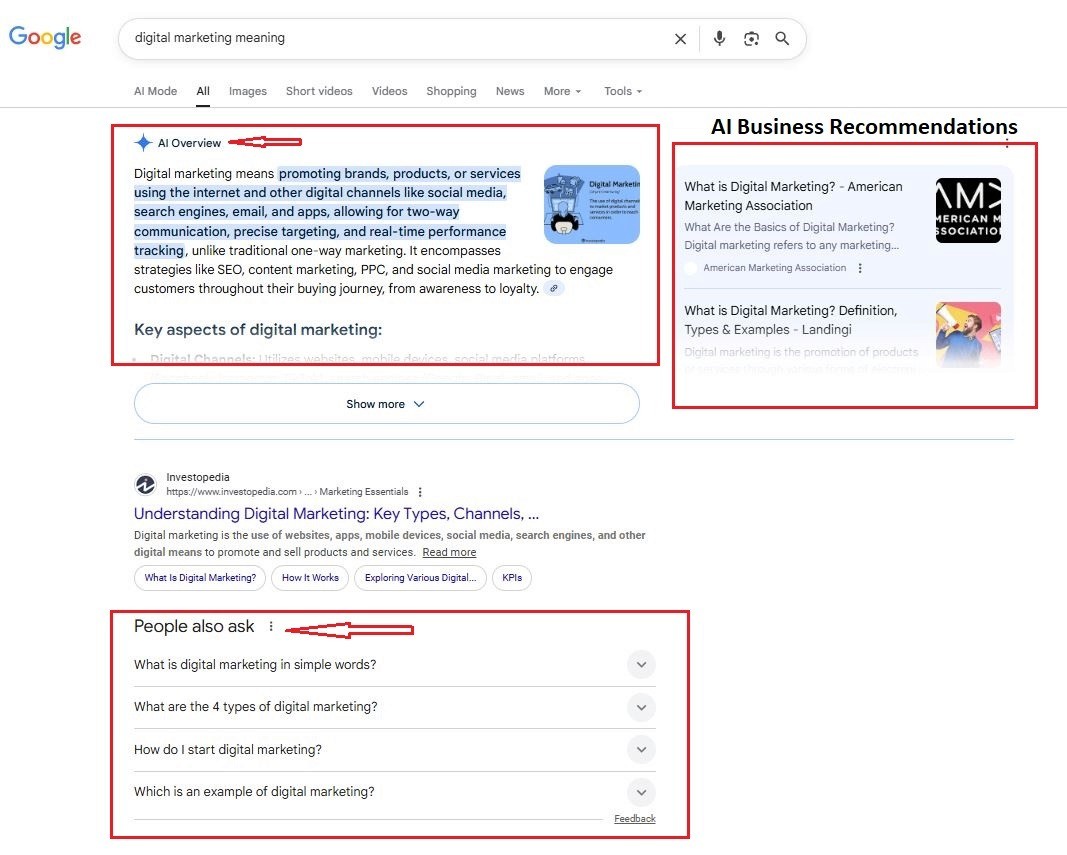
When someone types "best marketing agency near me," AI analyzes thousands of sources like reviews, websites, business listings, and social media to suggest the most relevant businesses. It looks at factors like your location, online reputation, customer reviews, and how well your business information matches the search intent.
But what does this mean for your business?
According to the Semrush study, 58.5% of US Google searches now end without a click, meaning users get their answers directly from AI Overviews without ever visiting a website. This is where AI business recommendations really matter. That means visibility inside AI answers is becoming more valuable than traditional rankings.
What AI looks for before recommending a business
Before AI recommends a business, it does a quiet background check. It's not impressed by loud ads or bold promises. Because AI answers now influence the entire buyer journey.
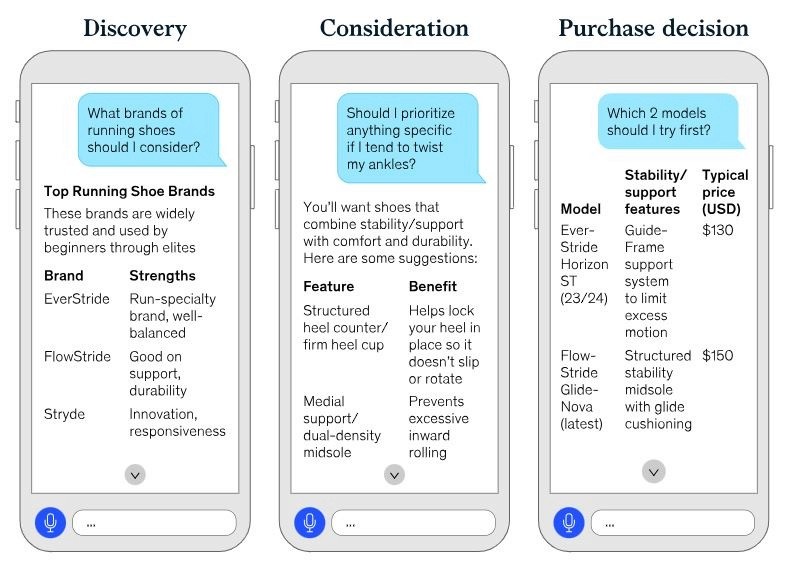
According to McKinsey, more than 70% of AI-powered search users ask questions at the top of the funnel to learn about a brand, product, or service. But AI isn't just educating consumers; it's shaping their purchasing decisions from research all the way to final purchase.
If your business doesn't show up in these AI-generated recommendations, you're invisible during the most critical moments of the decision-making process. This image shows exactly where AI influences your customer's buying decisions.
Source: McKinsey & Company
Topic relevance: If someone searches for a service, AI checks whether your website, Google Business Profile, and listings clearly explain what you do, where you operate, and who you serve. When your messaging is simple and consistent, AI can easily connect your business to the right searches.
Online authority signals: Mentions on trusted websites, backlinks from credible sources, industry certifications, and even how long you have been in business all help. These signals tell AI that your business is established, not random or unreliable.
Trust and reputation: Recent reviews, strong ratings, real customer feedback, and thoughtful responses to reviews matter more than perfect marketing copy.
AI recommendations vs. Google SEO: What's the difference?
Factor | Traditional Google SEO | AI Recommendations |
How it works | Ranks websites based on keywords, backlinks, and technical optimization | Analyzes multiple sources to give direct answers and recommendations |
User experience | Shows list of 10 blue links | Provides conversational answers with business recommendations |
Visibility goal | Rank on page 1 of search results | Appear inside AI-generated answers |
Timeframe | Takes 3-6 months to see results | Can appear in AI results faster with strong signals |
Traffic source | Direct website clicks from search | Featured in AI answers (less direct traffic) |
Optimization strategy | Technical SEO, link building, content marketing | Consistent NAP, reviews, authority signals, structured data |
Review importance | Helps with local SEO rankings | Critical and directly influences AI recommendations |
Local presence | Google Business Profile matters | Google Business Profile + consistency across all platforms |
Content type | Long-form blogs, landing pages | FAQs, clear service descriptions, customer testimonials |
Metrics to track | Organic traffic, keyword rankings, bounce rate | Brand mentions, review ratings, AI visibility tracking |
Competition | Compete for top 10 positions | Compete to be the recommended answer |
User intent | Users browse multiple options | AI narrows down to best options immediately |
Best for | Driving website traffic and conversions | Building trust and being discovered by new customers |
Future outlook | Still important but declining clicks | Growing rapidly and will dominate search behavior |
How to optimize your business for AI search engines
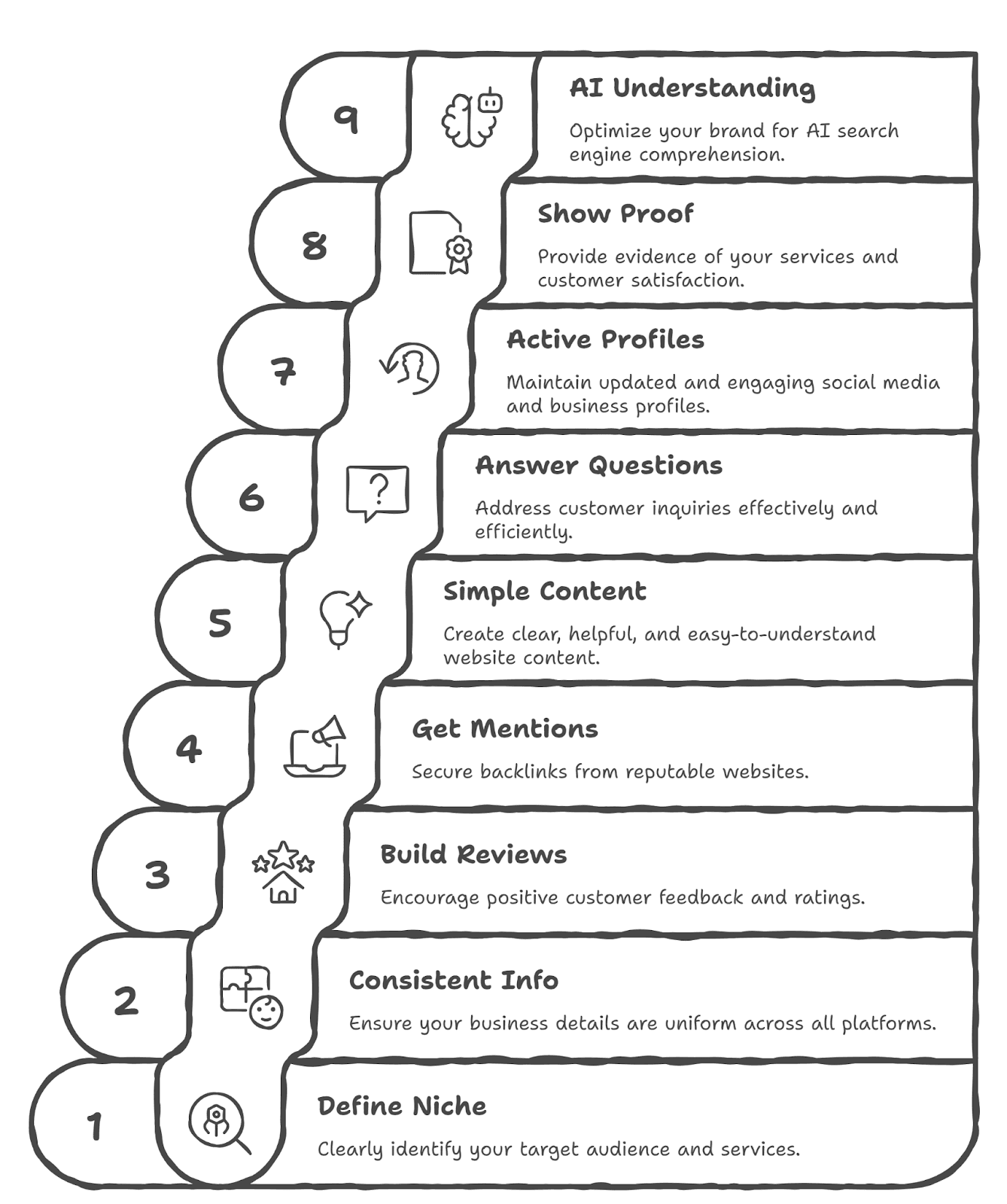
Getting your business recommended by AI is about sending the right signals. You don't need a huge marketing budget or technical expertise to get started. AI search optimization for businesses comes down to making your information easy to find, easy to understand, and easy to trust.
Whether you're an e-commerce brand or a B2B company, these strategies will help you show how AI search optimization for businesses comes down to making your information easy to find, easy to understand, and easy to trust.
1. Optimize your online presence
Begin with your website. Clearly explain what you do, who you serve, and where you operate. Use simple language, service-specific pages, and clear headings. So AI can quickly understand your core offering.
Keep your business information consistent across all platforms. Your name, address, phone number, services, and categories should match on your website, Google Business Profile, directories, and social channels. Inconsistencies confuse AI and weaken trust signals.
2. Create high-quality content
Start by answering the questions your customers actually ask. Think about the "how," "why," and "what if" questions that come up in sales calls or customer support. Turn those into detailed blog posts, FAQs, and guides. The more specific and useful your answers, the more likely AI will pull from your content.
Use real examples and firsthand experience. AI can detect authenticity. Share actual case studies, customer results, or behind-the-scenes insights. Content like "Here's how we helped a client reduce costs by 30%" carries more weight than generic claims.
Add original diagrams, charts, and infographics with descriptive alt text like "Chart showing 15% increase in AI search citations over 6 months." Embed short-form videos that explain your content. AI agents often watch videos to verify if you're a high-quality recommendation.
3. Build credibility signals
AI checks what others say about you. Start by actively collecting genuine reviews on Google, Yelp, and industry-specific platforms. Aim for 4+ stars with consistent, recent feedback. AI prioritizes businesses with fresh reviews from the last 30 to 60 days, so encourage satisfied customers to share their experiences regularly.
Respond to every review. AI notices how you handle feedback. A thoughtful response to a complaint shows you care about customer experience, which builds trust in AI's eyes. Showcase social proof on your website.
Add customer testimonials, case studies, and logos of brands you've worked with. Include real names, photos, and specific results whenever possible. Get mentioned by credible sources. When industry publications, local news sites, or respected blogs mention your business, AI sees this as third-party validation. These "unlinked mentions" boost your authority even without backlinks.
4. Structured data and SEO
Getting AI to recommend your business requires both traditional SEO fundamentals and modern structured data. Together, they help AI find, understand, and trust your content.
Start with SEO basics. Optimize your website for mobile, ensure fast loading speeds, and use clear, descriptive URLs. Focus on creating content around topics your customers actually search for, using natural language that matches how people ask questions.
But here's where 2026 differs. Add schema markup using JSON-LD format. This acts like a roadmap, telling AI exactly what your content means: your services, location, pricing, and customer reviews.
For instance, FAQ page schema helps AI pull your answers directly into conversational responses. The review schema displays your star ratings, instantly boosting credibility. Strong SEO gets you found. Structured data helps AI understand and recommend you. You need both.
5. Omnichannel presence
AI scans the entire internet to verify your business exists, is active, and is trustworthy. Start by claiming your profiles on all major platforms and industry-specific directories. But don't just create them; actively maintain them. Post updates, respond to messages, share content, and keep your information current across every channel.
Consistency is critical. When AI sees the same information across 10+ platforms, it views you as legitimate and established. Conflicting details raise red flags and hurt your credibility. Engage where your customers are.
If your audiences are on Reddit, TikTok, or niche forums, be present there too. AI notices where your brand gets mentioned and discussed. These "unlinked mentions" in community spaces act as social proof.
AI builds a complete picture of your business by cross-referencing multiple sources. The broader and more consistent your presence, the stronger your authority and the more likely AI will recommend your business.
6. Focus on local SEO
If you serve customers in specific locations, local SEO is non-negotiable. AI tools prioritize businesses that clearly match a user's geographic intent, especially for "near me" searches or location-based queries.
Start by optimizing your Google Business Profile. This is your most powerful local SEO asset. Fill out every section completely with business hours, services, categories, photos, and a detailed description. Post regular updates, respond to reviews promptly, and add fresh photos frequently.
Use location-specific keywords naturally throughout your website. Instead of just "plumbing services," use "plumbing services in Chicago." Create dedicated location pages if you serve multiple areas, each with unique, helpful content.
Get listed on Yelp, Yellow Pages, Angie's List, industry-specific directories, and local chamber of commerce sites. Encourage local reviews. Ask satisfied customers to mention specific locations or neighborhoods in their feedback. Reviews that say "best dentist in Brooklyn" carry more local weight than generic praise.
AI uses proximity, relevance, and reputation to recommend local businesses. Nail these three, and you'll dominate local AI search results.
How ChatGPT recommends businesses in the USA
ChatGPT evaluates signals across the web to determine who's trustworthy and relevant.
Quality and credibility: Accurate, current information that's consistent across platforms. If your details are outdated or conflicting, you're out.
SEO rankings: Businesses that rank well in traditional search engines naturally gain more visibility in AI recommendations because they've already proven relevance and authority.
Online reputation: ChatGPT prioritizes businesses with strong reviews, high ratings, and positive mentions across trusted sources by real people.
How to appear in Claude AI recommendations
Claude values clarity and authority over marketing fluff. It accesses live web data when needed, so your information must be current and trustworthy.
Focus on community validation like real mentions, reviews, and discussions about your brand.
Show a strong, unique value proposition (UVP) and clear market positioning. Claude looks for businesses that know who they are and what they solve.
Optimize by creating relevant, context-rich content using natural, human-like language that matches user intent.
Engage on industry forums and credible sites. Document what your company actually does with clear explanations.
How to get featured in Perplexity AI results
Your content needs a quality score of 0.75 or higher to appear in top answer placements in Perplexity AI. This score measures trustworthiness, accuracy, and overall content quality, ensuring only the best sources reach users.
So how do you hit that threshold?
Focus on creating well-researched, authoritative content with clear answers and credible sources. Use structured data, keep information current, and avoid fluff or keyword stuffing.
Perplexity values depth over volume. One expert-level article explaining a topic thoroughly beats ten shallow posts. Build backlinks from respected sites, earn genuine mentions, and maintain consistency across platforms.
How to outrank competitors in AI search?
Wrapping up
Getting AI business recommendations is not about chasing trends. It comes down to clarity, consistency, and credibility across your entire online presence. When AI understands exactly what you offer and sees that customers trust you, recommendations start to happen naturally.
Explore how eStore Factory Generative AI SEO service helps brands optimize for AI-driven discovery and turn visibility into real customers.
FAQs
Can AI recommend small businesses in the USA?
Yes. AI regularly recommends small businesses if they have clear information, good reviews, and a consistent online presence, not based on company size.
Does AI replace SEO for business discovery?
No. AI builds on SEO signals; it changes how results are shown, but strong SEO is still essential for visibility.
How do I know if AI is mentioning my business?
You will see brand mentions in AI answers, voice assistants, or referral traffic coming from AI tools and AI-powered search results.
Do paid ads influence AI recommendations?
No. AI recommendations are based on relevance, trust, and authority, not ad spend or paid placements.
TL;DR
AI search tools now give direct business recommendations instead of showing links, so being visible inside AI answers matters more than traditional rankings.
AI recommends businesses based on clarity (what you do, where you operate), consistency (same details everywhere), and credibility (reviews, mentions, authority signals).
Strong reviews, recent customer feedback, and active reputation management directly influence whether AI trusts and recommends your business.
Traditional SEO still matters, but structured data, FAQs, testimonials, and clear service descriptions help AI understand and surface your business faster.
A consistent omnichannel and local presence (website, Google Business Profile, directories, social platforms) strengthens AI confidence and visibility.
Businesses that provide accurate, up-to-date, well-researched content with real-world proof are more likely to be recommended by ChatGPT, Claude, and Perplexity.
The way people find businesses has completely changed. When someone searches for "best coffee shop near me," they're no longer scrolling through 10 blue links; they're asking AI tools for direct recommendations.
Around 40 to 55% of customers are now using AI-based search to make purchasing decisions. That's nearly half of your potential customers relying on AI to tell them who to trust and where to spend their money. This shift defines the AI SEO trends of 2026.
If AI doesn't know your business exists or worse, recommends your competitors instead, you're losing customers before they even know you're an option. Learning how to get AI to recommend your business is no longer optional.
But don't worry, if you are landing on this page searching for an answer, you have found the right source. This article shows you exactly what you need to know in 2026's AI-driven search landscape.
How AI tools recommend businesses today
AI tools are changing how people discover businesses, and this shift is happening faster than most brands realize. Today, platforms like ChatGPT, Google’s AI Overviews, and Perplexity don’t just show links; they give direct answers.
With ChatGPT now serving over 200 million weekly active users and Perplexity AI handling 100 million queries per week, these platforms have become the go-to source for business recommendations.
Let's break this down with an example.
When someone types "best marketing agency near me," AI analyzes thousands of sources like reviews, websites, business listings, and social media to suggest the most relevant businesses. It looks at factors like your location, online reputation, customer reviews, and how well your business information matches the search intent.
But what does this mean for your business?
According to the Semrush study, 58.5% of US Google searches now end without a click, meaning users get their answers directly from AI Overviews without ever visiting a website. This is where AI business recommendations really matter. That means visibility inside AI answers is becoming more valuable than traditional rankings.
What AI looks for before recommending a business
Before AI recommends a business, it does a quiet background check. It's not impressed by loud ads or bold promises. Because AI answers now influence the entire buyer journey.
According to McKinsey, more than 70% of AI-powered search users ask questions at the top of the funnel to learn about a brand, product, or service. But AI isn't just educating consumers; it's shaping their purchasing decisions from research all the way to final purchase.
If your business doesn't show up in these AI-generated recommendations, you're invisible during the most critical moments of the decision-making process. This image shows exactly where AI influences your customer's buying decisions.
Source: McKinsey & Company
Topic relevance: If someone searches for a service, AI checks whether your website, Google Business Profile, and listings clearly explain what you do, where you operate, and who you serve. When your messaging is simple and consistent, AI can easily connect your business to the right searches.
Online authority signals: Mentions on trusted websites, backlinks from credible sources, industry certifications, and even how long you have been in business all help. These signals tell AI that your business is established, not random or unreliable.
Trust and reputation: Recent reviews, strong ratings, real customer feedback, and thoughtful responses to reviews matter more than perfect marketing copy.
AI recommendations vs. Google SEO: What's the difference?
Factor | Traditional Google SEO | AI Recommendations |
How it works | Ranks websites based on keywords, backlinks, and technical optimization | Analyzes multiple sources to give direct answers and recommendations |
User experience | Shows list of 10 blue links | Provides conversational answers with business recommendations |
Visibility goal | Rank on page 1 of search results | Appear inside AI-generated answers |
Timeframe | Takes 3-6 months to see results | Can appear in AI results faster with strong signals |
Traffic source | Direct website clicks from search | Featured in AI answers (less direct traffic) |
Optimization strategy | Technical SEO, link building, content marketing | Consistent NAP, reviews, authority signals, structured data |
Review importance | Helps with local SEO rankings | Critical and directly influences AI recommendations |
Local presence | Google Business Profile matters | Google Business Profile + consistency across all platforms |
Content type | Long-form blogs, landing pages | FAQs, clear service descriptions, customer testimonials |
Metrics to track | Organic traffic, keyword rankings, bounce rate | Brand mentions, review ratings, AI visibility tracking |
Competition | Compete for top 10 positions | Compete to be the recommended answer |
User intent | Users browse multiple options | AI narrows down to best options immediately |
Best for | Driving website traffic and conversions | Building trust and being discovered by new customers |
Future outlook | Still important but declining clicks | Growing rapidly and will dominate search behavior |
How to optimize your business for AI search engines
Getting your business recommended by AI is about sending the right signals. You don't need a huge marketing budget or technical expertise to get started. AI search optimization for businesses comes down to making your information easy to find, easy to understand, and easy to trust.
Whether you're an e-commerce brand or a B2B company, these strategies will help you show how AI search optimization for businesses comes down to making your information easy to find, easy to understand, and easy to trust.
1. Optimize your online presence
Begin with your website. Clearly explain what you do, who you serve, and where you operate. Use simple language, service-specific pages, and clear headings. So AI can quickly understand your core offering.
Keep your business information consistent across all platforms. Your name, address, phone number, services, and categories should match on your website, Google Business Profile, directories, and social channels. Inconsistencies confuse AI and weaken trust signals.
2. Create high-quality content
Start by answering the questions your customers actually ask. Think about the "how," "why," and "what if" questions that come up in sales calls or customer support. Turn those into detailed blog posts, FAQs, and guides. The more specific and useful your answers, the more likely AI will pull from your content.
Use real examples and firsthand experience. AI can detect authenticity. Share actual case studies, customer results, or behind-the-scenes insights. Content like "Here's how we helped a client reduce costs by 30%" carries more weight than generic claims.
Add original diagrams, charts, and infographics with descriptive alt text like "Chart showing 15% increase in AI search citations over 6 months." Embed short-form videos that explain your content. AI agents often watch videos to verify if you're a high-quality recommendation.
3. Build credibility signals
AI checks what others say about you. Start by actively collecting genuine reviews on Google, Yelp, and industry-specific platforms. Aim for 4+ stars with consistent, recent feedback. AI prioritizes businesses with fresh reviews from the last 30 to 60 days, so encourage satisfied customers to share their experiences regularly.
Respond to every review. AI notices how you handle feedback. A thoughtful response to a complaint shows you care about customer experience, which builds trust in AI's eyes. Showcase social proof on your website.
Add customer testimonials, case studies, and logos of brands you've worked with. Include real names, photos, and specific results whenever possible. Get mentioned by credible sources. When industry publications, local news sites, or respected blogs mention your business, AI sees this as third-party validation. These "unlinked mentions" boost your authority even without backlinks.
4. Structured data and SEO
Getting AI to recommend your business requires both traditional SEO fundamentals and modern structured data. Together, they help AI find, understand, and trust your content.
Start with SEO basics. Optimize your website for mobile, ensure fast loading speeds, and use clear, descriptive URLs. Focus on creating content around topics your customers actually search for, using natural language that matches how people ask questions.
But here's where 2026 differs. Add schema markup using JSON-LD format. This acts like a roadmap, telling AI exactly what your content means: your services, location, pricing, and customer reviews.
For instance, FAQ page schema helps AI pull your answers directly into conversational responses. The review schema displays your star ratings, instantly boosting credibility. Strong SEO gets you found. Structured data helps AI understand and recommend you. You need both.
5. Omnichannel presence
AI scans the entire internet to verify your business exists, is active, and is trustworthy. Start by claiming your profiles on all major platforms and industry-specific directories. But don't just create them; actively maintain them. Post updates, respond to messages, share content, and keep your information current across every channel.
Consistency is critical. When AI sees the same information across 10+ platforms, it views you as legitimate and established. Conflicting details raise red flags and hurt your credibility. Engage where your customers are.
If your audiences are on Reddit, TikTok, or niche forums, be present there too. AI notices where your brand gets mentioned and discussed. These "unlinked mentions" in community spaces act as social proof.
AI builds a complete picture of your business by cross-referencing multiple sources. The broader and more consistent your presence, the stronger your authority and the more likely AI will recommend your business.
6. Focus on local SEO
If you serve customers in specific locations, local SEO is non-negotiable. AI tools prioritize businesses that clearly match a user's geographic intent, especially for "near me" searches or location-based queries.
Start by optimizing your Google Business Profile. This is your most powerful local SEO asset. Fill out every section completely with business hours, services, categories, photos, and a detailed description. Post regular updates, respond to reviews promptly, and add fresh photos frequently.
Use location-specific keywords naturally throughout your website. Instead of just "plumbing services," use "plumbing services in Chicago." Create dedicated location pages if you serve multiple areas, each with unique, helpful content.
Get listed on Yelp, Yellow Pages, Angie's List, industry-specific directories, and local chamber of commerce sites. Encourage local reviews. Ask satisfied customers to mention specific locations or neighborhoods in their feedback. Reviews that say "best dentist in Brooklyn" carry more local weight than generic praise.
AI uses proximity, relevance, and reputation to recommend local businesses. Nail these three, and you'll dominate local AI search results.
How ChatGPT recommends businesses in the USA
ChatGPT evaluates signals across the web to determine who's trustworthy and relevant.
Quality and credibility: Accurate, current information that's consistent across platforms. If your details are outdated or conflicting, you're out.
SEO rankings: Businesses that rank well in traditional search engines naturally gain more visibility in AI recommendations because they've already proven relevance and authority.
Online reputation: ChatGPT prioritizes businesses with strong reviews, high ratings, and positive mentions across trusted sources by real people.
How to appear in Claude AI recommendations
Claude values clarity and authority over marketing fluff. It accesses live web data when needed, so your information must be current and trustworthy.
Focus on community validation like real mentions, reviews, and discussions about your brand.
Show a strong, unique value proposition (UVP) and clear market positioning. Claude looks for businesses that know who they are and what they solve.
Optimize by creating relevant, context-rich content using natural, human-like language that matches user intent.
Engage on industry forums and credible sites. Document what your company actually does with clear explanations.
How to get featured in Perplexity AI results
Your content needs a quality score of 0.75 or higher to appear in top answer placements in Perplexity AI. This score measures trustworthiness, accuracy, and overall content quality, ensuring only the best sources reach users.
So how do you hit that threshold?
Focus on creating well-researched, authoritative content with clear answers and credible sources. Use structured data, keep information current, and avoid fluff or keyword stuffing.
Perplexity values depth over volume. One expert-level article explaining a topic thoroughly beats ten shallow posts. Build backlinks from respected sites, earn genuine mentions, and maintain consistency across platforms.
How to outrank competitors in AI search?
Wrapping up
Getting AI business recommendations is not about chasing trends. It comes down to clarity, consistency, and credibility across your entire online presence. When AI understands exactly what you offer and sees that customers trust you, recommendations start to happen naturally.
Explore how eStore Factory Generative AI SEO service helps brands optimize for AI-driven discovery and turn visibility into real customers.
FAQs
Can AI recommend small businesses in the USA?
Yes. AI regularly recommends small businesses if they have clear information, good reviews, and a consistent online presence, not based on company size.
Does AI replace SEO for business discovery?
No. AI builds on SEO signals; it changes how results are shown, but strong SEO is still essential for visibility.
How do I know if AI is mentioning my business?
You will see brand mentions in AI answers, voice assistants, or referral traffic coming from AI tools and AI-powered search results.
Do paid ads influence AI recommendations?
No. AI recommendations are based on relevance, trust, and authority, not ad spend or paid placements.
TL;DR
AI search tools now give direct business recommendations instead of showing links, so being visible inside AI answers matters more than traditional rankings.
AI recommends businesses based on clarity (what you do, where you operate), consistency (same details everywhere), and credibility (reviews, mentions, authority signals).
Strong reviews, recent customer feedback, and active reputation management directly influence whether AI trusts and recommends your business.
Traditional SEO still matters, but structured data, FAQs, testimonials, and clear service descriptions help AI understand and surface your business faster.
A consistent omnichannel and local presence (website, Google Business Profile, directories, social platforms) strengthens AI confidence and visibility.
Businesses that provide accurate, up-to-date, well-researched content with real-world proof are more likely to be recommended by ChatGPT, Claude, and Perplexity.
The way people find businesses has completely changed. When someone searches for "best coffee shop near me," they're no longer scrolling through 10 blue links; they're asking AI tools for direct recommendations.
Around 40 to 55% of customers are now using AI-based search to make purchasing decisions. That's nearly half of your potential customers relying on AI to tell them who to trust and where to spend their money. This shift defines the AI SEO trends of 2026.
If AI doesn't know your business exists or worse, recommends your competitors instead, you're losing customers before they even know you're an option. Learning how to get AI to recommend your business is no longer optional.
But don't worry, if you are landing on this page searching for an answer, you have found the right source. This article shows you exactly what you need to know in 2026's AI-driven search landscape.
How AI tools recommend businesses today
AI tools are changing how people discover businesses, and this shift is happening faster than most brands realize. Today, platforms like ChatGPT, Google’s AI Overviews, and Perplexity don’t just show links; they give direct answers.
With ChatGPT now serving over 200 million weekly active users and Perplexity AI handling 100 million queries per week, these platforms have become the go-to source for business recommendations.
Let's break this down with an example.
When someone types "best marketing agency near me," AI analyzes thousands of sources like reviews, websites, business listings, and social media to suggest the most relevant businesses. It looks at factors like your location, online reputation, customer reviews, and how well your business information matches the search intent.
But what does this mean for your business?
According to the Semrush study, 58.5% of US Google searches now end without a click, meaning users get their answers directly from AI Overviews without ever visiting a website. This is where AI business recommendations really matter. That means visibility inside AI answers is becoming more valuable than traditional rankings.
What AI looks for before recommending a business
Before AI recommends a business, it does a quiet background check. It's not impressed by loud ads or bold promises. Because AI answers now influence the entire buyer journey.
According to McKinsey, more than 70% of AI-powered search users ask questions at the top of the funnel to learn about a brand, product, or service. But AI isn't just educating consumers; it's shaping their purchasing decisions from research all the way to final purchase.
If your business doesn't show up in these AI-generated recommendations, you're invisible during the most critical moments of the decision-making process. This image shows exactly where AI influences your customer's buying decisions.
Source: McKinsey & Company
Topic relevance: If someone searches for a service, AI checks whether your website, Google Business Profile, and listings clearly explain what you do, where you operate, and who you serve. When your messaging is simple and consistent, AI can easily connect your business to the right searches.
Online authority signals: Mentions on trusted websites, backlinks from credible sources, industry certifications, and even how long you have been in business all help. These signals tell AI that your business is established, not random or unreliable.
Trust and reputation: Recent reviews, strong ratings, real customer feedback, and thoughtful responses to reviews matter more than perfect marketing copy.
AI recommendations vs. Google SEO: What's the difference?
Factor | Traditional Google SEO | AI Recommendations |
How it works | Ranks websites based on keywords, backlinks, and technical optimization | Analyzes multiple sources to give direct answers and recommendations |
User experience | Shows list of 10 blue links | Provides conversational answers with business recommendations |
Visibility goal | Rank on page 1 of search results | Appear inside AI-generated answers |
Timeframe | Takes 3-6 months to see results | Can appear in AI results faster with strong signals |
Traffic source | Direct website clicks from search | Featured in AI answers (less direct traffic) |
Optimization strategy | Technical SEO, link building, content marketing | Consistent NAP, reviews, authority signals, structured data |
Review importance | Helps with local SEO rankings | Critical and directly influences AI recommendations |
Local presence | Google Business Profile matters | Google Business Profile + consistency across all platforms |
Content type | Long-form blogs, landing pages | FAQs, clear service descriptions, customer testimonials |
Metrics to track | Organic traffic, keyword rankings, bounce rate | Brand mentions, review ratings, AI visibility tracking |
Competition | Compete for top 10 positions | Compete to be the recommended answer |
User intent | Users browse multiple options | AI narrows down to best options immediately |
Best for | Driving website traffic and conversions | Building trust and being discovered by new customers |
Future outlook | Still important but declining clicks | Growing rapidly and will dominate search behavior |
How to optimize your business for AI search engines
Getting your business recommended by AI is about sending the right signals. You don't need a huge marketing budget or technical expertise to get started. AI search optimization for businesses comes down to making your information easy to find, easy to understand, and easy to trust.
Whether you're an e-commerce brand or a B2B company, these strategies will help you show how AI search optimization for businesses comes down to making your information easy to find, easy to understand, and easy to trust.
1. Optimize your online presence
Begin with your website. Clearly explain what you do, who you serve, and where you operate. Use simple language, service-specific pages, and clear headings. So AI can quickly understand your core offering.
Keep your business information consistent across all platforms. Your name, address, phone number, services, and categories should match on your website, Google Business Profile, directories, and social channels. Inconsistencies confuse AI and weaken trust signals.
2. Create high-quality content
Start by answering the questions your customers actually ask. Think about the "how," "why," and "what if" questions that come up in sales calls or customer support. Turn those into detailed blog posts, FAQs, and guides. The more specific and useful your answers, the more likely AI will pull from your content.
Use real examples and firsthand experience. AI can detect authenticity. Share actual case studies, customer results, or behind-the-scenes insights. Content like "Here's how we helped a client reduce costs by 30%" carries more weight than generic claims.
Add original diagrams, charts, and infographics with descriptive alt text like "Chart showing 15% increase in AI search citations over 6 months." Embed short-form videos that explain your content. AI agents often watch videos to verify if you're a high-quality recommendation.
3. Build credibility signals
AI checks what others say about you. Start by actively collecting genuine reviews on Google, Yelp, and industry-specific platforms. Aim for 4+ stars with consistent, recent feedback. AI prioritizes businesses with fresh reviews from the last 30 to 60 days, so encourage satisfied customers to share their experiences regularly.
Respond to every review. AI notices how you handle feedback. A thoughtful response to a complaint shows you care about customer experience, which builds trust in AI's eyes. Showcase social proof on your website.
Add customer testimonials, case studies, and logos of brands you've worked with. Include real names, photos, and specific results whenever possible. Get mentioned by credible sources. When industry publications, local news sites, or respected blogs mention your business, AI sees this as third-party validation. These "unlinked mentions" boost your authority even without backlinks.
4. Structured data and SEO
Getting AI to recommend your business requires both traditional SEO fundamentals and modern structured data. Together, they help AI find, understand, and trust your content.
Start with SEO basics. Optimize your website for mobile, ensure fast loading speeds, and use clear, descriptive URLs. Focus on creating content around topics your customers actually search for, using natural language that matches how people ask questions.
But here's where 2026 differs. Add schema markup using JSON-LD format. This acts like a roadmap, telling AI exactly what your content means: your services, location, pricing, and customer reviews.
For instance, FAQ page schema helps AI pull your answers directly into conversational responses. The review schema displays your star ratings, instantly boosting credibility. Strong SEO gets you found. Structured data helps AI understand and recommend you. You need both.
5. Omnichannel presence
AI scans the entire internet to verify your business exists, is active, and is trustworthy. Start by claiming your profiles on all major platforms and industry-specific directories. But don't just create them; actively maintain them. Post updates, respond to messages, share content, and keep your information current across every channel.
Consistency is critical. When AI sees the same information across 10+ platforms, it views you as legitimate and established. Conflicting details raise red flags and hurt your credibility. Engage where your customers are.
If your audiences are on Reddit, TikTok, or niche forums, be present there too. AI notices where your brand gets mentioned and discussed. These "unlinked mentions" in community spaces act as social proof.
AI builds a complete picture of your business by cross-referencing multiple sources. The broader and more consistent your presence, the stronger your authority and the more likely AI will recommend your business.
6. Focus on local SEO
If you serve customers in specific locations, local SEO is non-negotiable. AI tools prioritize businesses that clearly match a user's geographic intent, especially for "near me" searches or location-based queries.
Start by optimizing your Google Business Profile. This is your most powerful local SEO asset. Fill out every section completely with business hours, services, categories, photos, and a detailed description. Post regular updates, respond to reviews promptly, and add fresh photos frequently.
Use location-specific keywords naturally throughout your website. Instead of just "plumbing services," use "plumbing services in Chicago." Create dedicated location pages if you serve multiple areas, each with unique, helpful content.
Get listed on Yelp, Yellow Pages, Angie's List, industry-specific directories, and local chamber of commerce sites. Encourage local reviews. Ask satisfied customers to mention specific locations or neighborhoods in their feedback. Reviews that say "best dentist in Brooklyn" carry more local weight than generic praise.
AI uses proximity, relevance, and reputation to recommend local businesses. Nail these three, and you'll dominate local AI search results.
How ChatGPT recommends businesses in the USA
ChatGPT evaluates signals across the web to determine who's trustworthy and relevant.
Quality and credibility: Accurate, current information that's consistent across platforms. If your details are outdated or conflicting, you're out.
SEO rankings: Businesses that rank well in traditional search engines naturally gain more visibility in AI recommendations because they've already proven relevance and authority.
Online reputation: ChatGPT prioritizes businesses with strong reviews, high ratings, and positive mentions across trusted sources by real people.
How to appear in Claude AI recommendations
Claude values clarity and authority over marketing fluff. It accesses live web data when needed, so your information must be current and trustworthy.
Focus on community validation like real mentions, reviews, and discussions about your brand.
Show a strong, unique value proposition (UVP) and clear market positioning. Claude looks for businesses that know who they are and what they solve.
Optimize by creating relevant, context-rich content using natural, human-like language that matches user intent.
Engage on industry forums and credible sites. Document what your company actually does with clear explanations.
How to get featured in Perplexity AI results
Your content needs a quality score of 0.75 or higher to appear in top answer placements in Perplexity AI. This score measures trustworthiness, accuracy, and overall content quality, ensuring only the best sources reach users.
So how do you hit that threshold?
Focus on creating well-researched, authoritative content with clear answers and credible sources. Use structured data, keep information current, and avoid fluff or keyword stuffing.
Perplexity values depth over volume. One expert-level article explaining a topic thoroughly beats ten shallow posts. Build backlinks from respected sites, earn genuine mentions, and maintain consistency across platforms.
How to outrank competitors in AI search?
Wrapping up
Getting AI business recommendations is not about chasing trends. It comes down to clarity, consistency, and credibility across your entire online presence. When AI understands exactly what you offer and sees that customers trust you, recommendations start to happen naturally.
Explore how eStore Factory Generative AI SEO service helps brands optimize for AI-driven discovery and turn visibility into real customers.
FAQs
Can AI recommend small businesses in the USA?
Yes. AI regularly recommends small businesses if they have clear information, good reviews, and a consistent online presence, not based on company size.
Does AI replace SEO for business discovery?
No. AI builds on SEO signals; it changes how results are shown, but strong SEO is still essential for visibility.
How do I know if AI is mentioning my business?
You will see brand mentions in AI answers, voice assistants, or referral traffic coming from AI tools and AI-powered search results.
Do paid ads influence AI recommendations?
No. AI recommendations are based on relevance, trust, and authority, not ad spend or paid placements.





eStore Factory is a full-service Amazon agency dedicated to building end-to-end strategies for brands of all sizes.


SERVICES FOR AMAZON
Product Setup ON AMAZON
GRAPHICS & BRANDING SERVICES
PPC MANAGEMENT
© Copyright 2014 - 2026. All Rights Reserved.
eStore Factory is a full-service Amazon agency dedicated to building end-to-end strategies for brands of all sizes.
SERVICES FOR AMAZON
Product Setup ON AMAZON
GRAPHICS & BRANDING SERVICES
PPC MANAGEMENT
© Copyright 2014 - 2026. All Rights Reserved.
eStore Factory is a full-service Amazon agency dedicated to building end-to-end strategies for brands of all sizes.
SERVICES FOR AMAZON
Product Setup ON AMAZON
GRAPHICS & BRANDING SERVICES
PPC MANAGEMENT
© Copyright 2014 - 2026. All Rights Reserved.