

Back to Page
Amazon Marketing
Multi-channel e-commerce strategy 2026: How brands are expanding beyond Amazon
Multi-channel e-commerce strategy 2026: How brands are expanding beyond Amazon
Back to Page
Amazon Marketing
Multi-channel e-commerce strategy 2026: How brands are expanding beyond Amazon
TL;DR
Amazon is powerful, but it represents only part of the total e-commerce market; most online sales happen outside of it.
A multi-channel strategy reduces platform risk and protects your business from policy changes, fee increases, or account suspensions.
Selling on platforms like Shopify, Walmart, TikTok Shop, eBay, and Etsy helps you reach different buyer segments and improve overall revenue potential.
DTC channels such as Shopify give you better control over branding, customer data, email marketing, and long-term customer lifetime value.
Inventory sync and fulfillment strategy, whether MCF, 3PL, or hybrid, is critical to avoid stockouts and operational chaos.
The most practical path for Amazon sellers is to stabilize Amazon first, add Shopify next, then expand to Walmart or other channels based on category fit and profitability.
If you're an Amazon seller, you already know the platform works. But here's something worth thinking about: Amazon holds 37.6% of the US e-commerce market share, which sounds impressive until you realize that means 62.4% of all online sales happen somewhere else.
That's not a small gap. That's the majority of the market. A solid multi-channel e-commerce strategy isn't about abandoning Amazon. It's about making sure your business isn't completely dependent on one platform's algorithm, one policy change, or one account suspension to survive.
In 2023, multichannel e-commerce sales totaled $575.6 billion, 47% of all e-commerce sales. By 2025, that figure is projected to reach $775.7 billion, a 15.7% year-over-year increase. The market is moving. The only question is whether you're moving with it or still waiting to see how it plays out.
What is a multi-channel e-commerce strategy?
Simply put, it means selling your products across more than one platform: Amazon, Shopify, Walmart, eBay, TikTok Shop, and Etsy, wherever your customers actually shop. Instead of listing your product in one basket, you distribute your presence across multiple sales channels so that no single platform controls your entire revenue stream.
What it is NOT:
Copy-pasting your Amazon listings everywhere without a plan
Running each channel in isolation with no unified backend
Ignoring platform-specific audiences and buying behaviors
What it is:
A deliberate strategy to reach customers across different touchpoints
A way to reduce platform dependency and business risk
A growth lever that compounds over time
How does multi-channel fulfillment work?
This is where most sellers get nervous, and understandably so. Managing orders from five different platforms sounds chaotic. But it doesn't have to be. There are three main fulfillment approaches:
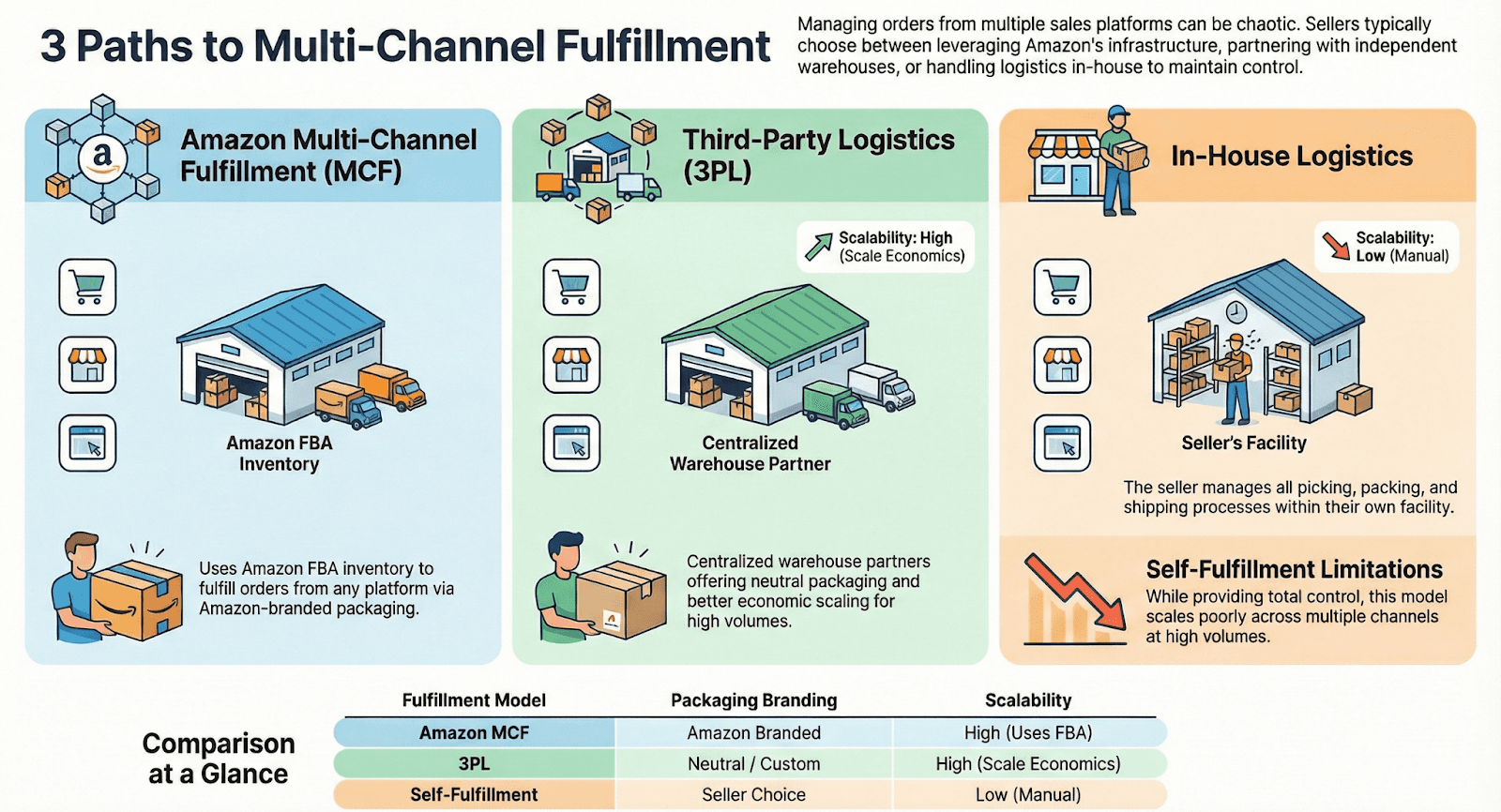
Amazon Multi-Channel Fulfillment (MCF): You use Amazon's FBA inventory to fulfill orders from other platforms, too. Amazon picks, packs, and ships on your behalf, even for non-Amazon orders. It's convenient but comes with fees and Amazon branding on the box.
Third-Party Logistics (3PL): You partner with a warehouse that fulfills orders from all your channels centrally. More control, often better economics at scale, and neutral packaging.
Self-Fulfillment: You handle everything in-house. Works at low volume but doesn't scale well across multiple channels.
Pro tip: For most growing sellers, a combination of MCF for speed and a 3PL for cost efficiency is the sweet spot.
Why multi-channel outperforms single-channel selling
Businesses selling on 3 or more channels generate 140% more revenue than those selling on fewer channels. That's not a marginal improvement; that's a fundamentally different growth trajectory.
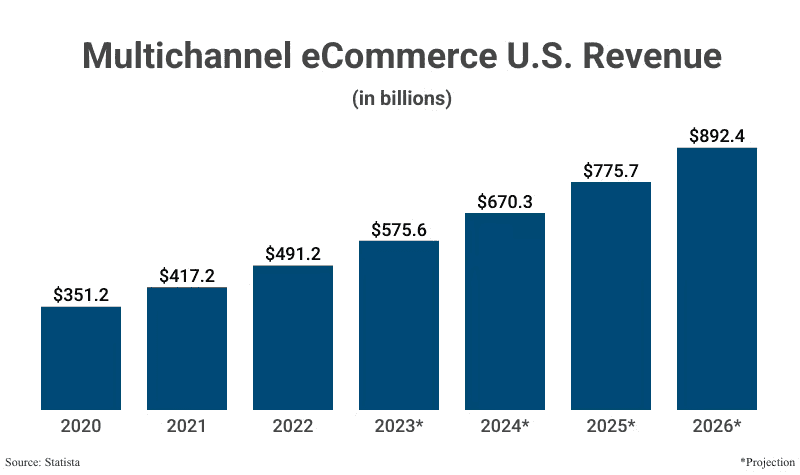
Source: Statista
Here's why it works:
Multi-channel e-commerce reduces platform risk. Amazon suspends accounts. It changes fee structures. It launches competing private label products. If Amazon is your only channel, any of these events can wipe out your business overnight. Diversification is insurance.
It gives you access to different buyer segments. Walmart shoppers behave differently from Amazon shoppers. Etsy buyers are looking for something unique. TikTok Shop is driven by impulse and discovery. Each platform has its own audience, and your product might resonate differently and profitably across all of them.
A customer discovering your brand through an Instagram ad and purchasing on your Shopify store is someone Amazon's algorithm would never have surfaced your product to. Selling on Amazon and Shopify simultaneously lets you capture both marketplace demand and brand-loyal direct buyers.
You have better margins on DTC channels. Amazon's referral fees, FBA fees, and advertising costs eat into your profit. On your own Shopify store, you control the pricing, upsells, and customer data. Many sellers find that their DTC channel delivers 15 to 25% better margins per unit, even with the cost of driving their own traffic.
Stronger brand equity. On Amazon, you're one of many sellers. On your own website and social channels, you're the brand. This matters for long-term value, whether you're building for growth or building to sell. You have better brand control. On Amazon, you're a product listing. On Shopify, you're a brand. Building a direct-to-consumer (DTC) channel means owning your customer relationships, your data, and your brand story.
It has the highest customer lifetime value. Customers who find you on multiple platforms tend to trust you more. A shopper who sees your brand on Amazon and then finds your Shopify store is more likely to become a repeat buyer. Amazon doesn't share customer email addresses or detailed purchase behavior. Your own store does. That data fuels email marketing, retargeting, and repeat purchase campaigns that aren't possible through Amazon alone.
Pro tip:
The best platforms for multi-channel selling depend on your category. Home goods and general consumer products perform well at Walmart. Beauty and lifestyle brands are seeing strong traction on TikTok Shop. Premium or niche products often thrive on a well-built Shopify store with targeted ads. The right mix is specific to your business, not a one-size-fits-all formula.
E-commerce diversification: Where should you actually sell?
Not every platform is right for every seller. Here's a practical breakdown of the best platforms for multi-channel e-commerce selling based on what you're selling and who you're targeting:
Platform | Best for | Key advantage |
Amazon | High-intent buyers | Built-in trust and traffic |
Shopify | Brand building and DTC | Full control and customer data |
Walmart | Value-conscious buyers | Lower competition, growing fast |
eBay | Used, rare, or niche products | Massive global reach |
Etsy | Handmade, vintage, custom items | Highly targeted niche audience |
TikTok Shop | Trend-driven, younger buyers | Viral discovery potential |
Which one is right for you?
A realistic starting point for most Amazon sellers is Amazon and Shopify first, then add Walmart Marketplace as your third channel once operations are stable.
Multi-channel e-commerce strategy for Amazon sellers: A practical implementation guide
You've built something on Amazon. Now the question is, how do you expand without breaking what's already working?
Here's a step-by-step implementation roadmap built specifically for Amazon sellers moving into multi-channel e-commerce that is practical, sequential, and actionable.
#1: Strengthen your Amazon foundation
Before adding channels, make sure your Amazon operation is competitive. Listings optimized. PPC profitable. Account health is good. Expanding from a weak base just multiplies problems.
#2: Pick your second sales channel
You can choose the Walmart marketplace if you want immediate marketplace demand with lower competition. Walmart crossed 200,000 active sellers in 2025, but that's still a fraction of Amazon's 1.9 million. Less competition means lower ad costs and better organic visibility.
You can also select Shopify DTC stores if you want to own the customer relationship, build brand equity, and capture better margins. You control pricing, email lists, and retargeting data that Amazon will never share with you.
Amazon sellers are choosing TikTok Shop if your product is visual, demonstrable, and targets a younger demographic. With $9 billion in US GMV in 2024 and 650% YoY growth, the opportunity is real for the right categories.
#3: Set up inventory sync before you list
This is where most sellers stumble. Connect your channels through a centralized inventory management and alerting tool like SellerQI. It helps you with the stock update in real time. Sellers combining MCF and FBA see 24% higher inventory turnover and 13% fewer stockouts. Don't list on a new platform until sync is live.
#4: Adapt and don't copy your listings
What converts on Amazon won't automatically convert elsewhere:
Walmart rewards competitive pricing and clean, concise titles. Keyword stuffing that works on Amazon hurts you here.
Shopify rewards strong brand storytelling, lifestyle photography, and detailed product pages. You're selling the brand, not just the product.
TikTok Shop rewards video content and creator partnerships. 58% of TikTok purchases come from the video feed, static listings won't cut it.
#5: Track per channel, optimize across channels
Monitor these metrics separately for each platform:
Revenue and units sold: Which channel is growing?
Profit margin after fees: Where are you making the most per unit?
Customer acquisition cost: Which channel delivers buyers at minimal cost?
Return rate: Are certain channels generating more returns?
Double down on channels delivering profitable growth. Scale back or cut channels that drain resources without returns. Multi-channel success is about being profitable everywhere you choose to be.
Selling on Amazon and Shopify simultaneously: What you need to know
It is the most common first step for Amazon sellers expanding beyond the platform and for good reason. Selling on Amazon and Shopify simultaneously gives you the best of both worlds: Amazon's traffic and Shopify's brand ownership.
What works well | What to watch out for |
Use Amazon for discovery and new customer acquisition | Keep pricing consistent across channels to avoid Buy Box issues |
Use Shopify to convert repeat buyers and build loyalty | Sync inventory in real time to prevent overselling |
Run email marketing and retargeting through Shopify | Do not rely only on Amazon traffic to grow Shopify |
Offer exclusive bundles or products on Shopify | Invest in your own traffic sources like Meta ads, Google Shopping, and SEO |
How to manage inventory across multiple channels
Selling on multiple platforms without real-time inventory sync leads to overselling, stockouts, and damaged seller metrics. According to Firework, 34% of e-commerce businesses struggle with inventory management across channels, and stockouts cost retailers $1 trillion annually in lost sales.
Here's how to avoid that:
Centralize your inventory data. Use one system of record that syncs stock across Amazon, Walmart, Shopify, and every other channel in real time.
Automate reorder triggers. Automated systems reduce stockouts by 30%. Set minimum quantity thresholds per channel.
Choose your fulfillment model. Amazon MCF works if you're already FBA-heavy sellers using both see higher inventory turns, and fewer stockouts. Third-party options give you branded packaging on DTC orders.
Reconcile weekly. Even with automation, audit for quantity mismatches and stranded inventory across platforms.
Final insights
Amazon is a powerful channel, but it's one channel. The sellers who will lead the next five years are those building diversified businesses that don't live or die by a single algorithm. E-commerce diversification isn't reserved for big brands. It's a series of deliberate steps to pick your next platform, sync your inventory, protect your brand, and keep building.
At eStore Factory, we help Amazon sellers build smart, scalable multi-channel strategies across Shopify, Walmart, and Tiktok without the guesswork.
Book a free strategy call and get ready to grow beyond Amazon!
FAQs
Is TikTok Shop worth it for ecommerce sellers?
Yes for visually demonstrable or trend-driven products. TikTok algorithm can surface your product to millions organically, making it a high-upside channel for the right product category.
What are the best platforms for multi channel selling?
Shopify, Walmart Marketplace, eBay, Etsy, and TikTok Shop. Start with Amazon plus Shopify, stabilize operations, then add Walmart as your third channel.
What is the difference between multi-channel and omnichannel e-commerce?
Multi-channel means selling on multiple platforms independently. Omnichannel selling strategies are fully integrated, sharing inventory, customer data, and a consistent brand experience across every touchpoint.
What are the benefits of selling on multiple e-commerce platforms?
Selling on multiple platforms reduces dependency on one channel, increases brand visibility, and unlocks new buyer segments. Businesses selling on three or more channels generate 140% more revenue than those selling on fewer channels.
TL;DR
Amazon is powerful, but it represents only part of the total e-commerce market; most online sales happen outside of it.
A multi-channel strategy reduces platform risk and protects your business from policy changes, fee increases, or account suspensions.
Selling on platforms like Shopify, Walmart, TikTok Shop, eBay, and Etsy helps you reach different buyer segments and improve overall revenue potential.
DTC channels such as Shopify give you better control over branding, customer data, email marketing, and long-term customer lifetime value.
Inventory sync and fulfillment strategy, whether MCF, 3PL, or hybrid, is critical to avoid stockouts and operational chaos.
The most practical path for Amazon sellers is to stabilize Amazon first, add Shopify next, then expand to Walmart or other channels based on category fit and profitability.
If you're an Amazon seller, you already know the platform works. But here's something worth thinking about: Amazon holds 37.6% of the US e-commerce market share, which sounds impressive until you realize that means 62.4% of all online sales happen somewhere else.
That's not a small gap. That's the majority of the market. A solid multi-channel e-commerce strategy isn't about abandoning Amazon. It's about making sure your business isn't completely dependent on one platform's algorithm, one policy change, or one account suspension to survive.
In 2023, multichannel e-commerce sales totaled $575.6 billion, 47% of all e-commerce sales. By 2025, that figure is projected to reach $775.7 billion, a 15.7% year-over-year increase. The market is moving. The only question is whether you're moving with it or still waiting to see how it plays out.
What is a multi-channel e-commerce strategy?
Simply put, it means selling your products across more than one platform: Amazon, Shopify, Walmart, eBay, TikTok Shop, and Etsy, wherever your customers actually shop. Instead of listing your product in one basket, you distribute your presence across multiple sales channels so that no single platform controls your entire revenue stream.
What it is NOT:
Copy-pasting your Amazon listings everywhere without a plan
Running each channel in isolation with no unified backend
Ignoring platform-specific audiences and buying behaviors
What it is:
A deliberate strategy to reach customers across different touchpoints
A way to reduce platform dependency and business risk
A growth lever that compounds over time
How does multi-channel fulfillment work?
This is where most sellers get nervous, and understandably so. Managing orders from five different platforms sounds chaotic. But it doesn't have to be. There are three main fulfillment approaches:
Amazon Multi-Channel Fulfillment (MCF): You use Amazon's FBA inventory to fulfill orders from other platforms, too. Amazon picks, packs, and ships on your behalf, even for non-Amazon orders. It's convenient but comes with fees and Amazon branding on the box.
Third-Party Logistics (3PL): You partner with a warehouse that fulfills orders from all your channels centrally. More control, often better economics at scale, and neutral packaging.
Self-Fulfillment: You handle everything in-house. Works at low volume but doesn't scale well across multiple channels.
Pro tip: For most growing sellers, a combination of MCF for speed and a 3PL for cost efficiency is the sweet spot.
Why multi-channel outperforms single-channel selling
Businesses selling on 3 or more channels generate 140% more revenue than those selling on fewer channels. That's not a marginal improvement; that's a fundamentally different growth trajectory.
Source: Statista
Here's why it works:
Multi-channel e-commerce reduces platform risk. Amazon suspends accounts. It changes fee structures. It launches competing private label products. If Amazon is your only channel, any of these events can wipe out your business overnight. Diversification is insurance.
It gives you access to different buyer segments. Walmart shoppers behave differently from Amazon shoppers. Etsy buyers are looking for something unique. TikTok Shop is driven by impulse and discovery. Each platform has its own audience, and your product might resonate differently and profitably across all of them.
A customer discovering your brand through an Instagram ad and purchasing on your Shopify store is someone Amazon's algorithm would never have surfaced your product to. Selling on Amazon and Shopify simultaneously lets you capture both marketplace demand and brand-loyal direct buyers.
You have better margins on DTC channels. Amazon's referral fees, FBA fees, and advertising costs eat into your profit. On your own Shopify store, you control the pricing, upsells, and customer data. Many sellers find that their DTC channel delivers 15 to 25% better margins per unit, even with the cost of driving their own traffic.
Stronger brand equity. On Amazon, you're one of many sellers. On your own website and social channels, you're the brand. This matters for long-term value, whether you're building for growth or building to sell. You have better brand control. On Amazon, you're a product listing. On Shopify, you're a brand. Building a direct-to-consumer (DTC) channel means owning your customer relationships, your data, and your brand story.
It has the highest customer lifetime value. Customers who find you on multiple platforms tend to trust you more. A shopper who sees your brand on Amazon and then finds your Shopify store is more likely to become a repeat buyer. Amazon doesn't share customer email addresses or detailed purchase behavior. Your own store does. That data fuels email marketing, retargeting, and repeat purchase campaigns that aren't possible through Amazon alone.
Pro tip:
The best platforms for multi-channel selling depend on your category. Home goods and general consumer products perform well at Walmart. Beauty and lifestyle brands are seeing strong traction on TikTok Shop. Premium or niche products often thrive on a well-built Shopify store with targeted ads. The right mix is specific to your business, not a one-size-fits-all formula.
E-commerce diversification: Where should you actually sell?
Not every platform is right for every seller. Here's a practical breakdown of the best platforms for multi-channel e-commerce selling based on what you're selling and who you're targeting:
Platform | Best for | Key advantage |
Amazon | High-intent buyers | Built-in trust and traffic |
Shopify | Brand building and DTC | Full control and customer data |
Walmart | Value-conscious buyers | Lower competition, growing fast |
eBay | Used, rare, or niche products | Massive global reach |
Etsy | Handmade, vintage, custom items | Highly targeted niche audience |
TikTok Shop | Trend-driven, younger buyers | Viral discovery potential |
Which one is right for you?
A realistic starting point for most Amazon sellers is Amazon and Shopify first, then add Walmart Marketplace as your third channel once operations are stable.
Multi-channel e-commerce strategy for Amazon sellers: A practical implementation guide
You've built something on Amazon. Now the question is, how do you expand without breaking what's already working?
Here's a step-by-step implementation roadmap built specifically for Amazon sellers moving into multi-channel e-commerce that is practical, sequential, and actionable.
#1: Strengthen your Amazon foundation
Before adding channels, make sure your Amazon operation is competitive. Listings optimized. PPC profitable. Account health is good. Expanding from a weak base just multiplies problems.
#2: Pick your second sales channel
You can choose the Walmart marketplace if you want immediate marketplace demand with lower competition. Walmart crossed 200,000 active sellers in 2025, but that's still a fraction of Amazon's 1.9 million. Less competition means lower ad costs and better organic visibility.
You can also select Shopify DTC stores if you want to own the customer relationship, build brand equity, and capture better margins. You control pricing, email lists, and retargeting data that Amazon will never share with you.
Amazon sellers are choosing TikTok Shop if your product is visual, demonstrable, and targets a younger demographic. With $9 billion in US GMV in 2024 and 650% YoY growth, the opportunity is real for the right categories.
#3: Set up inventory sync before you list
This is where most sellers stumble. Connect your channels through a centralized inventory management and alerting tool like SellerQI. It helps you with the stock update in real time. Sellers combining MCF and FBA see 24% higher inventory turnover and 13% fewer stockouts. Don't list on a new platform until sync is live.
#4: Adapt and don't copy your listings
What converts on Amazon won't automatically convert elsewhere:
Walmart rewards competitive pricing and clean, concise titles. Keyword stuffing that works on Amazon hurts you here.
Shopify rewards strong brand storytelling, lifestyle photography, and detailed product pages. You're selling the brand, not just the product.
TikTok Shop rewards video content and creator partnerships. 58% of TikTok purchases come from the video feed, static listings won't cut it.
#5: Track per channel, optimize across channels
Monitor these metrics separately for each platform:
Revenue and units sold: Which channel is growing?
Profit margin after fees: Where are you making the most per unit?
Customer acquisition cost: Which channel delivers buyers at minimal cost?
Return rate: Are certain channels generating more returns?
Double down on channels delivering profitable growth. Scale back or cut channels that drain resources without returns. Multi-channel success is about being profitable everywhere you choose to be.
Selling on Amazon and Shopify simultaneously: What you need to know
It is the most common first step for Amazon sellers expanding beyond the platform and for good reason. Selling on Amazon and Shopify simultaneously gives you the best of both worlds: Amazon's traffic and Shopify's brand ownership.
What works well | What to watch out for |
Use Amazon for discovery and new customer acquisition | Keep pricing consistent across channels to avoid Buy Box issues |
Use Shopify to convert repeat buyers and build loyalty | Sync inventory in real time to prevent overselling |
Run email marketing and retargeting through Shopify | Do not rely only on Amazon traffic to grow Shopify |
Offer exclusive bundles or products on Shopify | Invest in your own traffic sources like Meta ads, Google Shopping, and SEO |
How to manage inventory across multiple channels
Selling on multiple platforms without real-time inventory sync leads to overselling, stockouts, and damaged seller metrics. According to Firework, 34% of e-commerce businesses struggle with inventory management across channels, and stockouts cost retailers $1 trillion annually in lost sales.
Here's how to avoid that:
Centralize your inventory data. Use one system of record that syncs stock across Amazon, Walmart, Shopify, and every other channel in real time.
Automate reorder triggers. Automated systems reduce stockouts by 30%. Set minimum quantity thresholds per channel.
Choose your fulfillment model. Amazon MCF works if you're already FBA-heavy sellers using both see higher inventory turns, and fewer stockouts. Third-party options give you branded packaging on DTC orders.
Reconcile weekly. Even with automation, audit for quantity mismatches and stranded inventory across platforms.
Final insights
Amazon is a powerful channel, but it's one channel. The sellers who will lead the next five years are those building diversified businesses that don't live or die by a single algorithm. E-commerce diversification isn't reserved for big brands. It's a series of deliberate steps to pick your next platform, sync your inventory, protect your brand, and keep building.
At eStore Factory, we help Amazon sellers build smart, scalable multi-channel strategies across Shopify, Walmart, and Tiktok without the guesswork.
Book a free strategy call and get ready to grow beyond Amazon!
FAQs
Is TikTok Shop worth it for ecommerce sellers?
Yes for visually demonstrable or trend-driven products. TikTok algorithm can surface your product to millions organically, making it a high-upside channel for the right product category.
What are the best platforms for multi channel selling?
Shopify, Walmart Marketplace, eBay, Etsy, and TikTok Shop. Start with Amazon plus Shopify, stabilize operations, then add Walmart as your third channel.
What is the difference between multi-channel and omnichannel e-commerce?
Multi-channel means selling on multiple platforms independently. Omnichannel selling strategies are fully integrated, sharing inventory, customer data, and a consistent brand experience across every touchpoint.
What are the benefits of selling on multiple e-commerce platforms?
Selling on multiple platforms reduces dependency on one channel, increases brand visibility, and unlocks new buyer segments. Businesses selling on three or more channels generate 140% more revenue than those selling on fewer channels.
TL;DR
Amazon is powerful, but it represents only part of the total e-commerce market; most online sales happen outside of it.
A multi-channel strategy reduces platform risk and protects your business from policy changes, fee increases, or account suspensions.
Selling on platforms like Shopify, Walmart, TikTok Shop, eBay, and Etsy helps you reach different buyer segments and improve overall revenue potential.
DTC channels such as Shopify give you better control over branding, customer data, email marketing, and long-term customer lifetime value.
Inventory sync and fulfillment strategy, whether MCF, 3PL, or hybrid, is critical to avoid stockouts and operational chaos.
The most practical path for Amazon sellers is to stabilize Amazon first, add Shopify next, then expand to Walmart or other channels based on category fit and profitability.
If you're an Amazon seller, you already know the platform works. But here's something worth thinking about: Amazon holds 37.6% of the US e-commerce market share, which sounds impressive until you realize that means 62.4% of all online sales happen somewhere else.
That's not a small gap. That's the majority of the market. A solid multi-channel e-commerce strategy isn't about abandoning Amazon. It's about making sure your business isn't completely dependent on one platform's algorithm, one policy change, or one account suspension to survive.
In 2023, multichannel e-commerce sales totaled $575.6 billion, 47% of all e-commerce sales. By 2025, that figure is projected to reach $775.7 billion, a 15.7% year-over-year increase. The market is moving. The only question is whether you're moving with it or still waiting to see how it plays out.
What is a multi-channel e-commerce strategy?
Simply put, it means selling your products across more than one platform: Amazon, Shopify, Walmart, eBay, TikTok Shop, and Etsy, wherever your customers actually shop. Instead of listing your product in one basket, you distribute your presence across multiple sales channels so that no single platform controls your entire revenue stream.
What it is NOT:
Copy-pasting your Amazon listings everywhere without a plan
Running each channel in isolation with no unified backend
Ignoring platform-specific audiences and buying behaviors
What it is:
A deliberate strategy to reach customers across different touchpoints
A way to reduce platform dependency and business risk
A growth lever that compounds over time
How does multi-channel fulfillment work?
This is where most sellers get nervous, and understandably so. Managing orders from five different platforms sounds chaotic. But it doesn't have to be. There are three main fulfillment approaches:
Amazon Multi-Channel Fulfillment (MCF): You use Amazon's FBA inventory to fulfill orders from other platforms, too. Amazon picks, packs, and ships on your behalf, even for non-Amazon orders. It's convenient but comes with fees and Amazon branding on the box.
Third-Party Logistics (3PL): You partner with a warehouse that fulfills orders from all your channels centrally. More control, often better economics at scale, and neutral packaging.
Self-Fulfillment: You handle everything in-house. Works at low volume but doesn't scale well across multiple channels.
Pro tip: For most growing sellers, a combination of MCF for speed and a 3PL for cost efficiency is the sweet spot.
Why multi-channel outperforms single-channel selling
Businesses selling on 3 or more channels generate 140% more revenue than those selling on fewer channels. That's not a marginal improvement; that's a fundamentally different growth trajectory.
Source: Statista
Here's why it works:
Multi-channel e-commerce reduces platform risk. Amazon suspends accounts. It changes fee structures. It launches competing private label products. If Amazon is your only channel, any of these events can wipe out your business overnight. Diversification is insurance.
It gives you access to different buyer segments. Walmart shoppers behave differently from Amazon shoppers. Etsy buyers are looking for something unique. TikTok Shop is driven by impulse and discovery. Each platform has its own audience, and your product might resonate differently and profitably across all of them.
A customer discovering your brand through an Instagram ad and purchasing on your Shopify store is someone Amazon's algorithm would never have surfaced your product to. Selling on Amazon and Shopify simultaneously lets you capture both marketplace demand and brand-loyal direct buyers.
You have better margins on DTC channels. Amazon's referral fees, FBA fees, and advertising costs eat into your profit. On your own Shopify store, you control the pricing, upsells, and customer data. Many sellers find that their DTC channel delivers 15 to 25% better margins per unit, even with the cost of driving their own traffic.
Stronger brand equity. On Amazon, you're one of many sellers. On your own website and social channels, you're the brand. This matters for long-term value, whether you're building for growth or building to sell. You have better brand control. On Amazon, you're a product listing. On Shopify, you're a brand. Building a direct-to-consumer (DTC) channel means owning your customer relationships, your data, and your brand story.
It has the highest customer lifetime value. Customers who find you on multiple platforms tend to trust you more. A shopper who sees your brand on Amazon and then finds your Shopify store is more likely to become a repeat buyer. Amazon doesn't share customer email addresses or detailed purchase behavior. Your own store does. That data fuels email marketing, retargeting, and repeat purchase campaigns that aren't possible through Amazon alone.
Pro tip:
The best platforms for multi-channel selling depend on your category. Home goods and general consumer products perform well at Walmart. Beauty and lifestyle brands are seeing strong traction on TikTok Shop. Premium or niche products often thrive on a well-built Shopify store with targeted ads. The right mix is specific to your business, not a one-size-fits-all formula.
E-commerce diversification: Where should you actually sell?
Not every platform is right for every seller. Here's a practical breakdown of the best platforms for multi-channel e-commerce selling based on what you're selling and who you're targeting:
Platform | Best for | Key advantage |
Amazon | High-intent buyers | Built-in trust and traffic |
Shopify | Brand building and DTC | Full control and customer data |
Walmart | Value-conscious buyers | Lower competition, growing fast |
eBay | Used, rare, or niche products | Massive global reach |
Etsy | Handmade, vintage, custom items | Highly targeted niche audience |
TikTok Shop | Trend-driven, younger buyers | Viral discovery potential |
Which one is right for you?
A realistic starting point for most Amazon sellers is Amazon and Shopify first, then add Walmart Marketplace as your third channel once operations are stable.
Multi-channel e-commerce strategy for Amazon sellers: A practical implementation guide
You've built something on Amazon. Now the question is, how do you expand without breaking what's already working?
Here's a step-by-step implementation roadmap built specifically for Amazon sellers moving into multi-channel e-commerce that is practical, sequential, and actionable.
#1: Strengthen your Amazon foundation
Before adding channels, make sure your Amazon operation is competitive. Listings optimized. PPC profitable. Account health is good. Expanding from a weak base just multiplies problems.
#2: Pick your second sales channel
You can choose the Walmart marketplace if you want immediate marketplace demand with lower competition. Walmart crossed 200,000 active sellers in 2025, but that's still a fraction of Amazon's 1.9 million. Less competition means lower ad costs and better organic visibility.
You can also select Shopify DTC stores if you want to own the customer relationship, build brand equity, and capture better margins. You control pricing, email lists, and retargeting data that Amazon will never share with you.
Amazon sellers are choosing TikTok Shop if your product is visual, demonstrable, and targets a younger demographic. With $9 billion in US GMV in 2024 and 650% YoY growth, the opportunity is real for the right categories.
#3: Set up inventory sync before you list
This is where most sellers stumble. Connect your channels through a centralized inventory management and alerting tool like SellerQI. It helps you with the stock update in real time. Sellers combining MCF and FBA see 24% higher inventory turnover and 13% fewer stockouts. Don't list on a new platform until sync is live.
#4: Adapt and don't copy your listings
What converts on Amazon won't automatically convert elsewhere:
Walmart rewards competitive pricing and clean, concise titles. Keyword stuffing that works on Amazon hurts you here.
Shopify rewards strong brand storytelling, lifestyle photography, and detailed product pages. You're selling the brand, not just the product.
TikTok Shop rewards video content and creator partnerships. 58% of TikTok purchases come from the video feed, static listings won't cut it.
#5: Track per channel, optimize across channels
Monitor these metrics separately for each platform:
Revenue and units sold: Which channel is growing?
Profit margin after fees: Where are you making the most per unit?
Customer acquisition cost: Which channel delivers buyers at minimal cost?
Return rate: Are certain channels generating more returns?
Double down on channels delivering profitable growth. Scale back or cut channels that drain resources without returns. Multi-channel success is about being profitable everywhere you choose to be.
Selling on Amazon and Shopify simultaneously: What you need to know
It is the most common first step for Amazon sellers expanding beyond the platform and for good reason. Selling on Amazon and Shopify simultaneously gives you the best of both worlds: Amazon's traffic and Shopify's brand ownership.
What works well | What to watch out for |
Use Amazon for discovery and new customer acquisition | Keep pricing consistent across channels to avoid Buy Box issues |
Use Shopify to convert repeat buyers and build loyalty | Sync inventory in real time to prevent overselling |
Run email marketing and retargeting through Shopify | Do not rely only on Amazon traffic to grow Shopify |
Offer exclusive bundles or products on Shopify | Invest in your own traffic sources like Meta ads, Google Shopping, and SEO |
How to manage inventory across multiple channels
Selling on multiple platforms without real-time inventory sync leads to overselling, stockouts, and damaged seller metrics. According to Firework, 34% of e-commerce businesses struggle with inventory management across channels, and stockouts cost retailers $1 trillion annually in lost sales.
Here's how to avoid that:
Centralize your inventory data. Use one system of record that syncs stock across Amazon, Walmart, Shopify, and every other channel in real time.
Automate reorder triggers. Automated systems reduce stockouts by 30%. Set minimum quantity thresholds per channel.
Choose your fulfillment model. Amazon MCF works if you're already FBA-heavy sellers using both see higher inventory turns, and fewer stockouts. Third-party options give you branded packaging on DTC orders.
Reconcile weekly. Even with automation, audit for quantity mismatches and stranded inventory across platforms.
Final insights
Amazon is a powerful channel, but it's one channel. The sellers who will lead the next five years are those building diversified businesses that don't live or die by a single algorithm. E-commerce diversification isn't reserved for big brands. It's a series of deliberate steps to pick your next platform, sync your inventory, protect your brand, and keep building.
At eStore Factory, we help Amazon sellers build smart, scalable multi-channel strategies across Shopify, Walmart, and Tiktok without the guesswork.
Book a free strategy call and get ready to grow beyond Amazon!
FAQs
Is TikTok Shop worth it for ecommerce sellers?
Yes for visually demonstrable or trend-driven products. TikTok algorithm can surface your product to millions organically, making it a high-upside channel for the right product category.
What are the best platforms for multi channel selling?
Shopify, Walmart Marketplace, eBay, Etsy, and TikTok Shop. Start with Amazon plus Shopify, stabilize operations, then add Walmart as your third channel.
What is the difference between multi-channel and omnichannel e-commerce?
Multi-channel means selling on multiple platforms independently. Omnichannel selling strategies are fully integrated, sharing inventory, customer data, and a consistent brand experience across every touchpoint.
What are the benefits of selling on multiple e-commerce platforms?
Selling on multiple platforms reduces dependency on one channel, increases brand visibility, and unlocks new buyer segments. Businesses selling on three or more channels generate 140% more revenue than those selling on fewer channels.





eStore Factory is a full-service Amazon agency dedicated to building end-to-end strategies for brands of all sizes.


SERVICES FOR AMAZON
Product Setup ON AMAZON
GRAPHICS & BRANDING SERVICES
PPC MANAGEMENT
© Copyright 2014 - 2026. All Rights Reserved.
eStore Factory is a full-service Amazon agency dedicated to building end-to-end strategies for brands of all sizes.
SERVICES FOR AMAZON
Product Setup ON AMAZON
GRAPHICS & BRANDING SERVICES
PPC MANAGEMENT
© Copyright 2014 - 2026. All Rights Reserved.
eStore Factory is a full-service Amazon agency dedicated to building end-to-end strategies for brands of all sizes.
SERVICES FOR AMAZON
Product Setup ON AMAZON
GRAPHICS & BRANDING SERVICES
PPC MANAGEMENT
© Copyright 2014 - 2026. All Rights Reserved.