

Back to Page
Product Photo & Videography
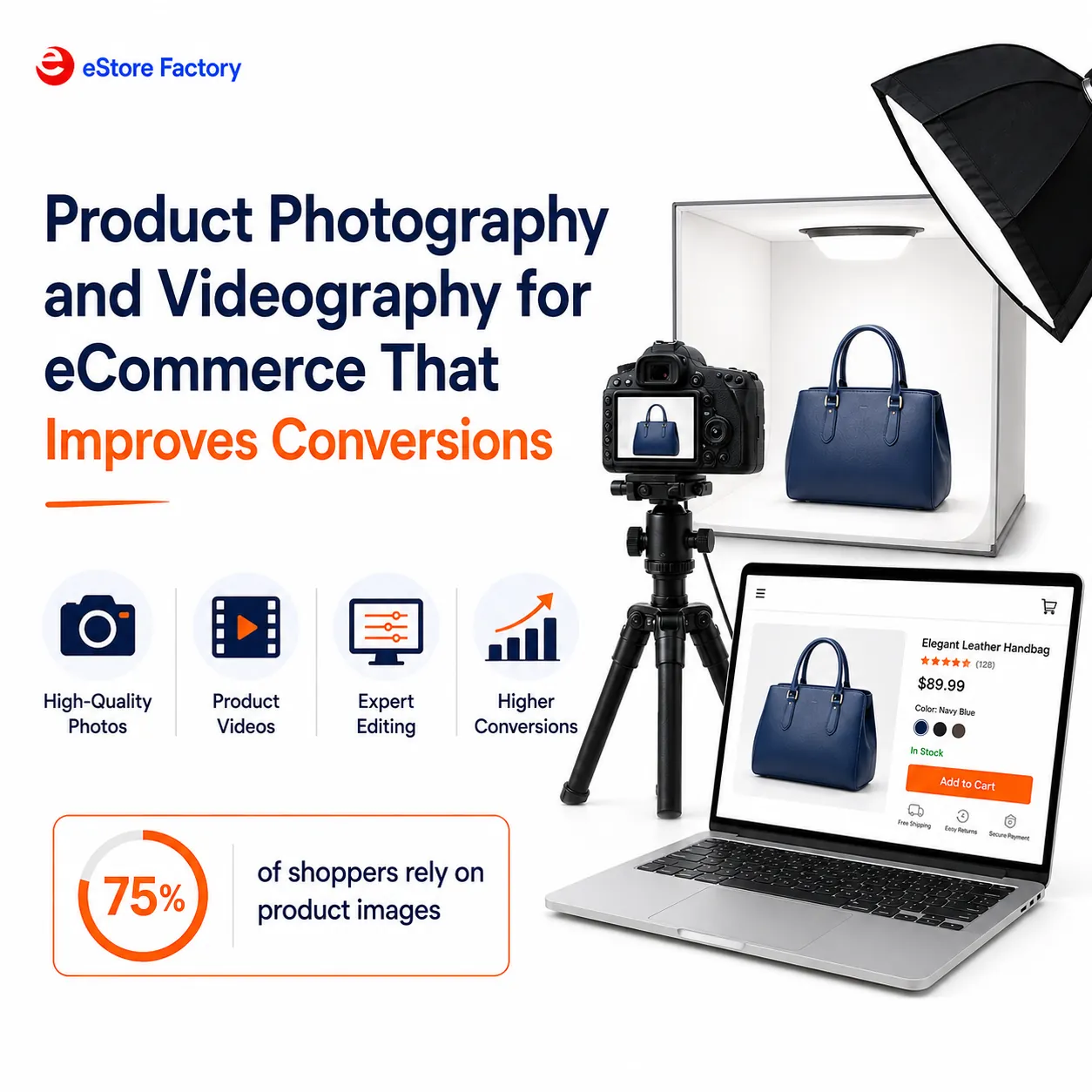
Product Photography and Videography for eCommerce That Improves Conversions
Product Photography and Videography for eCommerce That Improves Conversions
Back to Page
Product Photo & Videography
Product Photography and Videography for eCommerce That Improves Conversions
Your product is getting clicks, but shoppers are leaving without buying. Have you considered that your visuals might be the reason? In eCommerce, customers cannot hold a product, feel its texture, or test its quality before purchasing. That gap is filled entirely by product photography and videography. When the images are unclear, inconsistent, or simply uninspiring, buyers move on to a listing that gives them more confidence. Strong visuals build the kind of trust that turns a browser into a buyer. When the images are weak, even a well-priced product gets scrolled past.
At eStore Factory, professional product photography is treated as a core part of listing strategy, not an add-on. Brands that get their visuals right from the start see it reflected in their click-through rates, conversion numbers, and return rates. The right images and videos do not just show your product, they give shoppers a reason to buy it.
Why Are Your Listings Getting Traffic But Not Sales?
High traffic with low conversions is one of the most frustrating situations for an eCommerce seller. The ads are running, the listing is live, people are clicking, but the sales are not following. Before adjusting pricing or rewriting bullet points, it is worth looking at what shoppers actually see when they land on the page.
Online shoppers cannot physically interact with a product before buying. Everything they need to feel confident has to come from the screen. This is exactly where ecommerce product video services and listing visuals carry the full weight of the buying decision.
Here is what weak visuals are silently costing sellers:
Lost trust at first glance: Shoppers judge a listing in seconds. A poorly lit or blurry image gives them a reason to leave before reading a single word.
Higher bounce rates: On Amazon, the first image either stops the scroll or loses the click. There is no second chance at that moment.
Higher return rates: When the product a buyer receives does not match what the listing showed, the result is a return, a bad review, or both.
Wasted ad spend: Paid traffic sent to a listing with weak visuals does not convert. The ads bring the clicks, but the images lose the sale.
Research shows that 75% of online shoppers rely on product images when making a purchase decision. The visual quality of a listing is, in the absence of any in-person experience, the brand itself.
What Does High-Converting Product Photography Actually Look Like?
Professional product photography for eCommerce is not about making a product look pretty. It is about giving the shopper enough visual information to feel confident buying without ever touching the product.
White Background vs. Lifestyle: Which One Sells?
Both types serve a different purpose, and a strong listing needs both. White background images meet Amazon's main image requirements and establish product clarity. Lifestyle images place the product in a real setting, helping the shopper picture themselves using it. The strongest listings use both in a deliberate order, clarity first, context second.
How Many Images Does a Listing Actually Need?
Amazon allows up to nine image slots, and listings that use all available slots consistently outperform those that do not. Every image should answer a specific shopper question, what does it look like, how big is it, how does it work, who is it for. A product photography studio with eCommerce experience builds a short list around those questions, not just around visual appeal.
What Role Does Post-Production Play in Final Image Quality?
A great shoot is only half the process. Ecommerce photo editing is where color accuracy, consistency, and platform compliance are built into the final output. Background removal, shadow correction, and color grading are not optional finishing steps, they determine how professional the listing looks and how much trust the shopper extends to the brand.
How Does Product Video Change the Conversion Equation?
Photography answers what a product looks like. The video answers how it works, how it moves, and why it is worth buying. Together, product photography and videography cover the full range of questions a shopper has before making a purchase decision.
Customers who watch product videos spend 174% more than those who do not. That is not a small lift, it reflects a fundamental shift in buyer confidence that static images alone cannot achieve.
Which Video Type Works Best for Which Situation?
Not all product videos serve the same purpose. The right format depends on where the shopper is in the buying journey and where the video will appear.
Video Type | Best Use Case | Conversion Impact |
Product Listing Video | Amazon's main image carousel | Increases time on listing, reduces bounce |
Sponsored Brand Video | Top-of-search ad placement | Outperforms banner ads by up to 30% |
How-To / Explainer Video | Complex or first-time-use products | Reduces purchase hesitation significantly |
Lifestyle / Social Cut | Social ads, off-Amazon traffic | Drives awareness and new-to-brand buyers |
What Can Video Do That Photography Cannot?
Video communicates what static images cannot capture, movement, scale, texture in real use, and product functionality. For categories like tools, fitness equipment, skincare, and kitchenware, a well-produced video from a reliable video production company can single-handedly answer the objections that were quietly preventing a purchase.
Does eCommerce Photo Editing Deserve More Attention Than It Gets?
Yes. Ecommerce photo editing is where a good shoot becomes a converting listing. Most brands treat it as a finishing step, but it is actually where platform compliance, visual consistency, and color accuracy are established.
Is a Raw Product Shot Ever Enough?
No. A raw file is where the shoot ends, not where the asset begins:
Unedited shots rarely meet Amazon's requirements for background color, resolution, and image dimensions.
Lighting gaps and surface reflections show up clearly in raw files and pull attention away from the product.
The color a camera captures and the color of the actual product are often not the same thing.
What Happens to Conversions When Editing Is Inconsistent?
When editing lacks consistency across a listing, shoppers notice, even if they cannot explain why:
Images that do not match in tone, cropping, or background make a listing look rushed and unpolished.
Visual inconsistency creates doubt about the brand, and doubt at the listing stage costs sales.
A listing where every image looks like it belongs together builds the kind of quiet confidence that moves a shopper toward the buy button.
How Does Color Accuracy in Editing Affect Return Rates?
Color inaccuracy is one of the most common causes of product returns in eCommerce:
When the product a customer receives does not match what they saw in the listing, they feel misled.
Studies link visual misrepresentation to 30 to 40% of eCommerce return rates.
Accurate color correction during editing directly protects seller ratings and long-term revenue.
How Does eStore Factory Approach Product Photography and Videography Differently?
eStore Factory builds visual content with one goal in mind, Amazon conversion. Every image and video produced is mapped to listing performance, not just creative output. Brands working with eStore Factory get a product photography studio setup and production workflow built specifically around how Amazon shoppers buy.
Amazon-First Shot Planning: Every shoot is structured around Amazon's image requirements, so each slot in the listing gallery has a clear purpose and contributes directly to conversion.
Photography and Video Under One Workflow: Images and videos are produced together, which keeps the visual tone consistent across the listing, A+ Content, and Sponsored Brand campaigns without back and forth between multiple vendors.
Editing Built Into the Delivery Process: Color correction, background work, and compliance formatting are part of the standard delivery, so assets arrive listing-ready without needing additional rounds of revision.
Visuals Aligned With the Full Listing: Photography and video are planned alongside A+ Content, Brand Store, and infographic needs, so every visual element across the listing works together rather than looking like it was produced separately.
Is It Time to Upgrade Your Listing Visuals?
Strong visuals are not a one-time investment, they are an ongoing part of how a listing performs. Ecommerce product video services combined with well-edited, platform-optimized images create the kind of shopper experience that reduces hesitation and increases purchase confidence consistently.
eStore Factory brings professional product photography, videography, and post-production together under one Amazon-focused workflow. If your listings are getting traffic but not converting the way they should, the visuals are worth a closer look. Connect with eStore Factory today and get a visual strategy built around your listing goals.
FAQs
What is the difference between product photography and videography for eCommerce?
How many product images does an Amazon listing need to perform well?
Does product video really improve eCommerce sales?
Why does eCommerce photo editing matter for conversions?
When should an eCommerce brand hire a professional photography and videography service?
Your product is getting clicks, but shoppers are leaving without buying. Have you considered that your visuals might be the reason? In eCommerce, customers cannot hold a product, feel its texture, or test its quality before purchasing. That gap is filled entirely by product photography and videography. When the images are unclear, inconsistent, or simply uninspiring, buyers move on to a listing that gives them more confidence. Strong visuals build the kind of trust that turns a browser into a buyer. When the images are weak, even a well-priced product gets scrolled past.
At eStore Factory, professional product photography is treated as a core part of listing strategy, not an add-on. Brands that get their visuals right from the start see it reflected in their click-through rates, conversion numbers, and return rates. The right images and videos do not just show your product, they give shoppers a reason to buy it.
Why Are Your Listings Getting Traffic But Not Sales?
High traffic with low conversions is one of the most frustrating situations for an eCommerce seller. The ads are running, the listing is live, people are clicking, but the sales are not following. Before adjusting pricing or rewriting bullet points, it is worth looking at what shoppers actually see when they land on the page.
Online shoppers cannot physically interact with a product before buying. Everything they need to feel confident has to come from the screen. This is exactly where ecommerce product video services and listing visuals carry the full weight of the buying decision.
Here is what weak visuals are silently costing sellers:
Lost trust at first glance: Shoppers judge a listing in seconds. A poorly lit or blurry image gives them a reason to leave before reading a single word.
Higher bounce rates: On Amazon, the first image either stops the scroll or loses the click. There is no second chance at that moment.
Higher return rates: When the product a buyer receives does not match what the listing showed, the result is a return, a bad review, or both.
Wasted ad spend: Paid traffic sent to a listing with weak visuals does not convert. The ads bring the clicks, but the images lose the sale.
Research shows that 75% of online shoppers rely on product images when making a purchase decision. The visual quality of a listing is, in the absence of any in-person experience, the brand itself.
What Does High-Converting Product Photography Actually Look Like?
Professional product photography for eCommerce is not about making a product look pretty. It is about giving the shopper enough visual information to feel confident buying without ever touching the product.
White Background vs. Lifestyle: Which One Sells?
Both types serve a different purpose, and a strong listing needs both. White background images meet Amazon's main image requirements and establish product clarity. Lifestyle images place the product in a real setting, helping the shopper picture themselves using it. The strongest listings use both in a deliberate order, clarity first, context second.
How Many Images Does a Listing Actually Need?
Amazon allows up to nine image slots, and listings that use all available slots consistently outperform those that do not. Every image should answer a specific shopper question, what does it look like, how big is it, how does it work, who is it for. A product photography studio with eCommerce experience builds a short list around those questions, not just around visual appeal.
What Role Does Post-Production Play in Final Image Quality?
A great shoot is only half the process. Ecommerce photo editing is where color accuracy, consistency, and platform compliance are built into the final output. Background removal, shadow correction, and color grading are not optional finishing steps, they determine how professional the listing looks and how much trust the shopper extends to the brand.
How Does Product Video Change the Conversion Equation?
Photography answers what a product looks like. The video answers how it works, how it moves, and why it is worth buying. Together, product photography and videography cover the full range of questions a shopper has before making a purchase decision.
Customers who watch product videos spend 174% more than those who do not. That is not a small lift, it reflects a fundamental shift in buyer confidence that static images alone cannot achieve.
Which Video Type Works Best for Which Situation?
Not all product videos serve the same purpose. The right format depends on where the shopper is in the buying journey and where the video will appear.
Video Type | Best Use Case | Conversion Impact |
Product Listing Video | Amazon's main image carousel | Increases time on listing, reduces bounce |
Sponsored Brand Video | Top-of-search ad placement | Outperforms banner ads by up to 30% |
How-To / Explainer Video | Complex or first-time-use products | Reduces purchase hesitation significantly |
Lifestyle / Social Cut | Social ads, off-Amazon traffic | Drives awareness and new-to-brand buyers |
What Can Video Do That Photography Cannot?
Video communicates what static images cannot capture, movement, scale, texture in real use, and product functionality. For categories like tools, fitness equipment, skincare, and kitchenware, a well-produced video from a reliable video production company can single-handedly answer the objections that were quietly preventing a purchase.
Does eCommerce Photo Editing Deserve More Attention Than It Gets?
Yes. Ecommerce photo editing is where a good shoot becomes a converting listing. Most brands treat it as a finishing step, but it is actually where platform compliance, visual consistency, and color accuracy are established.
Is a Raw Product Shot Ever Enough?
No. A raw file is where the shoot ends, not where the asset begins:
Unedited shots rarely meet Amazon's requirements for background color, resolution, and image dimensions.
Lighting gaps and surface reflections show up clearly in raw files and pull attention away from the product.
The color a camera captures and the color of the actual product are often not the same thing.
What Happens to Conversions When Editing Is Inconsistent?
When editing lacks consistency across a listing, shoppers notice, even if they cannot explain why:
Images that do not match in tone, cropping, or background make a listing look rushed and unpolished.
Visual inconsistency creates doubt about the brand, and doubt at the listing stage costs sales.
A listing where every image looks like it belongs together builds the kind of quiet confidence that moves a shopper toward the buy button.
How Does Color Accuracy in Editing Affect Return Rates?
Color inaccuracy is one of the most common causes of product returns in eCommerce:
When the product a customer receives does not match what they saw in the listing, they feel misled.
Studies link visual misrepresentation to 30 to 40% of eCommerce return rates.
Accurate color correction during editing directly protects seller ratings and long-term revenue.
How Does eStore Factory Approach Product Photography and Videography Differently?
eStore Factory builds visual content with one goal in mind, Amazon conversion. Every image and video produced is mapped to listing performance, not just creative output. Brands working with eStore Factory get a product photography studio setup and production workflow built specifically around how Amazon shoppers buy.
Amazon-First Shot Planning: Every shoot is structured around Amazon's image requirements, so each slot in the listing gallery has a clear purpose and contributes directly to conversion.
Photography and Video Under One Workflow: Images and videos are produced together, which keeps the visual tone consistent across the listing, A+ Content, and Sponsored Brand campaigns without back and forth between multiple vendors.
Editing Built Into the Delivery Process: Color correction, background work, and compliance formatting are part of the standard delivery, so assets arrive listing-ready without needing additional rounds of revision.
Visuals Aligned With the Full Listing: Photography and video are planned alongside A+ Content, Brand Store, and infographic needs, so every visual element across the listing works together rather than looking like it was produced separately.
Is It Time to Upgrade Your Listing Visuals?
Strong visuals are not a one-time investment, they are an ongoing part of how a listing performs. Ecommerce product video services combined with well-edited, platform-optimized images create the kind of shopper experience that reduces hesitation and increases purchase confidence consistently.
eStore Factory brings professional product photography, videography, and post-production together under one Amazon-focused workflow. If your listings are getting traffic but not converting the way they should, the visuals are worth a closer look. Connect with eStore Factory today and get a visual strategy built around your listing goals.
FAQs
What is the difference between product photography and videography for eCommerce?
How many product images does an Amazon listing need to perform well?
Does product video really improve eCommerce sales?
Why does eCommerce photo editing matter for conversions?
When should an eCommerce brand hire a professional photography and videography service?
Your product is getting clicks, but shoppers are leaving without buying. Have you considered that your visuals might be the reason? In eCommerce, customers cannot hold a product, feel its texture, or test its quality before purchasing. That gap is filled entirely by product photography and videography. When the images are unclear, inconsistent, or simply uninspiring, buyers move on to a listing that gives them more confidence. Strong visuals build the kind of trust that turns a browser into a buyer. When the images are weak, even a well-priced product gets scrolled past.
At eStore Factory, professional product photography is treated as a core part of listing strategy, not an add-on. Brands that get their visuals right from the start see it reflected in their click-through rates, conversion numbers, and return rates. The right images and videos do not just show your product, they give shoppers a reason to buy it.
Why Are Your Listings Getting Traffic But Not Sales?
High traffic with low conversions is one of the most frustrating situations for an eCommerce seller. The ads are running, the listing is live, people are clicking, but the sales are not following. Before adjusting pricing or rewriting bullet points, it is worth looking at what shoppers actually see when they land on the page.
Online shoppers cannot physically interact with a product before buying. Everything they need to feel confident has to come from the screen. This is exactly where ecommerce product video services and listing visuals carry the full weight of the buying decision.
Here is what weak visuals are silently costing sellers:
Lost trust at first glance: Shoppers judge a listing in seconds. A poorly lit or blurry image gives them a reason to leave before reading a single word.
Higher bounce rates: On Amazon, the first image either stops the scroll or loses the click. There is no second chance at that moment.
Higher return rates: When the product a buyer receives does not match what the listing showed, the result is a return, a bad review, or both.
Wasted ad spend: Paid traffic sent to a listing with weak visuals does not convert. The ads bring the clicks, but the images lose the sale.
Research shows that 75% of online shoppers rely on product images when making a purchase decision. The visual quality of a listing is, in the absence of any in-person experience, the brand itself.
What Does High-Converting Product Photography Actually Look Like?
Professional product photography for eCommerce is not about making a product look pretty. It is about giving the shopper enough visual information to feel confident buying without ever touching the product.
White Background vs. Lifestyle: Which One Sells?
Both types serve a different purpose, and a strong listing needs both. White background images meet Amazon's main image requirements and establish product clarity. Lifestyle images place the product in a real setting, helping the shopper picture themselves using it. The strongest listings use both in a deliberate order, clarity first, context second.
How Many Images Does a Listing Actually Need?
Amazon allows up to nine image slots, and listings that use all available slots consistently outperform those that do not. Every image should answer a specific shopper question, what does it look like, how big is it, how does it work, who is it for. A product photography studio with eCommerce experience builds a short list around those questions, not just around visual appeal.
What Role Does Post-Production Play in Final Image Quality?
A great shoot is only half the process. Ecommerce photo editing is where color accuracy, consistency, and platform compliance are built into the final output. Background removal, shadow correction, and color grading are not optional finishing steps, they determine how professional the listing looks and how much trust the shopper extends to the brand.
How Does Product Video Change the Conversion Equation?
Photography answers what a product looks like. The video answers how it works, how it moves, and why it is worth buying. Together, product photography and videography cover the full range of questions a shopper has before making a purchase decision.
Customers who watch product videos spend 174% more than those who do not. That is not a small lift, it reflects a fundamental shift in buyer confidence that static images alone cannot achieve.
Which Video Type Works Best for Which Situation?
Not all product videos serve the same purpose. The right format depends on where the shopper is in the buying journey and where the video will appear.
Video Type | Best Use Case | Conversion Impact |
Product Listing Video | Amazon's main image carousel | Increases time on listing, reduces bounce |
Sponsored Brand Video | Top-of-search ad placement | Outperforms banner ads by up to 30% |
How-To / Explainer Video | Complex or first-time-use products | Reduces purchase hesitation significantly |
Lifestyle / Social Cut | Social ads, off-Amazon traffic | Drives awareness and new-to-brand buyers |
What Can Video Do That Photography Cannot?
Video communicates what static images cannot capture, movement, scale, texture in real use, and product functionality. For categories like tools, fitness equipment, skincare, and kitchenware, a well-produced video from a reliable video production company can single-handedly answer the objections that were quietly preventing a purchase.
Does eCommerce Photo Editing Deserve More Attention Than It Gets?
Yes. Ecommerce photo editing is where a good shoot becomes a converting listing. Most brands treat it as a finishing step, but it is actually where platform compliance, visual consistency, and color accuracy are established.
Is a Raw Product Shot Ever Enough?
No. A raw file is where the shoot ends, not where the asset begins:
Unedited shots rarely meet Amazon's requirements for background color, resolution, and image dimensions.
Lighting gaps and surface reflections show up clearly in raw files and pull attention away from the product.
The color a camera captures and the color of the actual product are often not the same thing.
What Happens to Conversions When Editing Is Inconsistent?
When editing lacks consistency across a listing, shoppers notice, even if they cannot explain why:
Images that do not match in tone, cropping, or background make a listing look rushed and unpolished.
Visual inconsistency creates doubt about the brand, and doubt at the listing stage costs sales.
A listing where every image looks like it belongs together builds the kind of quiet confidence that moves a shopper toward the buy button.
How Does Color Accuracy in Editing Affect Return Rates?
Color inaccuracy is one of the most common causes of product returns in eCommerce:
When the product a customer receives does not match what they saw in the listing, they feel misled.
Studies link visual misrepresentation to 30 to 40% of eCommerce return rates.
Accurate color correction during editing directly protects seller ratings and long-term revenue.
How Does eStore Factory Approach Product Photography and Videography Differently?
eStore Factory builds visual content with one goal in mind, Amazon conversion. Every image and video produced is mapped to listing performance, not just creative output. Brands working with eStore Factory get a product photography studio setup and production workflow built specifically around how Amazon shoppers buy.
Amazon-First Shot Planning: Every shoot is structured around Amazon's image requirements, so each slot in the listing gallery has a clear purpose and contributes directly to conversion.
Photography and Video Under One Workflow: Images and videos are produced together, which keeps the visual tone consistent across the listing, A+ Content, and Sponsored Brand campaigns without back and forth between multiple vendors.
Editing Built Into the Delivery Process: Color correction, background work, and compliance formatting are part of the standard delivery, so assets arrive listing-ready without needing additional rounds of revision.
Visuals Aligned With the Full Listing: Photography and video are planned alongside A+ Content, Brand Store, and infographic needs, so every visual element across the listing works together rather than looking like it was produced separately.
Is It Time to Upgrade Your Listing Visuals?
Strong visuals are not a one-time investment, they are an ongoing part of how a listing performs. Ecommerce product video services combined with well-edited, platform-optimized images create the kind of shopper experience that reduces hesitation and increases purchase confidence consistently.
eStore Factory brings professional product photography, videography, and post-production together under one Amazon-focused workflow. If your listings are getting traffic but not converting the way they should, the visuals are worth a closer look. Connect with eStore Factory today and get a visual strategy built around your listing goals.
FAQs
What is the difference between product photography and videography for eCommerce?
How many product images does an Amazon listing need to perform well?
Does product video really improve eCommerce sales?
Why does eCommerce photo editing matter for conversions?
When should an eCommerce brand hire a professional photography and videography service?





eStore Factory is a full-service agency for Amazon Sellers dedicated to building end-to-end strategies for brands of all sizes.


SERVICES FOR AMAZON
Product Setup ON AMAZON
GRAPHICS & BRANDING SERVICES
PHOTOGRAPHY SERVICES
PPC MANAGEMENT
© Copyright 2014 - 2026. All Rights Reserved.
eStore Factory is a full-service agency for Amazon Sellers dedicated to building end-to-end strategies for brands of all sizes.
SERVICES FOR AMAZON
Product Setup ON AMAZON
GRAPHICS & BRANDING SERVICES
PHOTOGRAPHY SERVICES
PPC MANAGEMENT
© Copyright 2014 - 2026. All Rights Reserved.
eStore Factory is a full-service agency for Amazon Sellers dedicated to building end-to-end strategies for brands of all sizes.
SERVICES FOR AMAZON
Product Setup ON AMAZON
GRAPHICS & BRANDING SERVICES
PHOTOGRAPHY SERVICES
PPC MANAGEMENT
© Copyright 2014 - 2026. All Rights Reserved.