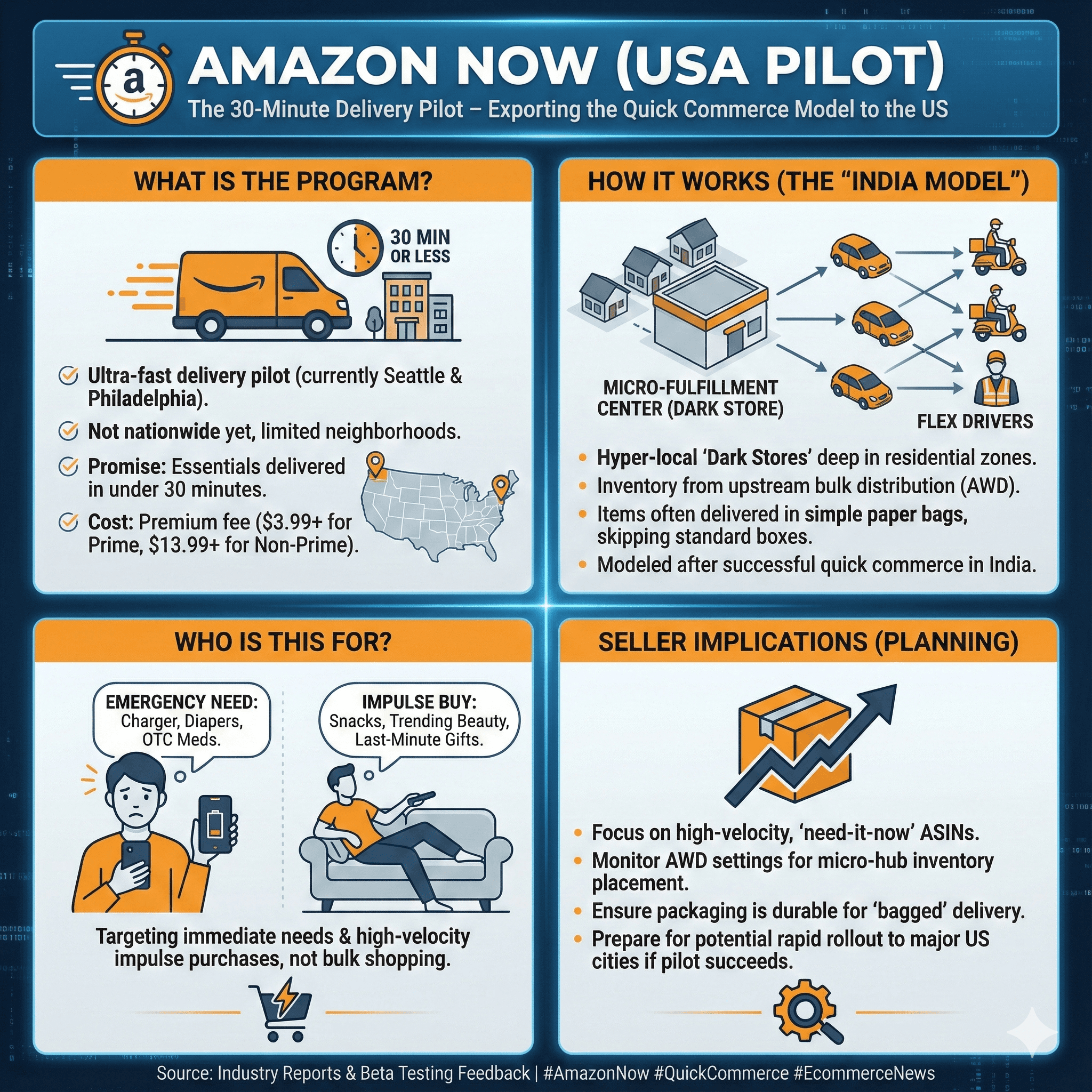
🚀 The "10-Minute Delivery" war has officially landed in the US.
We’ve seen the Quick Commerce revolution take over India (via Blinkit, Zepto, and Amazon’s own rapid expansion). Now, Amazon is taking that exact playbook and testing it stateside with the quiet launch of the Amazon Now pilot in Seattle and Philadelphia.
If you are a US Seller, here is your "Week 1" briefing on what this means for your brand.
📦 The Pilot: Amazon Now (USA)
Unlike "Amazon Haul" (which competes with Temu on price/slowness), Amazon Now is all about speed.
Promise: Delivery in 30 minutes or less.
Locations: Currently live in select neighborhoods in Seattle, WA and Philadelphia, PA.
The Model: Micro-fulfillment centers (Dark Stores) located deep within residential zones, delivering essentials via Flex drivers.
📊 Initial Reviews & Sentiment
The early feedback from beta testers and tech journalists is mixed but promising:
The Good: The speed is real. Users are shocked to get charging cables and milk in 24 minutes.
The Bad: The fees. Unlike India’s low-fee model, the US pilot charges ~$3.99 per order for Prime members and up to $13.99 for non-Prime.
The Verdict: It’s currently seen as an "Emergency Service" rather than a daily habit—but that will likely change as logistics tighten.
🎯 How Can US Sellers Plan for This?
If you want your products to be "Amazon Now" eligible, you cannot rely on standard FBA strategies. This game is about Proximity and Velocity.
1. Product Suitability Audit "Amazon Now" isn't for slow-moving furniture. It is for "I need this immediately."
Ask yourself: Is your product an "Emergency" (OTC meds, chargers, diapers) or an "Impulse" (snacks, trending beauty)? These are the categories getting shelf space in the new micro-hubs.
2. The "Micro-Fulfillment" Shift Inventory for these 30-minute deliveries does not come from the massive FCs on the outskirts of town. It comes from small, urban dark stores.
Action: Monitor your AWD (Amazon Warehousing & Distribution) settings. Amazon’s algorithm will prioritize stocking these micro-hubs with high-velocity ASINs that are already in their upstream bulk distribution network.
3. Packaging for Speed The 30-minute delivery model often skips the heavy cardboard boxing. Items are often delivered in simple paper bags.
Action: Ensure your product packaging is durable enough to survive a "bagged" delivery ride without the protection of a standard Amazon smiley box.
🔮 The Prediction: Amazon is using this pilot to see if US consumers will pay for the convenience that Indian consumers demand. If the unit economics work, expect a rapid rollout to NYC, LA, and Chicago by Q2 2026.