

Back to Page
Amazon Marketing
Does Amazon A+ Content Really Increase Sales? The Data and What to Do About It
Does Amazon A+ Content Really Increase Sales? The Data and What to Do About It
Back to Page
Amazon Marketing
Does Amazon A+ Content Really Increase Sales? The Data and What to Do About It
If your Amazon product page is getting traffic but not enough sales, the problem is rarely the product itself, it is usually what the page fails to communicate. Amazon A+ content gives brand-registered sellers the ability to go beyond basic bullet points and plain text descriptions. It brings in enhanced visuals, structured layouts, and brand storytelling that help shoppers understand exactly what they are buying. The result is fewer hesitations, fewer returns, and more completed purchases.
Brands working with experienced Amazon EBC design partners like eStore Factory have seen this reflected directly in their conversion numbers. The data behind A+ Content is worth understanding before your competitors use it better than you do.
What Is Amazon A+ Content, and Who Can Use It?
Amazon A+ content is a Seller Central feature that lets brand-registered sellers replace the standard plain-text product description with a richer, more structured page layout. Think enhanced visuals, comparison charts, brand story modules, and formatted text blocks that make a product page significantly more informative than a default listing.
Who can access it?
Active Professional selling plan on Amazon
Enrollment in Amazon Brand Registry
Without brand registration, this feature is not accessible
Basic A+ vs. Premium A+: What is the difference?
Basic A+ | Premium A+ | |
Cost | Free for eligible brands | Requires Amazon eligibility threshold |
Modules | Images, text blocks, comparison charts | All Basic modules + video, interactive hotspots, larger hero images |
Best For | New to mid-stage brands | Established brands scaling visibility |
Not sure which tier your brand qualifies for or needs right now? Professional Amazon A content services help assess your current stage and build a content plan around it.
What Does the Data Actually Say?
The numbers behind Amazon A+ content come directly from Amazon, and they are specific enough to be taken seriously by any seller evaluating whether this investment makes sense.
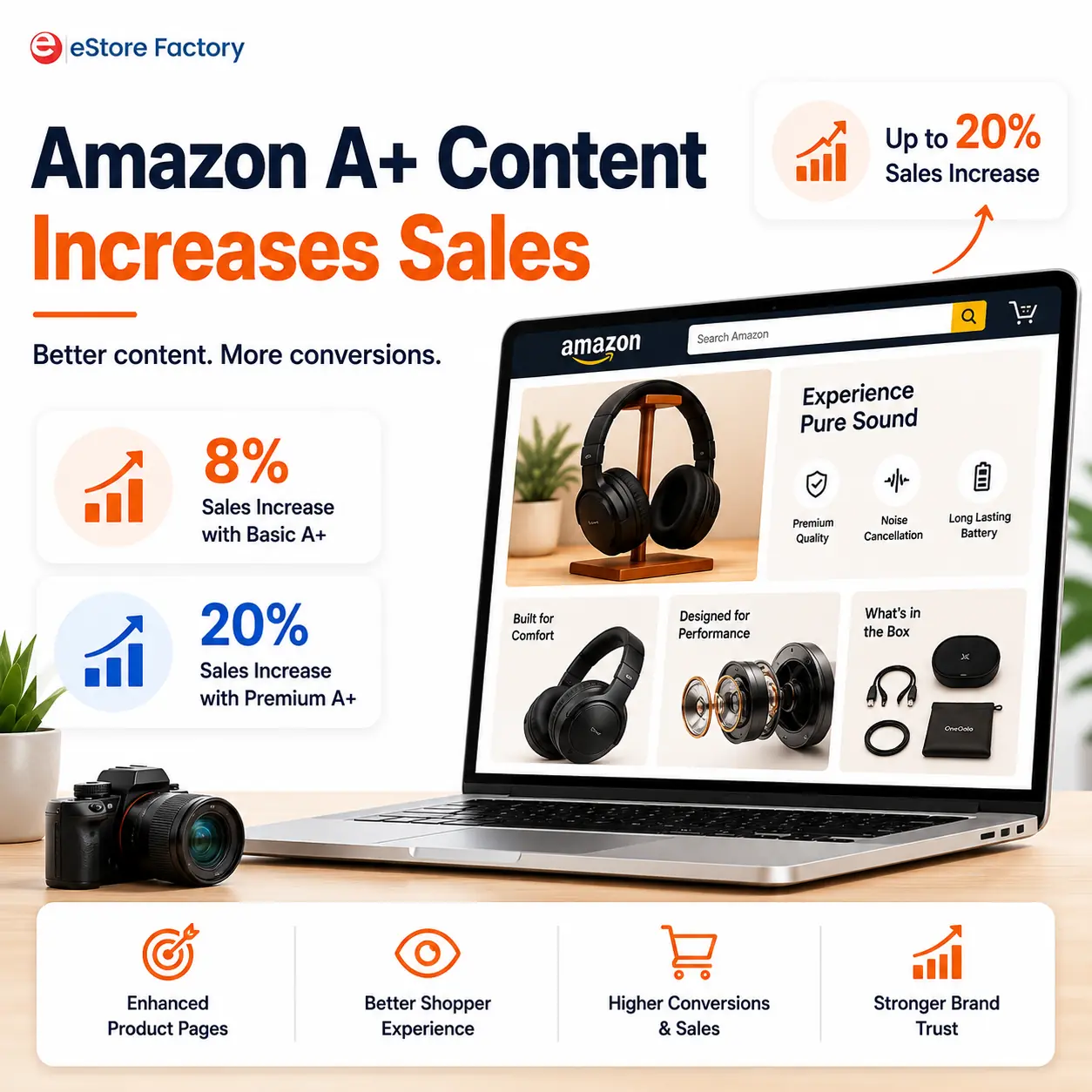
Basic A+ Content can increase sales by up to 8%. Premium A+ Content pushes that figure up to 20%. Across both tiers, product listings with A+ Content generally report a 3 to 10% improvement in conversion rates compared to standard listings.
But here is the condition that every competitor blog conveniently skips over. These figures assume the content is actually well-executed. A rushed A+ page with generic images, bloated text, or inconsistent branding does not produce these results. The data reflects quality implementation, not just the presence of A+ Content on a page.
So what does quality implementation look like in practice?
It means visuals that answer buyer questions before they are asked. It means layouts that guide the shopper through the product story without overwhelming them. It means messaging that matches what your target customer actually needs to hear before making a purchase decision.
That level of execution is where professional Amazon A+ content services make a measurable difference, and it is the reason why the same feature produces wildly different results across different brands.
Basic vs. Premium A+: Which One Is Right for Your Brand?
Choosing between Basic and Premium A+ is less about budget and more about where your brand currently stands on Amazon. Both tiers improve your listing, but they serve different stages of brand growth.
Basic A+ | Premium A+ | |
Availability | All Brand Registry sellers | Sellers meeting Amazon's eligibility criteria |
Visual Modules | Images, text blocks, brand story | All Basic modules + video, hotspots, larger hero images |
Comparison Charts | Available | Available with advanced formatting |
Mobile Experience | Standard optimization | Enhanced layout for mobile shoppers |
Best Suited For | Brands building their Amazon presence | Established brands focused on scaling |
Which tier should you start with?
If your brand is newly registered or still building its product catalog, Basic A+ is the right starting point. It costs nothing and still delivers a meaningful lift when designed properly.
If you are an established brand with consistent traffic and you want to maximize conversion on high-performing listings, Premium A+ is worth pursuing.
If you are unsure where you stand, an audit of your current listings will clarify which tier delivers the better return for your specific situation.
Strong Amazon EBC services cover both tiers and help brands make this decision based on actual listing performance data, not guesswork. The right choice is rarely about which tier has more features. It is about which one your brand is ready to execute well right now. Quality Amazon EBC design at the Basic level will consistently outperform a poorly executed Premium page.
Why Does A+ Content Actually Increase Sales? The Mechanics Behind the Numbers
Sellers often wonder why two brands in the same category get such different results from Amazon A+ content. The answer almost always comes down to how the page affects shopper behavior once they land on it.
It keeps shoppers on the page longer: A well-organized listing with clear visuals and structured information holds attention. Amazon notices this and rewards listings that keep shoppers engaged with stronger placement in search results.
It removes the questions that kill conversions: Size confusion, quality doubts, and unclear use cases are the most common reasons shoppers leave without buying. A properly built A+ page tackles each of these directly through charts, callouts, and focused visuals.
It makes newer brands look established: Shoppers have no way to verify a brand they have never bought from before. A structured, professionally presented page fills that trust gap and makes the buying decision feel safer.
It works harder on mobile than a standard listing ever could: Over 60% of Amazon purchases are completed on a phone. Amazon A+ content services that are built with mobile in mind ensure the layout holds up on smaller screens instead of pushing shoppers away.
How Does eStore Factory Build Amazon A+ Content That Actually Converts?
Most A+ pages underperform not because the feature does not work, but because the content on them was never built around what actually drives a shopper to buy. eStore Factory approaches Amazon A+ content services differently by treating every page as a conversion asset, not just a design deliverable. The work starts with understanding your product, your buyer, and the specific objections that stand between a page visit and a completed purchase.
1. Objection-First Content Strategy: Before a single module goes live, the team maps out what your shopper is unsure about and builds the page around resolving those specific doubts, not just showcasing the product.
2. Mobile-Optimized Layout Design: The page is built for phone screens from the start, because a layout that only looks good on desktop is already losing more than half of your potential buyers.
3. Brand-Aligned Visual Storytelling: Generic product shots get replaced with a deliberate visual flow built on Amazon EBC design principles, one that tells shoppers who the brand is and why this product belongs in their hands.
4. Performance-Driven Content Iteration: After the page goes live, results get tracked and weak spots get fixed, because a page that worked six months ago may not be doing the same job today.
When Does A+ Content Not Deliver Results?
A lot of sellers activate Amazon A+ content and then wonder why nothing has changed. In most cases, the feature is not the problem. The way the content was put together is.
Blurry or off-brand images tell shoppers the brand did not put much thought into the page, and that doubt follows them right to the exit.
Walls of text with no visual breaks are the fastest way to lose a shopper who came to the page ready to buy, but left because it was too much to read.
Copy that does not match what the product actually is plants uncertainty in the shopper's mind right when they are closest to making a decision.
A page built only for desktop quietly loses every shopper who opened the listing on their phone and found a cluttered, hard-to-follow layout.
Content that never gets revisited slowly becomes outdated as competitors improve their pages and shopper expectations move forward.
This gap between a page that just exists and one that actually sells is where strong Amazon A content services step in and make a real difference.
Let's Build an A+ Page That Actually Sells
Amazon A+ content moves the needle when the people building it understand what makes shoppers buy, not just what looks good on a page. The lift in sales is there, but it goes to brands that put real thought into how their listing communicates, not just brands that switch the feature on.
If people are finding your listings but leaving without buying, the page itself is likely the issue. eStore Factory builds Amazon EBC services around one goal: getting your product page to do the selling for you. Book a free strategy call today and get a clear picture of where your listings stand and what it will take to fix them.
FAQs
Does Amazon A+ content directly improve search ranking?
How long before A+ content starts showing results?
Should small brands go for Premium A+ or stick with Basic?
Can better A+ content lead to fewer product returns?
How often does A+ content need to be refreshed?
If your Amazon product page is getting traffic but not enough sales, the problem is rarely the product itself, it is usually what the page fails to communicate. Amazon A+ content gives brand-registered sellers the ability to go beyond basic bullet points and plain text descriptions. It brings in enhanced visuals, structured layouts, and brand storytelling that help shoppers understand exactly what they are buying. The result is fewer hesitations, fewer returns, and more completed purchases.
Brands working with experienced Amazon EBC design partners like eStore Factory have seen this reflected directly in their conversion numbers. The data behind A+ Content is worth understanding before your competitors use it better than you do.
What Is Amazon A+ Content, and Who Can Use It?
Amazon A+ content is a Seller Central feature that lets brand-registered sellers replace the standard plain-text product description with a richer, more structured page layout. Think enhanced visuals, comparison charts, brand story modules, and formatted text blocks that make a product page significantly more informative than a default listing.
Who can access it?
Active Professional selling plan on Amazon
Enrollment in Amazon Brand Registry
Without brand registration, this feature is not accessible
Basic A+ vs. Premium A+: What is the difference?
Basic A+ | Premium A+ | |
Cost | Free for eligible brands | Requires Amazon eligibility threshold |
Modules | Images, text blocks, comparison charts | All Basic modules + video, interactive hotspots, larger hero images |
Best For | New to mid-stage brands | Established brands scaling visibility |
Not sure which tier your brand qualifies for or needs right now? Professional Amazon A content services help assess your current stage and build a content plan around it.
What Does the Data Actually Say?
The numbers behind Amazon A+ content come directly from Amazon, and they are specific enough to be taken seriously by any seller evaluating whether this investment makes sense.
Basic A+ Content can increase sales by up to 8%. Premium A+ Content pushes that figure up to 20%. Across both tiers, product listings with A+ Content generally report a 3 to 10% improvement in conversion rates compared to standard listings.
But here is the condition that every competitor blog conveniently skips over. These figures assume the content is actually well-executed. A rushed A+ page with generic images, bloated text, or inconsistent branding does not produce these results. The data reflects quality implementation, not just the presence of A+ Content on a page.
So what does quality implementation look like in practice?
It means visuals that answer buyer questions before they are asked. It means layouts that guide the shopper through the product story without overwhelming them. It means messaging that matches what your target customer actually needs to hear before making a purchase decision.
That level of execution is where professional Amazon A+ content services make a measurable difference, and it is the reason why the same feature produces wildly different results across different brands.
Basic vs. Premium A+: Which One Is Right for Your Brand?
Choosing between Basic and Premium A+ is less about budget and more about where your brand currently stands on Amazon. Both tiers improve your listing, but they serve different stages of brand growth.
Basic A+ | Premium A+ | |
Availability | All Brand Registry sellers | Sellers meeting Amazon's eligibility criteria |
Visual Modules | Images, text blocks, brand story | All Basic modules + video, hotspots, larger hero images |
Comparison Charts | Available | Available with advanced formatting |
Mobile Experience | Standard optimization | Enhanced layout for mobile shoppers |
Best Suited For | Brands building their Amazon presence | Established brands focused on scaling |
Which tier should you start with?
If your brand is newly registered or still building its product catalog, Basic A+ is the right starting point. It costs nothing and still delivers a meaningful lift when designed properly.
If you are an established brand with consistent traffic and you want to maximize conversion on high-performing listings, Premium A+ is worth pursuing.
If you are unsure where you stand, an audit of your current listings will clarify which tier delivers the better return for your specific situation.
Strong Amazon EBC services cover both tiers and help brands make this decision based on actual listing performance data, not guesswork. The right choice is rarely about which tier has more features. It is about which one your brand is ready to execute well right now. Quality Amazon EBC design at the Basic level will consistently outperform a poorly executed Premium page.
Why Does A+ Content Actually Increase Sales? The Mechanics Behind the Numbers
Sellers often wonder why two brands in the same category get such different results from Amazon A+ content. The answer almost always comes down to how the page affects shopper behavior once they land on it.
It keeps shoppers on the page longer: A well-organized listing with clear visuals and structured information holds attention. Amazon notices this and rewards listings that keep shoppers engaged with stronger placement in search results.
It removes the questions that kill conversions: Size confusion, quality doubts, and unclear use cases are the most common reasons shoppers leave without buying. A properly built A+ page tackles each of these directly through charts, callouts, and focused visuals.
It makes newer brands look established: Shoppers have no way to verify a brand they have never bought from before. A structured, professionally presented page fills that trust gap and makes the buying decision feel safer.
It works harder on mobile than a standard listing ever could: Over 60% of Amazon purchases are completed on a phone. Amazon A+ content services that are built with mobile in mind ensure the layout holds up on smaller screens instead of pushing shoppers away.
How Does eStore Factory Build Amazon A+ Content That Actually Converts?
Most A+ pages underperform not because the feature does not work, but because the content on them was never built around what actually drives a shopper to buy. eStore Factory approaches Amazon A+ content services differently by treating every page as a conversion asset, not just a design deliverable. The work starts with understanding your product, your buyer, and the specific objections that stand between a page visit and a completed purchase.
1. Objection-First Content Strategy: Before a single module goes live, the team maps out what your shopper is unsure about and builds the page around resolving those specific doubts, not just showcasing the product.
2. Mobile-Optimized Layout Design: The page is built for phone screens from the start, because a layout that only looks good on desktop is already losing more than half of your potential buyers.
3. Brand-Aligned Visual Storytelling: Generic product shots get replaced with a deliberate visual flow built on Amazon EBC design principles, one that tells shoppers who the brand is and why this product belongs in their hands.
4. Performance-Driven Content Iteration: After the page goes live, results get tracked and weak spots get fixed, because a page that worked six months ago may not be doing the same job today.
When Does A+ Content Not Deliver Results?
A lot of sellers activate Amazon A+ content and then wonder why nothing has changed. In most cases, the feature is not the problem. The way the content was put together is.
Blurry or off-brand images tell shoppers the brand did not put much thought into the page, and that doubt follows them right to the exit.
Walls of text with no visual breaks are the fastest way to lose a shopper who came to the page ready to buy, but left because it was too much to read.
Copy that does not match what the product actually is plants uncertainty in the shopper's mind right when they are closest to making a decision.
A page built only for desktop quietly loses every shopper who opened the listing on their phone and found a cluttered, hard-to-follow layout.
Content that never gets revisited slowly becomes outdated as competitors improve their pages and shopper expectations move forward.
This gap between a page that just exists and one that actually sells is where strong Amazon A content services step in and make a real difference.
Let's Build an A+ Page That Actually Sells
Amazon A+ content moves the needle when the people building it understand what makes shoppers buy, not just what looks good on a page. The lift in sales is there, but it goes to brands that put real thought into how their listing communicates, not just brands that switch the feature on.
If people are finding your listings but leaving without buying, the page itself is likely the issue. eStore Factory builds Amazon EBC services around one goal: getting your product page to do the selling for you. Book a free strategy call today and get a clear picture of where your listings stand and what it will take to fix them.
FAQs
Does Amazon A+ content directly improve search ranking?
How long before A+ content starts showing results?
Should small brands go for Premium A+ or stick with Basic?
Can better A+ content lead to fewer product returns?
How often does A+ content need to be refreshed?
If your Amazon product page is getting traffic but not enough sales, the problem is rarely the product itself, it is usually what the page fails to communicate. Amazon A+ content gives brand-registered sellers the ability to go beyond basic bullet points and plain text descriptions. It brings in enhanced visuals, structured layouts, and brand storytelling that help shoppers understand exactly what they are buying. The result is fewer hesitations, fewer returns, and more completed purchases.
Brands working with experienced Amazon EBC design partners like eStore Factory have seen this reflected directly in their conversion numbers. The data behind A+ Content is worth understanding before your competitors use it better than you do.
What Is Amazon A+ Content, and Who Can Use It?
Amazon A+ content is a Seller Central feature that lets brand-registered sellers replace the standard plain-text product description with a richer, more structured page layout. Think enhanced visuals, comparison charts, brand story modules, and formatted text blocks that make a product page significantly more informative than a default listing.
Who can access it?
Active Professional selling plan on Amazon
Enrollment in Amazon Brand Registry
Without brand registration, this feature is not accessible
Basic A+ vs. Premium A+: What is the difference?
Basic A+ | Premium A+ | |
Cost | Free for eligible brands | Requires Amazon eligibility threshold |
Modules | Images, text blocks, comparison charts | All Basic modules + video, interactive hotspots, larger hero images |
Best For | New to mid-stage brands | Established brands scaling visibility |
Not sure which tier your brand qualifies for or needs right now? Professional Amazon A content services help assess your current stage and build a content plan around it.
What Does the Data Actually Say?
The numbers behind Amazon A+ content come directly from Amazon, and they are specific enough to be taken seriously by any seller evaluating whether this investment makes sense.
Basic A+ Content can increase sales by up to 8%. Premium A+ Content pushes that figure up to 20%. Across both tiers, product listings with A+ Content generally report a 3 to 10% improvement in conversion rates compared to standard listings.
But here is the condition that every competitor blog conveniently skips over. These figures assume the content is actually well-executed. A rushed A+ page with generic images, bloated text, or inconsistent branding does not produce these results. The data reflects quality implementation, not just the presence of A+ Content on a page.
So what does quality implementation look like in practice?
It means visuals that answer buyer questions before they are asked. It means layouts that guide the shopper through the product story without overwhelming them. It means messaging that matches what your target customer actually needs to hear before making a purchase decision.
That level of execution is where professional Amazon A+ content services make a measurable difference, and it is the reason why the same feature produces wildly different results across different brands.
Basic vs. Premium A+: Which One Is Right for Your Brand?
Choosing between Basic and Premium A+ is less about budget and more about where your brand currently stands on Amazon. Both tiers improve your listing, but they serve different stages of brand growth.
Basic A+ | Premium A+ | |
Availability | All Brand Registry sellers | Sellers meeting Amazon's eligibility criteria |
Visual Modules | Images, text blocks, brand story | All Basic modules + video, hotspots, larger hero images |
Comparison Charts | Available | Available with advanced formatting |
Mobile Experience | Standard optimization | Enhanced layout for mobile shoppers |
Best Suited For | Brands building their Amazon presence | Established brands focused on scaling |
Which tier should you start with?
If your brand is newly registered or still building its product catalog, Basic A+ is the right starting point. It costs nothing and still delivers a meaningful lift when designed properly.
If you are an established brand with consistent traffic and you want to maximize conversion on high-performing listings, Premium A+ is worth pursuing.
If you are unsure where you stand, an audit of your current listings will clarify which tier delivers the better return for your specific situation.
Strong Amazon EBC services cover both tiers and help brands make this decision based on actual listing performance data, not guesswork. The right choice is rarely about which tier has more features. It is about which one your brand is ready to execute well right now. Quality Amazon EBC design at the Basic level will consistently outperform a poorly executed Premium page.
Why Does A+ Content Actually Increase Sales? The Mechanics Behind the Numbers
Sellers often wonder why two brands in the same category get such different results from Amazon A+ content. The answer almost always comes down to how the page affects shopper behavior once they land on it.
It keeps shoppers on the page longer: A well-organized listing with clear visuals and structured information holds attention. Amazon notices this and rewards listings that keep shoppers engaged with stronger placement in search results.
It removes the questions that kill conversions: Size confusion, quality doubts, and unclear use cases are the most common reasons shoppers leave without buying. A properly built A+ page tackles each of these directly through charts, callouts, and focused visuals.
It makes newer brands look established: Shoppers have no way to verify a brand they have never bought from before. A structured, professionally presented page fills that trust gap and makes the buying decision feel safer.
It works harder on mobile than a standard listing ever could: Over 60% of Amazon purchases are completed on a phone. Amazon A+ content services that are built with mobile in mind ensure the layout holds up on smaller screens instead of pushing shoppers away.
How Does eStore Factory Build Amazon A+ Content That Actually Converts?
Most A+ pages underperform not because the feature does not work, but because the content on them was never built around what actually drives a shopper to buy. eStore Factory approaches Amazon A+ content services differently by treating every page as a conversion asset, not just a design deliverable. The work starts with understanding your product, your buyer, and the specific objections that stand between a page visit and a completed purchase.
1. Objection-First Content Strategy: Before a single module goes live, the team maps out what your shopper is unsure about and builds the page around resolving those specific doubts, not just showcasing the product.
2. Mobile-Optimized Layout Design: The page is built for phone screens from the start, because a layout that only looks good on desktop is already losing more than half of your potential buyers.
3. Brand-Aligned Visual Storytelling: Generic product shots get replaced with a deliberate visual flow built on Amazon EBC design principles, one that tells shoppers who the brand is and why this product belongs in their hands.
4. Performance-Driven Content Iteration: After the page goes live, results get tracked and weak spots get fixed, because a page that worked six months ago may not be doing the same job today.
When Does A+ Content Not Deliver Results?
A lot of sellers activate Amazon A+ content and then wonder why nothing has changed. In most cases, the feature is not the problem. The way the content was put together is.
Blurry or off-brand images tell shoppers the brand did not put much thought into the page, and that doubt follows them right to the exit.
Walls of text with no visual breaks are the fastest way to lose a shopper who came to the page ready to buy, but left because it was too much to read.
Copy that does not match what the product actually is plants uncertainty in the shopper's mind right when they are closest to making a decision.
A page built only for desktop quietly loses every shopper who opened the listing on their phone and found a cluttered, hard-to-follow layout.
Content that never gets revisited slowly becomes outdated as competitors improve their pages and shopper expectations move forward.
This gap between a page that just exists and one that actually sells is where strong Amazon A content services step in and make a real difference.
Let's Build an A+ Page That Actually Sells
Amazon A+ content moves the needle when the people building it understand what makes shoppers buy, not just what looks good on a page. The lift in sales is there, but it goes to brands that put real thought into how their listing communicates, not just brands that switch the feature on.
If people are finding your listings but leaving without buying, the page itself is likely the issue. eStore Factory builds Amazon EBC services around one goal: getting your product page to do the selling for you. Book a free strategy call today and get a clear picture of where your listings stand and what it will take to fix them.
FAQs
Does Amazon A+ content directly improve search ranking?
How long before A+ content starts showing results?
Should small brands go for Premium A+ or stick with Basic?
Can better A+ content lead to fewer product returns?
How often does A+ content need to be refreshed?





eStore Factory is a full-service agency for Amazon Sellers dedicated to building end-to-end strategies for brands of all sizes.


SERVICES FOR AMAZON
Product Setup ON AMAZON
GRAPHICS & BRANDING SERVICES
PPC MANAGEMENT
© Copyright 2014 - 2026. All Rights Reserved.
eStore Factory is a full-service agency for Amazon Sellers dedicated to building end-to-end strategies for brands of all sizes.
SERVICES FOR AMAZON
Product Setup ON AMAZON
GRAPHICS & BRANDING SERVICES
PPC MANAGEMENT
© Copyright 2014 - 2026. All Rights Reserved.
eStore Factory is a full-service agency for Amazon Sellers dedicated to building end-to-end strategies for brands of all sizes.
SERVICES FOR AMAZON
Product Setup ON AMAZON
GRAPHICS & BRANDING SERVICES
PPC MANAGEMENT
© Copyright 2014 - 2026. All Rights Reserved.